
Crawl Space encapsulation seals your crawl space from the ground up with a heavy vapor barrier, sealed seams, drainage, and a dehumidifier, turning a damp, vented space into a dry, controlled one. In older New Hampshire homes it stops the moisture, mold, radon, and wood rot that an open crawl space lets into the house above.
What is crawl space encapsulation?
Encapsulation is the process of sealing a crawl space so the ground stops feeding moisture and soil gas into your home. The dirt or short concrete floor, the foundation walls, and every seam get covered in a thick vapor barrier and sealed shut. Then a dehumidifier holds the humidity down for good.
Here is the spec 603 actually installs, not a roll of cheap plastic: a 12-mil vapor barrier on the walls, a heavier 20-mil barrier on the floor, dimpled drainage matting under the floor barrier so any water drains through to a sump, every seam sealed with spray-foam insulation, and a dehumidifier and sump pump to keep the space dry. That floor-wall joint is where most crawl spaces leak, so we seal it tight.
The dangers of ignoring an unhealthy crawl space
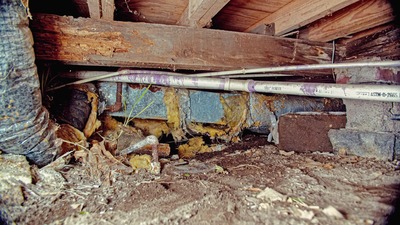
A crawl space is out of sight, so it gets ignored until something upstairs goes wrong. The problem is that air moves up. Whatever sits in your crawl space, damp air, mold spores, radon, ends up in the rooms where your family breathes. Here is what an open, vented crawl space does to an older New Hampshire home.
Mold, moisture, and that musty smell
That musty smell almost always starts with moisture in the insulation and the wood, not with mold itself. Damp air condenses on the cold framing and soaks into fiberglass batts. Once the wood and insulation stay wet, mold has everything it needs to grow, and that is when the smell turns from damp to musty.
It is a moisture problem first. The U.S. Department of Energy notes that air movement carries more than 98 percent of the water vapor that gets into building cavities, which is why sealing and air-sealing a crawl space, not just adding a fan, is the most effective way to control the moisture (DOE Energy Saver, energy.gov/energysaver/moisture-control). Dry out the space and the mold has nothing to live on.
Wood rot and structural damage
Your floor is held up by wood that lives in the crawl space: joists, beams, and the sill plate that sits on top of the foundation. Keep that wood damp and it rots. Rotted joists sag, floors above them get bouncy or soft, and a rotted sill beam is one of the most expensive repairs a New England home can need.
Older homes here make it worse. Many sit on fieldstone foundations that were never sealed and breathe moisture straight out of the ground. Add a New Hampshire winter and you get frost heave, where wet soil freezes, expands, and shoves on the foundation and the wood resting on it. Each freeze-thaw cycle works the damage a little further. Encapsulation is a different job than full basement waterproofing; if you have a poured or block basement instead of a crawl space, our basement waterproofing and the Forever Dry System are the fix for that.
Radon and indoor air quality
A vented crawl space is an open door for radon, the colorless, odorless gas that seeps up out of the soil. The EPA calls radon the number one cause of lung cancer among people who do not smoke and the second leading cause overall, tied to about 21,000 lung-cancer deaths in the U.S. every year, with an action level of 4 pCi/L (EPA, Health Risk of Radon, epa.gov/radon/health-risk-radon).
This is not an abstract risk in our service area. New Hampshire’s granite bedrock pushes indoor radon to roughly four times the national average of 1.3 pCi/L, and in Rockingham County, where most of our crews work, more than half of the homes tested came back elevated. The state attributes about 100 radon-related lung-cancer deaths a year to it (NH DHHS, Tracking Radon, dhhs.nh.gov). Sealing the crawl space cuts off the soil-gas entry path, but you should still test. If the number is high, you need a real radon mitigation system on top of the encapsulation, which is exactly how we build it.
Pests
A damp crawl space with open vents is a welcome mat. Mice, rats, termites, carpenter ants, and other pests get in through the vents, nest in wet insulation, and chew on the wood that holds your floor up. Seal the space and you take away both the entrance and the damp, dark home they were after.
Higher energy bills
An open crawl space leaks. Cold New Hampshire air pours in through the vents, your floors run cold, and your furnace works overtime to make up for it in winter. In summer, humid air loads up your air conditioner. Either way you pay for it on the utility bill, which brings us to the part of encapsulation that pays you back.
How encapsulation lowers your heating and cooling bills
Sealing the crawl space turns a hole in your home’s envelope into part of it. Cold drafts stop coming up through the floor, the dehumidifier pulls out the damp air that makes a space feel colder than it is, and your HVAC stops fighting the ground.
The savings are real because the heat loss is real. The U.S. Department of Energy reports that heat loss through an uninsulated foundation can account for up to one-third of the heat loss in an average home (DOE Building America, via ENERGY STAR, energystar.gov/saveathome/seal_insulate/basement_crawl space). Close that gap and your system runs less, which also means it lasts longer. Dry air helps too: an HVAC system works harder to condition humid air than dry air, so a sealed, dehumidified crawl space lightens the load every cycle. We are not going to quote you a magic percentage on your bill, because every house is different, but buyers and inspectors both value a dry, efficient home, and so will you the first winter the floors are not cold.
One caution worth stating up front: ENERGY STAR recommends you test for radon, and mitigate it if needed, before you seal a crawl space, because sealing can trap soil gas like radon inside (ENERGY STAR, energystar.gov/saveathome/seal_insulate/basement_crawl space). We build radon testing and, if needed, mitigation into the job so you get the energy savings without the trade-off.
The encapsulation process, step by step
Here is how a 603 crawl space job actually runs:
1. Inspect. We crawl the whole space, find where water and air get in, check the joists, beams, and sill for rot, and look at the radon picture.
2. Clean and clear. Out comes the debris, the old wet insulation, and anything else in the way of a clean seal.
3. Lay the drainage. Dimpled drainage matting goes down first so any water that shows up has a path through to the sump instead of pooling under the barrier.
4. Seal the floor and walls. A 20-mil vapor barrier goes over the floor, a 12-mil barrier goes up the walls, and the two get tied together at the floor-wall joint.
5. Seal every seam. All seams and corners get locked down with spray-foam insulation, so there is no open path for moisture or soil gas.
6. Set the dehumidifier and sump. A dehumidifier holds the humidity down and the sump pump moves out any water the matting collects.
When we are done, the crawl space is a clean, dry, sealed room under your house instead of a damp dirt cave. The encapsulation carries a 25-year warranty on the liner, wall barriers, and workmanship; the dehumidifier carries a 5-year warranty per the manufacturer.
What does crawl space encapsulation cost in New Hampshire?
603’s NH range for crawl space encapsulation is $3,000 to $25,000. That is a wide band on purpose, because a tidy 400-square-foot crawl with a dry floor is a different job than a big, wet, low-clearance space packed with rotted insulation.
What moves your job within the band:
- Size. More square footage means more barrier, more matting, and more labor.
- How wet it is. A space that needs full drainage matting and a sump costs more than one that just needs sealing and a dehumidifier.
- Access and clearance. A tight, low crawl is slow, hands-and-knees work. Easy access keeps the price down.
- Cleanup. Hauling out years of soaked insulation and debris adds time before we can even start sealing.
- Radon. If we bundle radon work, that is its own line. Testing runs $50, and a full radon mitigation system runs $900 to $6,000 depending on the home.
We give you a free inspection and a written estimate so you see exactly what your space needs, not a number pulled from the air. For the full menu, see our crawl space services.
Why a professional install matters, and what DIY misses
You can buy a roll of plastic and staple it up yourself. It will not last. DIY encapsulation almost always traps moisture instead of stopping it, skips the seams where the air actually moves, uses a barrier far too thin to hold up, and ignores radon airflow entirely. A half-sealed crawl space can end up damper than an open one.
New England crawl spaces in particular need the real thing: frost heave, seasonal soil shift, and old fieldstone foundations punish a cheap job. A professional encapsulation is sealed at every seam, drained to a sump, dehumidified, and built to handle radon. It is also why we can stand behind it with a 25-year warranty, which is the part you can never DIY. Want the details on how we back our work? See the 603 guarantee.
Frequently asked questions
What is crawl space encapsulation?
Crawl Space encapsulation seals the crawl space with a heavy vapor barrier, a 12-mil layer on the walls and a 20-mil layer on the floor, plus drainage matting, sealed seams, a sump pump, and a dehumidifier. It turns a damp, vented space into a dry, controlled one so moisture and soil gas stop reaching the house above.
How much does crawl space encapsulation cost in New Hampshire?
603’s NH range is $3,000 to $25,000. Where your job lands depends on the size of the crawl space, how wet it is and whether it needs full drainage and a sump, how tight the access is, how much old insulation and debris we have to clear out, and whether radon work is bundled in.
Does crawl space encapsulation help with radon?
Yes. Sealing the crawl space cuts off the soil-gas entry path that lets radon into your home. But it is not a substitute for testing. ENERGY STAR advises testing, and mitigating if needed, before you seal, and New Hampshire is a high-radon state, so we test and add a mitigation system when the levels call for it.
Will encapsulation lower my heating and cooling bills?
It usually does. The Department of Energy reports that an uninsulated foundation can account for up to one-third of a home’s heat loss, and sealing the crawl space stops cold drafts and lets your HVAC run less. We will not promise a specific percentage, because every house is different, but a sealed, dry crawl space takes load off your system year-round.
Why does my crawl space smell musty?
The musty smell comes from moisture in the insulation and the wood first, and then from the mold that grows once that material stays wet. It is a moisture problem at the root. Dry the space out with encapsulation and a dehumidifier, and the smell goes with it.
Can I encapsulate a crawl space myself?
We do not recommend it. DIY jobs usually trap moisture, miss the seams where air actually moves, use a barrier too thin to last, and do nothing for radon. A professional install is sealed, drained, dehumidified, radon-safe, and backed by a 25-year warranty you cannot get from a hardware-store roll of plastic.
Get your free crawl space inspection
If your crawl space is damp, musty, or just out of sight and out of mind, let us take a look. We are a local New Hampshire family crew, BBB A+ accredited since 2022, rated 4.9 stars across 250 Google reviews, state-certified for radon, and trusted by more than 5,000 homeowners across New England. The inspection is free, the estimate is free, and you will have your written quote within 24 hours.
Real People, Real Great Results. Book your free crawl space inspection and we will tell you straight what your space needs, and what it does not.