
Uneven or sagging floors
A low, sloping, or springy floor can trace back to joists, a beam, a sill, a support column, or settlement below the foundation. The useful next step is to follow the load path before trying to level the visible surface.
At 603 Basement Solutions, we specialize in structural and foundation repair services, addressing issues like bowing, buckling, and cracked walls. Whether you need wall stabilization, foundation wall replacement, or reinforcement, our team ensures long-lasting results to restore your home’s structural integrity.
We also offer basement slab and floor demolition and replacement for damaged or uneven flooring. Our expert team will remove and replace old slabs with durable materials, improving both safety and appearance.
Additionally, we repair and replace floor support beams, ensuring your foundation remains stable. Trust us to reinforce and protect your home’s foundation for years to come.
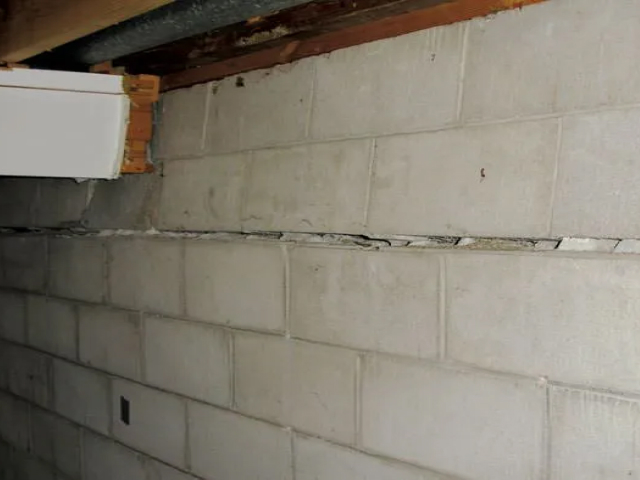
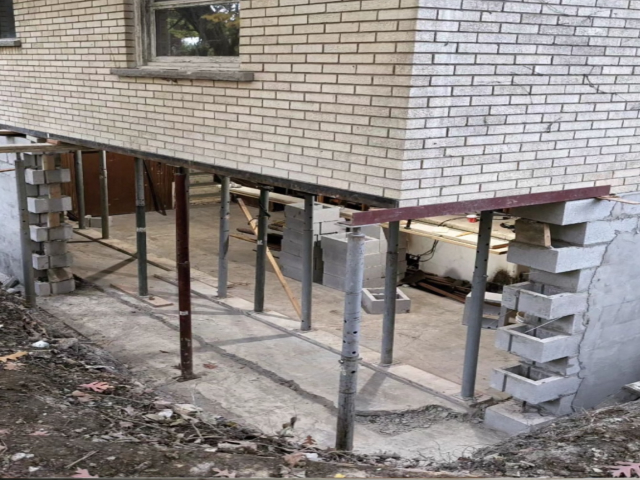
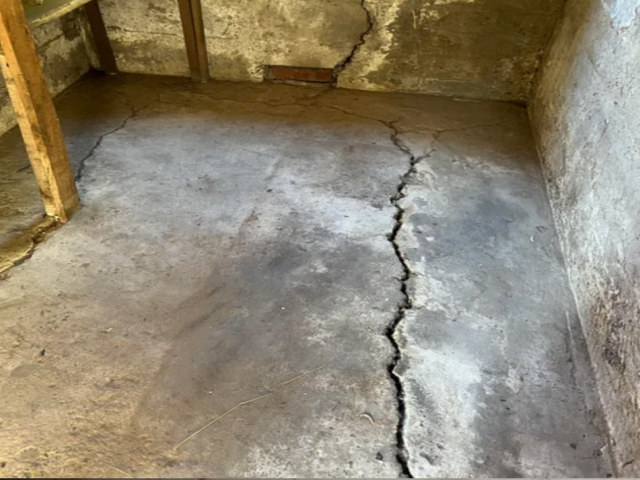
If your basement floor is cracked or uneven, our slab and floor demolition and replacement services provide a lasting solution. We carefully remove damaged flooring and install a new, durable slab to restore stability and improve your basement’s functionality.
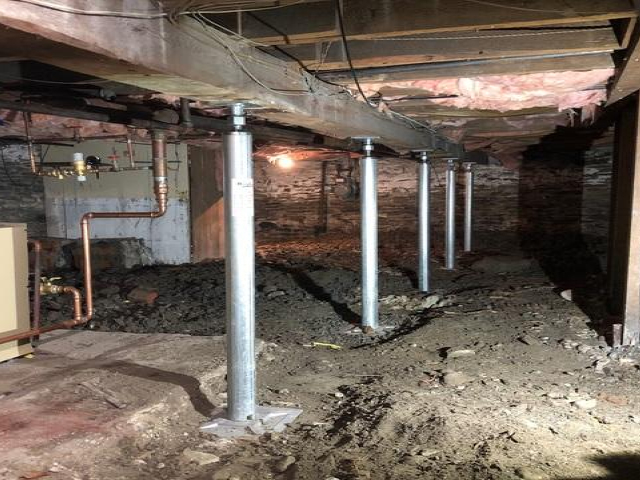
Floor support beams are crucial for maintaining the stability of your home’s structure. We offer expert repair and replacement services to reinforce weakened beams, ensuring your foundation remains strong and secure.
Reach out to us today to start the process of transforming and improving your home.
With our Forever Dry system, we 100% guarantee you stay dry or we come back free of charge.

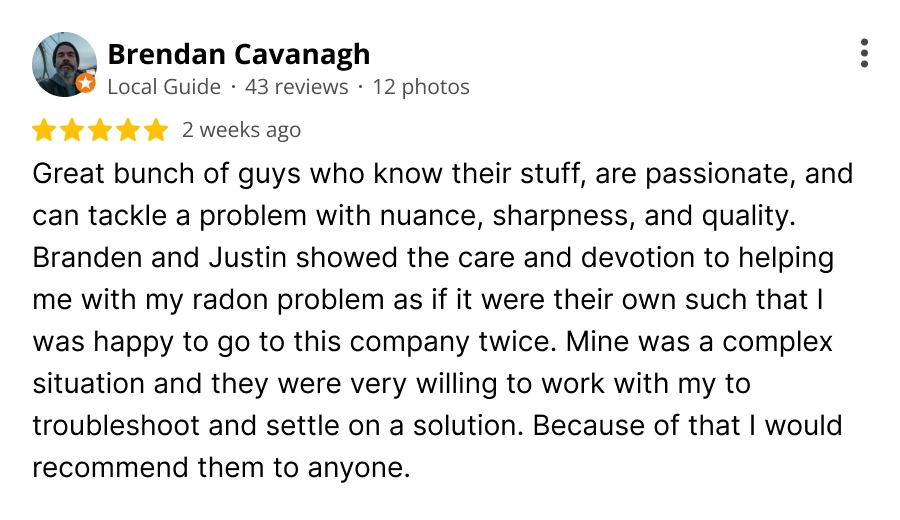
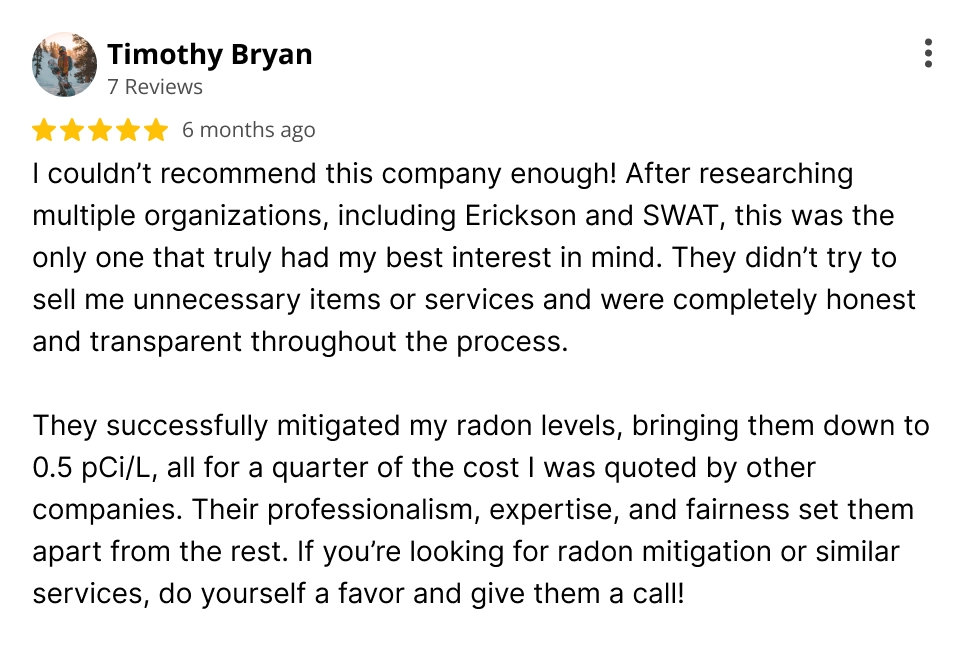
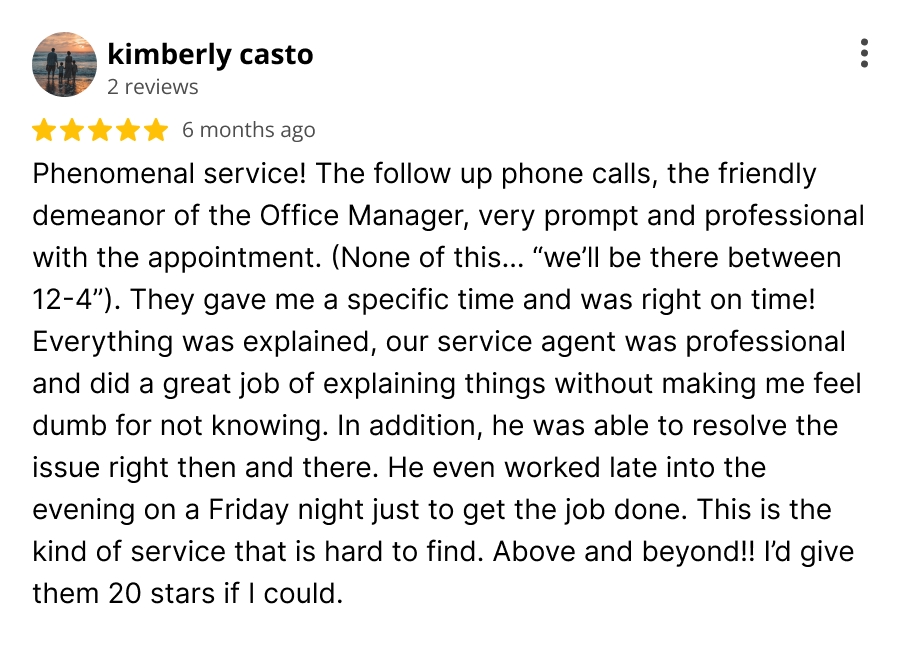
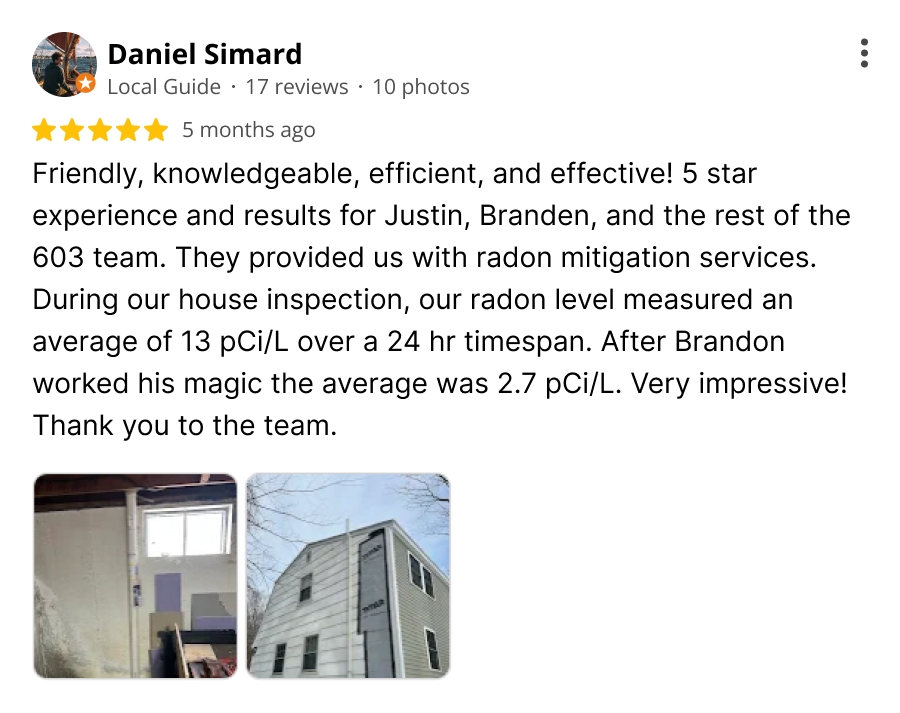
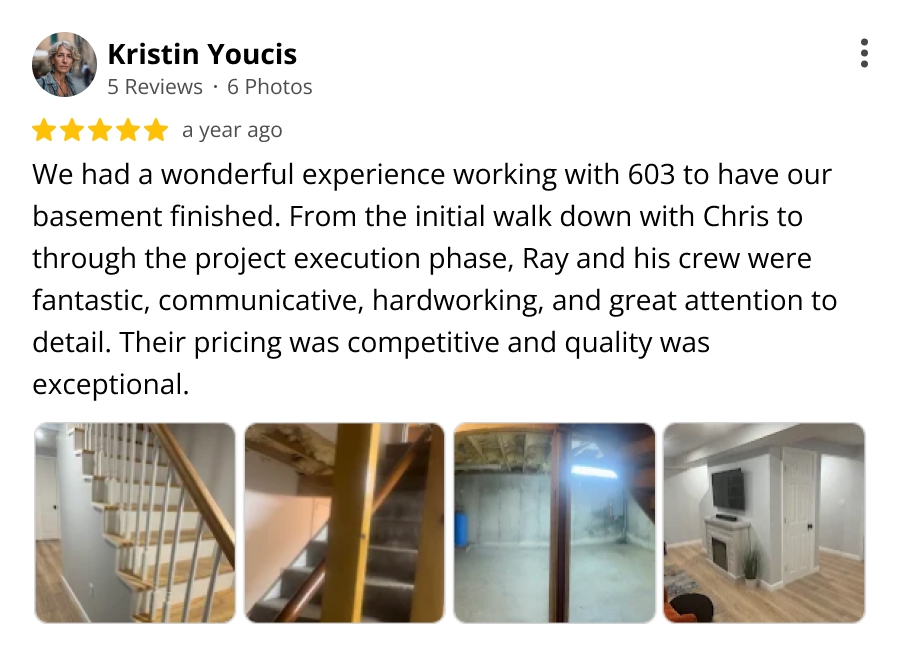
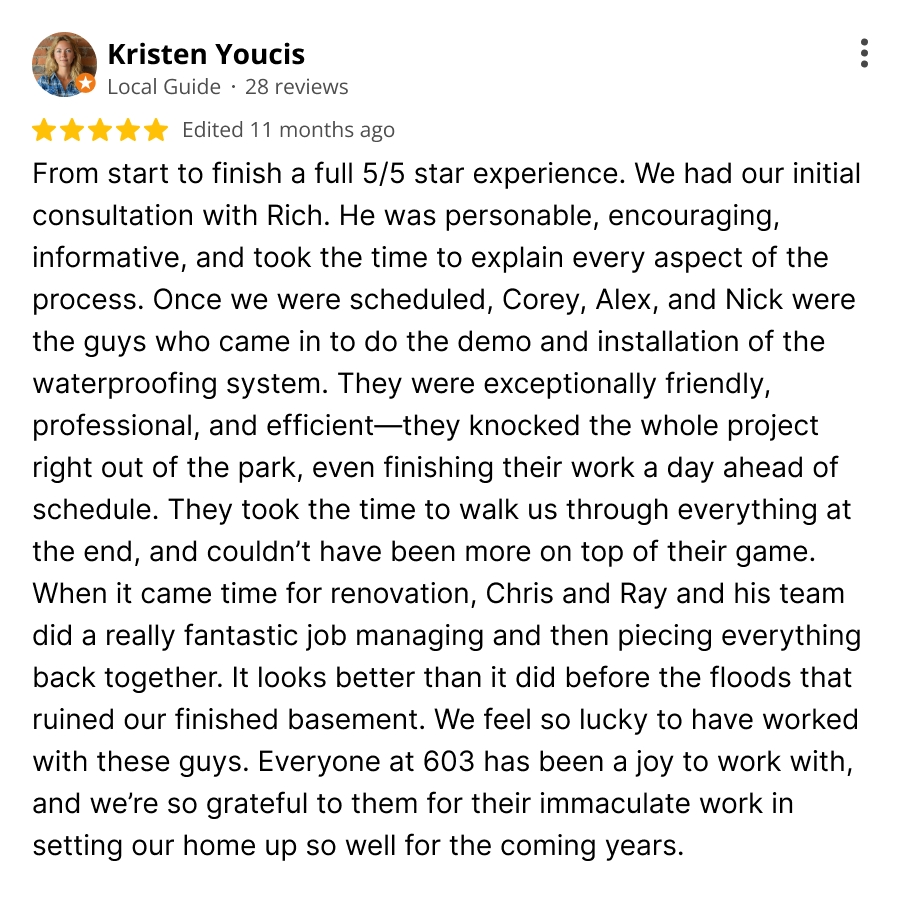
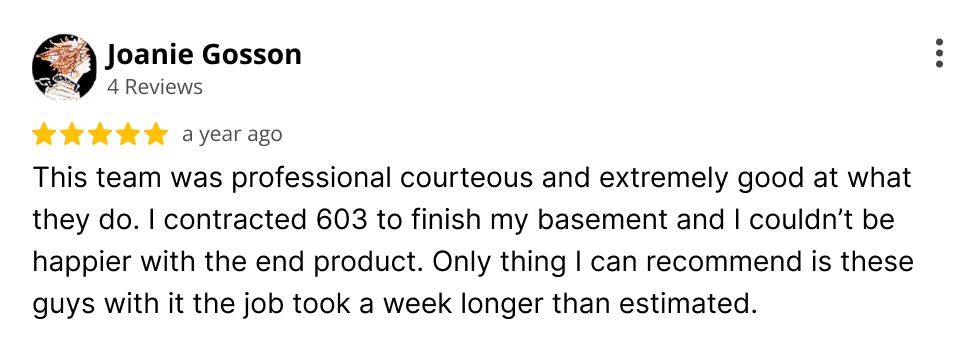
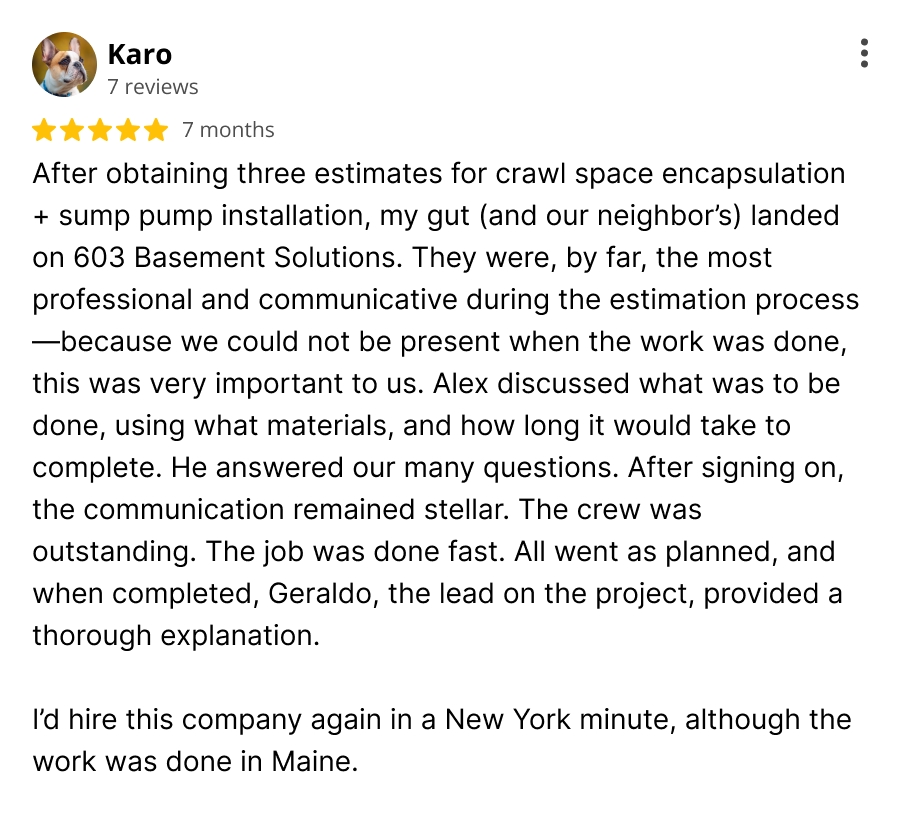
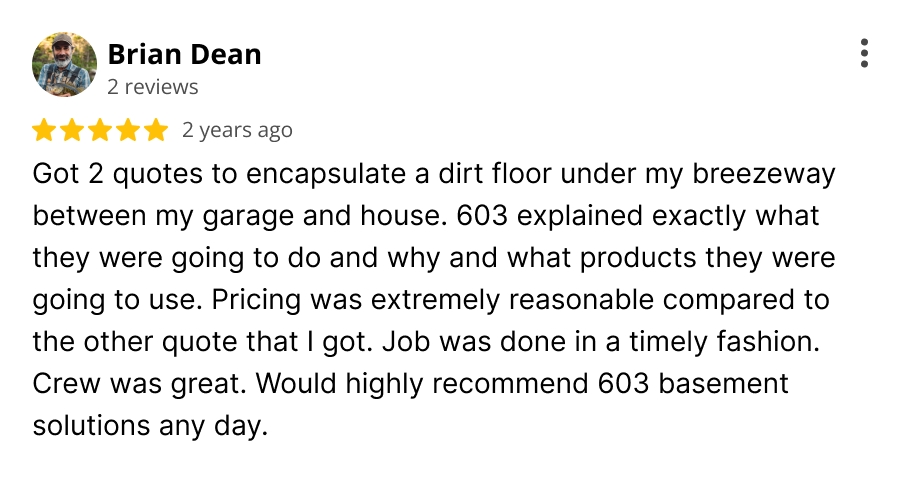
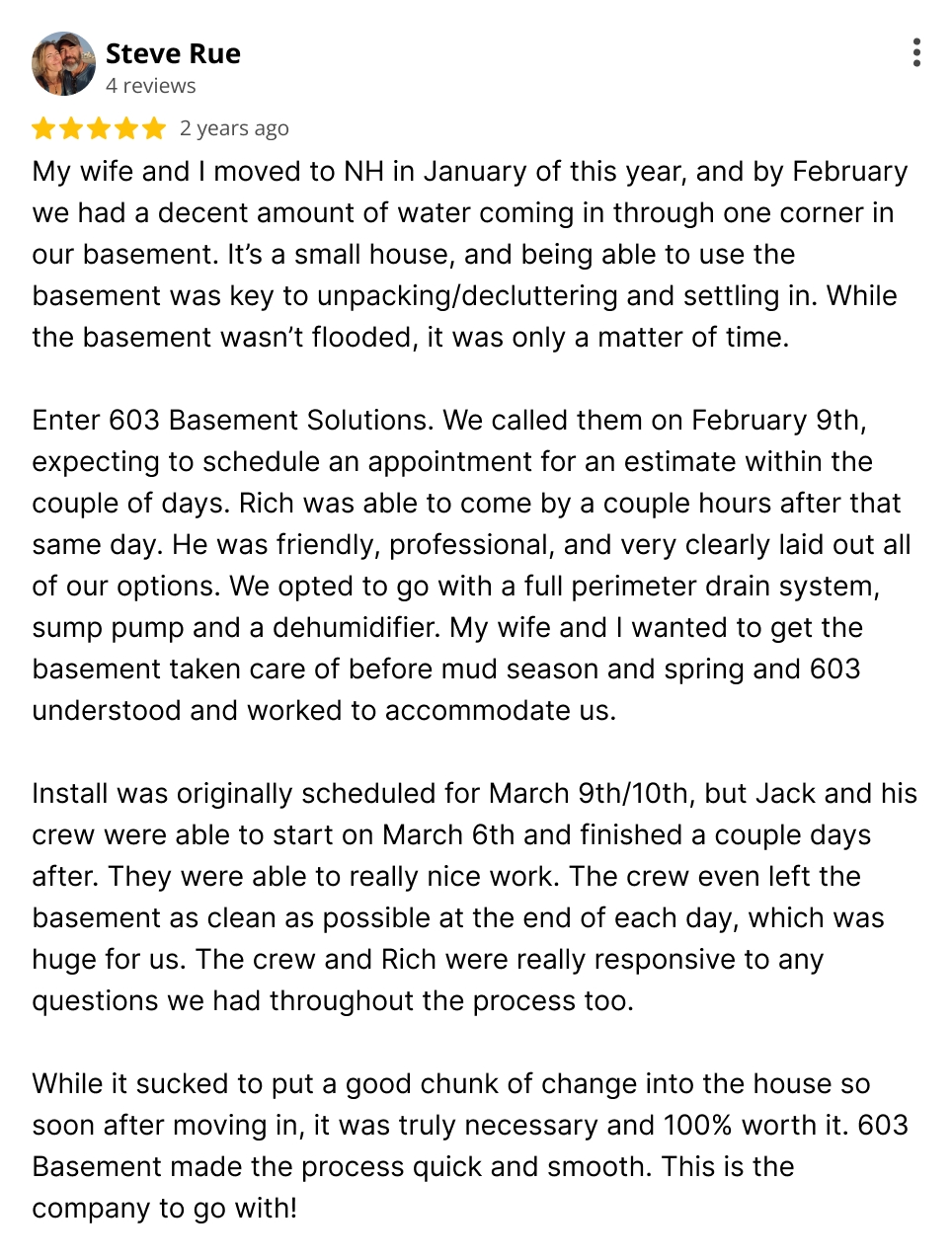
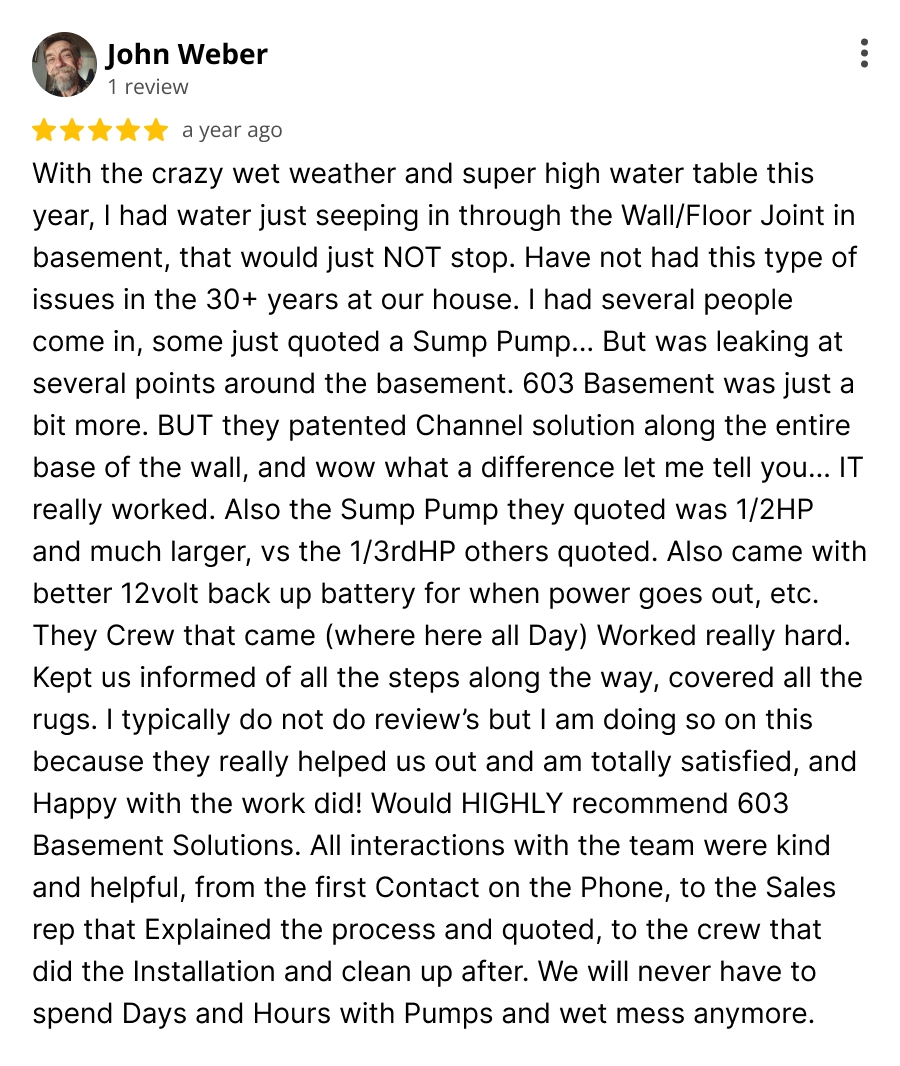
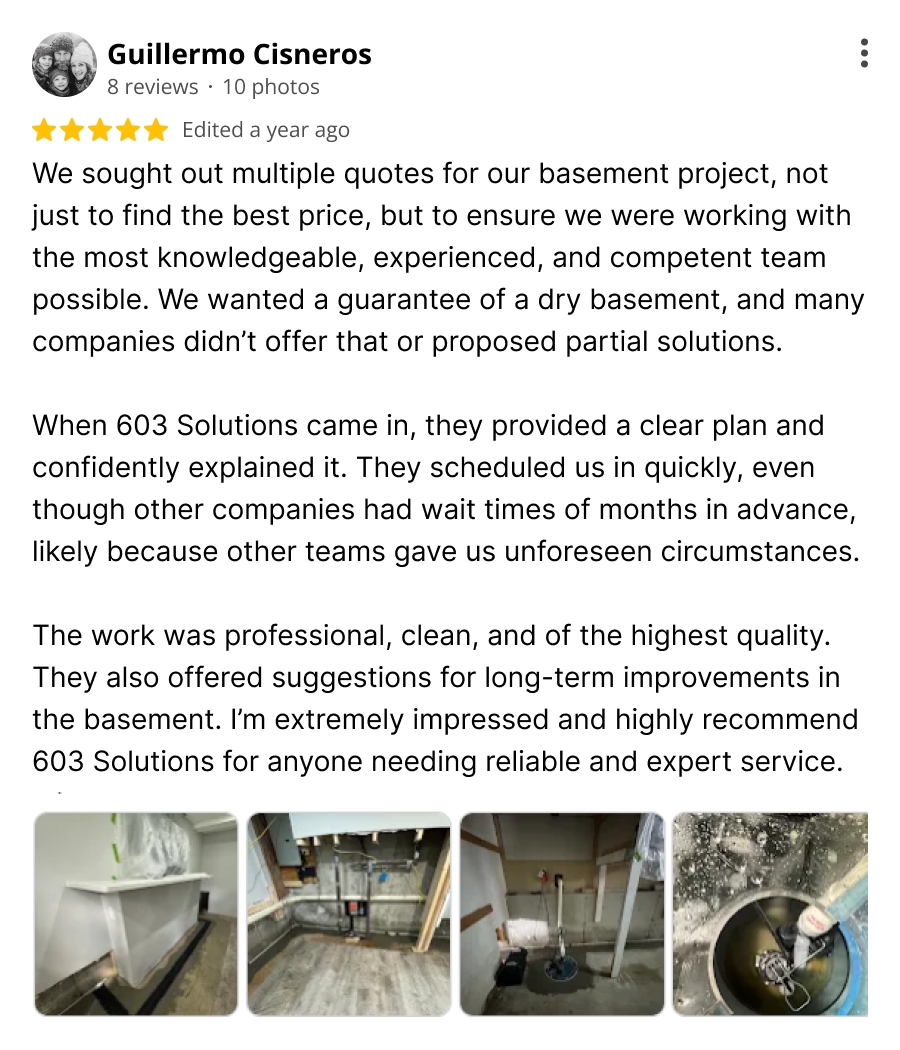
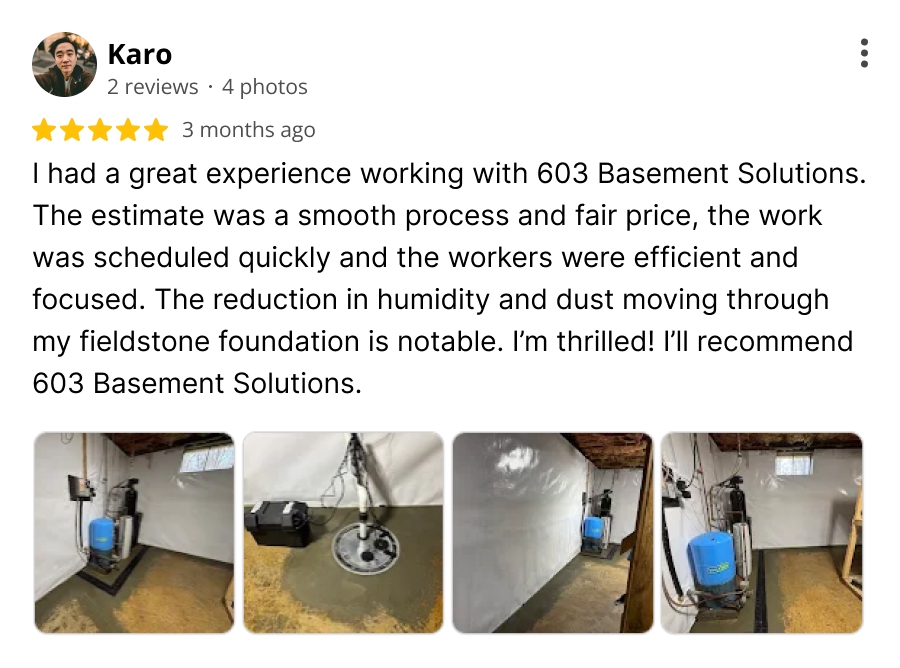
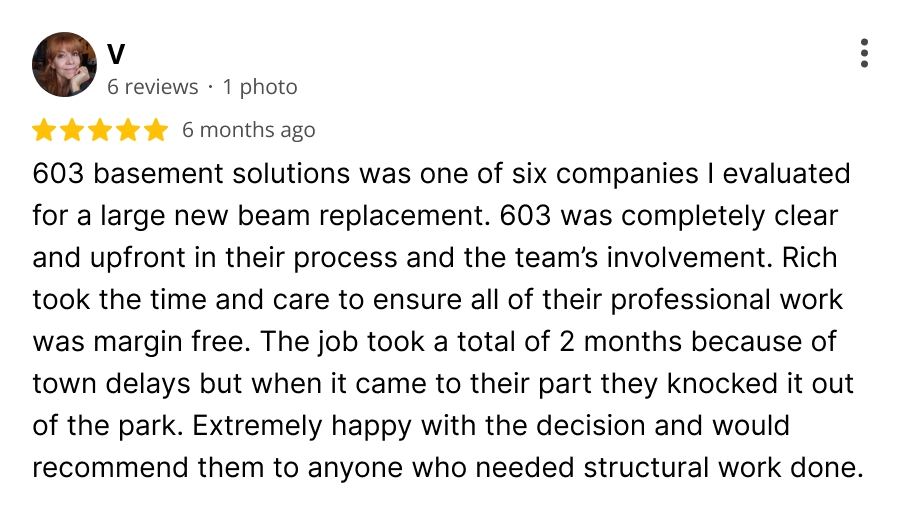
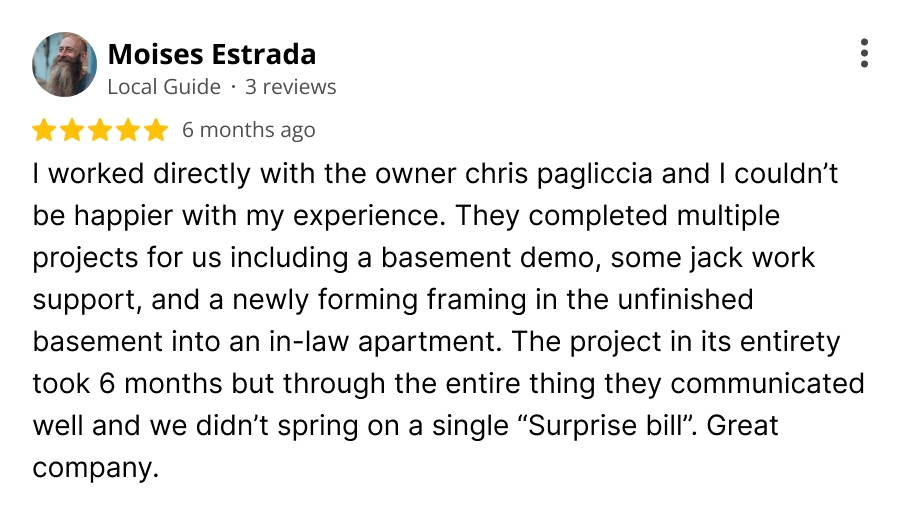
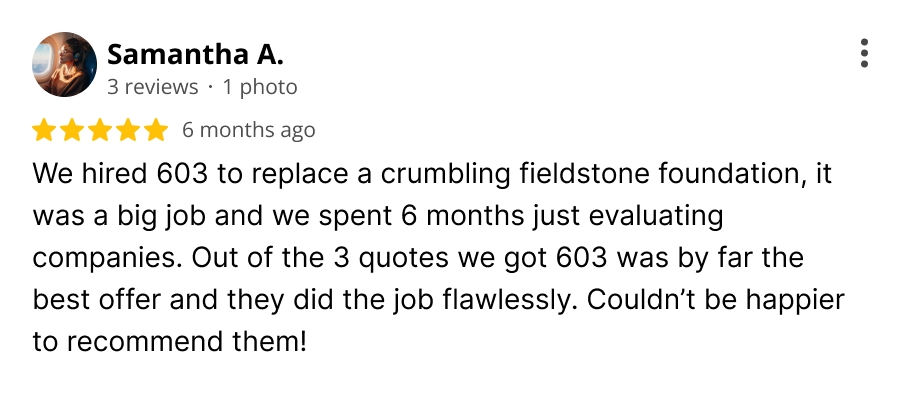
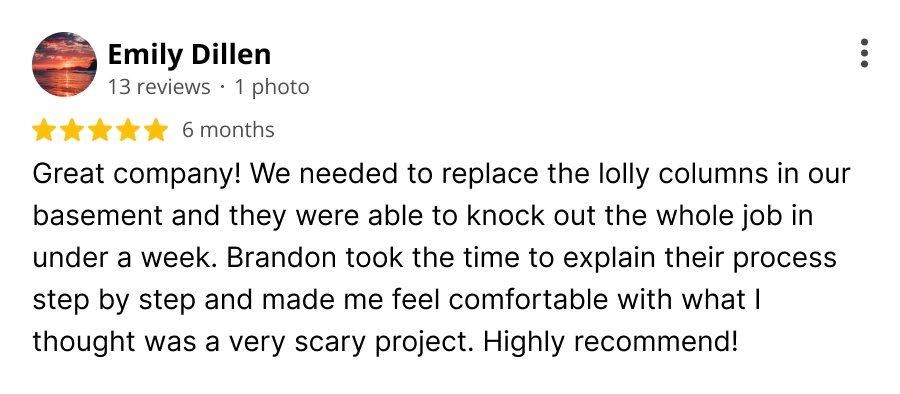
Structural and foundation repair fixes the things holding your house up when they start to fail: bowing or cracked foundation walls, a settling or sinking foundation, rotting sills and beams, failing support columns, and the cracks and uneven floors that come with them. 603 Basement Solutions diagnoses and repairs all of it across the New Hampshire Seacoast, Rockingham County, southern Maine, and northeastern Massachusetts. Unlike most contractors who sub the heavy structural work out, 603 self-performs its helical pier and structural installs in-house with its own crew. The same people who inspect your foundation are the ones who fix it and stand behind the warranty. Most repairs start with a free on-site assessment. Call (603) 610-1770.
Foundation problems are not one problem. They show up as a few distinct failures, each with its own fix and its own price range. Here is the full picture, from the wall that is bending inward to the floor that has started to slope.
A horizontal crack across a wall is not the same problem as a corner that is sinking, and a rotting sill is not the same problem as a failing column. Getting the diagnosis right is the whole job, because the wrong repair either does not hold or costs far more than the situation needs. Below, each section explains the symptom, how the repair works, and where 603’s pricing lands when the price is confirmed.
A foundation wall that is bowing or buckling inward is taking a sideways load it was not built to hold. The pressure comes from saturated soil and water outside the wall, made worse in New Hampshire by freeze-thaw cycles that push on the foundation every winter. The early warning sign is a horizontal crack running roughly across the middle of the wall, where the bending stress is highest. As This Old House explains, horizontal cracks are “usually caused by the lateral pressure exerted by the soil surrounding the foundation,” and if left alone they “can lead to bowing or bulging walls.” (See This Old House on foundation wall cracks.)
How the wall is built changes the read. On a concrete block (CMU) wall, a clean horizontal crack along a mortar joint about mid-height is the classic lateral-pressure signature. A poured concrete wall more often cracks vertically as it cures or on a diagonal from a corner, so a horizontal crack in a poured wall is a louder signal that real outside pressure is at work.
The fix matches the severity of the bow, not the size of the crack:
If you are looking at a crack right now and trying to tell whether it is structural, start with why a foundation wall bows and what a horizontal crack means, or our deeper read on bowing foundation walls and why New Hampshire homeowners should not ignore them.
When part of your foundation is sitting on soil that can no longer carry it, the house starts to move. You see a corner dropping, stair-step cracks in block walls, doors and windows that stick, and floors that slope toward the affected area. The fix is helical piers: steel shafts with screw-shaped plates that a crew drives down with a hydraulic motor until the plates reach soil firm enough to hold the home. A bracket then transfers the weight of the house off the failing soil and onto the pier. Because there is no concrete to cure, helical piers go in year-round, including in a New England winter.
603 installs helical piers at $2,700 per pier for the first three, then $2,200 per pier after that, backed by a 25-year engineered warranty that transfers to a new owner (conditional on the installed work not being altered by others). A single settling corner is usually a few piers; a failing section or a full perimeter is more. This is the work 603 self-performs in-house rather than handing to a subcontractor.
Read more: how much helical piers cost and what drives the price, and when to call a professional for a sinking foundation.
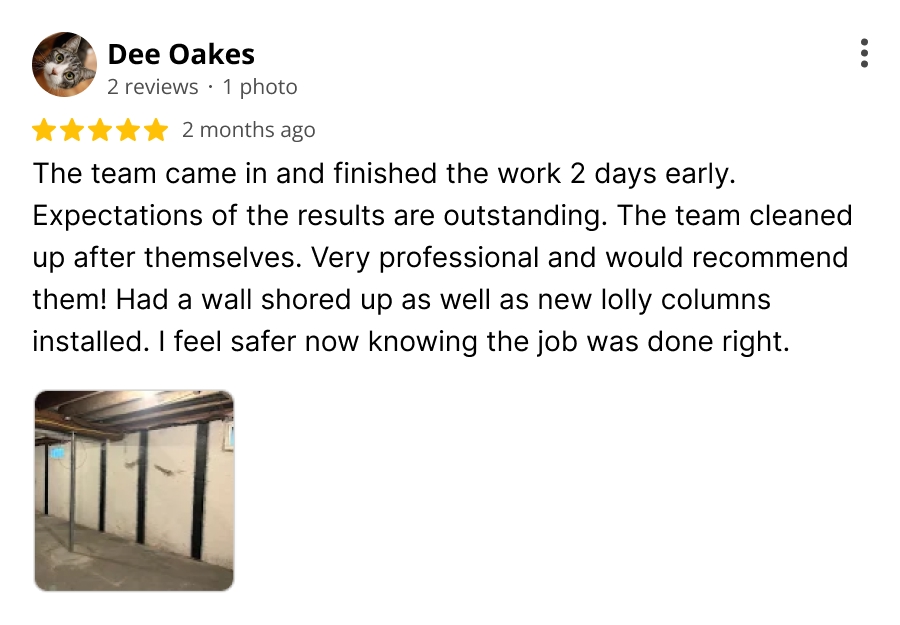
Inside the basement, the steel posts that carry your main girder are called lally columns. When the base rusts, the column buckles, or it was undersized to begin with, you get sagging floors and bouncing above. A failing lally column is a quiet problem that gets loud, because everything above it depends on it. 603 replaces lally columns for $1,300 to $2,500 each, backed by a 10-year warranty, with the price depending on the load, the height, and the footing underneath.
Read more: what a lally column replacement costs, and the signs and risks of failing lally columns.
The sill is the wood beam that sits on top of the foundation and ties the house frame to it. In New England’s older homes, water and insects rot it from below, and the frame starts to drop where the sill has gone soft. Because the sill carries the load of the wall above, repairs range widely depending on how much has rotted and how the house has to be supported while it is replaced. 603’s sill and beam work runs $7,000 to $40,000 depending on the length of the rot and the access. Floor support beams that have weakened are repaired or replaced in the same family of work.
Read more: why rotting sills are common in New England homes, and what a rotting sill beam replacement costs.
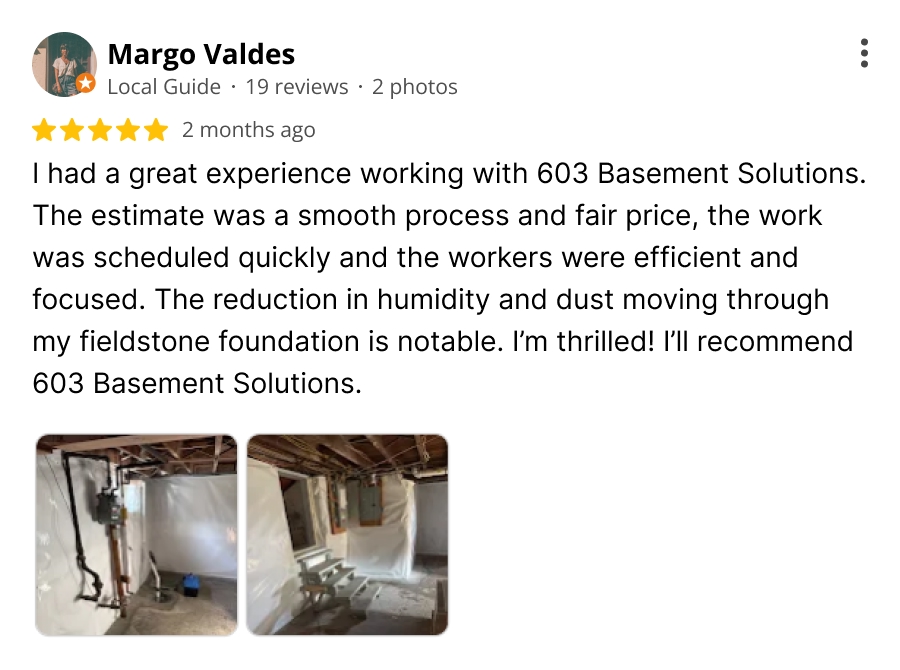
Many of the oldest homes in the region sit on fieldstone foundations: stacked stone and mortar that loosens, crumbles, and lets water through as the mortar fails. These need a different approach than a poured or block wall, because the goal is to re-bind and reinforce the stone (and often add an interior wall) rather than patch a single crack.
Read more: repairing a crumbling fieldstone foundation.
Not every crack is structural. A thin vertical crack in a poured wall is often a shrinkage crack from curing, and it can be sealed before it lets water in. A horizontal crack, a widening crack, or stair-step cracking in block is a structural signal that needs the wall work above, not just a seal. 603 repairs non-structural cracks for $1,000 to $3,000 depending on length and access. The key is telling the two apart, which is exactly what an inspection is for.
Read more: foundation cracks and when New Hampshire homeowners should act.
Uneven floors are usually a symptom, not the root problem. A floor that slopes toward one wall can point to a settling foundation under that side; a floor that sags in the middle often points to a failing support column or a weakened beam below. The repair is whichever underlying cause is at fault, which is why a sloping floor always gets traced back to the foundation, the columns, or the beams before anything is leveled.
Read more: what to do when your floors are uneven or sagging.
603 Basement Solutions provides structural and foundation repair across the New Hampshire Seacoast and Rockingham County, southern Maine, and northeastern Massachusetts, from its base in East Kingston, NH. If your foundation is moving, cracking, sinking, or sagging, the next step is a free on-site assessment. Call (603) 610-1770 or request a visit.
Get a free foundation assessment →
Explore the repairs in depth: bowing and cracked walls · foundation cracks · helical piers cost · lally columns · rotting sills · fieldstone foundations · uneven floors
Foundation problems look different from house to house. Choose your state and city to see the structural repairs we offer near you.
Start with what you can see. The pattern helps us decide whether the next step belongs with the foundation, wall, framing, support line, or something simpler.
A low, sloping, or springy floor can trace back to joists, a beam, a sill, a support column, or settlement below the foundation. The useful next step is to follow the load path before trying to level the visible surface.
A horizontal crack, inward curve, or displaced block can be evidence that a wall is moving. Measuring the wall and checking its construction separates a stable crack from a condition that may need bracing or a larger repair.
The stepped pattern is evidence of movement, but it does not identify the cause by itself. The surrounding masonry, nearby openings, wall alignment, and foundation condition help distinguish settlement from mortar, veneer, or lintel problems.
Rough stone and old mortar are not automatically a structural failure. Loose material, displaced stone, moisture, past patching, and the bearing condition above the wall show whether the need is maintenance, water control, or structural repair.
One crack or sticky door can have an ordinary cause. Several connected changes near the same area, such as sloping floors, opening cracks, and separation at trim or masonry, make it worth measuring the foundation before choosing a pier system.
A single opening often points to hardware, paint, or seasonal humidity. Several doors or windows changing together, especially with floor slope or wall cracks, can justify a broader structural check instead of repeated adjustments to the openings.
It is the repair of the parts of a house that carry its weight and keep it stable: foundation walls, the footing and soil under them, support columns, sills and beams, and the slab. It covers bowing or cracked walls, settling and sinking foundations, failing lally columns, rotting sills, crumbling fieldstone, and the cracks and uneven floors that come with those problems. 603 diagnoses and repairs all of it, starting with a free on-site assessment.
A thin vertical crack in a poured wall is often a harmless shrinkage crack from curing. A horizontal crack, a crack that is widening, or stair-step cracking in a block wall is a structural signal that the wall is under pressure or the foundation is moving, and it needs more than a seal. The reliable way to tell is an inspection. 603 repairs non-structural cracks for $1,000 to $3,000 and prices structural wall work after seeing the wall.
It depends entirely on the problem. 603’s confirmed pricing: carbon fiber straps for a bowing wall are $850 each, power braces are $1,300 each, helical piers are $2,700 per pier for the first three then $2,200 after, lally columns are $1,300 to $2,500 each, and crack repair runs $1,000 to $3,000. Sill and beam work ranges from $7,000 to $40,000 depending on how much has rotted. Heavier structural work, like wall anchors, steel I-beams, or a wall rebuild, is quoted after an on-site assessment.
603 self-performs its structural installs in-house, including helical piers, with its own crew. Most foundation companies sub the heavy lift out to another contractor. With 603, the team that inspects and quotes your foundation is the team that does the repair and is accountable for the warranty.
It is structural, not cosmetic. A horizontal crack across the middle of a foundation wall almost always means the wall is bowing inward under pressure from the soil and water outside it. Caught early, most bowing walls are stabilized from the inside with carbon fiber straps ($850 each) without replacing the foundation. Left alone, the wall keeps moving and the repair gets larger. This is worth an inspection sooner rather than later.
Yes. Helical pier work carries a 25-year engineered warranty that transfers to a new owner, as long as the installed work is not altered by others. Lally column replacements carry a 10-year warranty. A documented, warrantied repair can help rather than hurt when you sell the home.
603 Basement Solutions works across the New Hampshire Seacoast and Rockingham County, southern Maine, and northeastern Massachusetts, from its base in East Kingston, NH. Call (603) 610-1770 for a free on-site assessment.
A crack, a sloping floor, and a bowed wall do not get the same repair. Start with what you can see. We will inspect what is carrying the load and tell you what the house actually needs.
Not sure which one fits? Start with a free foundation inspection. We will show you what is moving and what is not.