

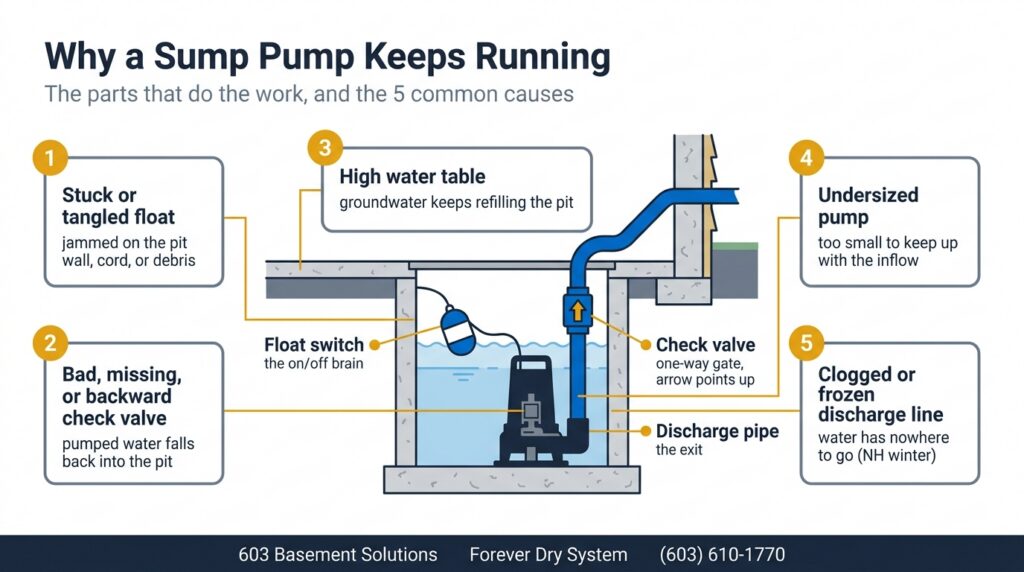
A sump pump that keeps running usually means one of five things: a stuck float switch, a bad or missing check valve, a high water table feeding the pit nonstop, an undersized pump, or a clogged or frozen discharge line. The first three are the most common, and in New Hampshire a frozen exterior discharge line in winter and snowmelt-driven groundwater in spring are the two culprits we see most often.
Here is the quick way to think about it. A sump pump runs when water in the pit rises high enough to lift the float. So if your pump never shuts off, either water keeps coming back into the pit, or the pump never gets the signal to stop. Everything below is just figuring out which one you have.
The Quick Version
- Pump runs nonstop? Water is refilling the pit faster than the pump can clear it, or the float is stuck and never tells it to stop.
- Most common DIY-fixable causes: a float jammed against the pit wall, or a bad/missing check valve letting pumped water fall back in.
- Most common NH-specific cause: a frozen exterior discharge line in winter, so water has nowhere to go.
- Sometimes it’s normal: after snowmelt or a nor’easter, a high water table can keep a healthy pump running for a while.
- Call a pro when: the pump runs constantly even when the rest of the basement is dry, or you keep getting water back no matter what you check.
How a sump pump knows when to run
Before you can tell why a pump won’t quit, it helps to know how it decides to run in the first place. It is simpler than people expect.
A submersible sump pump sits down in the pit. When water rises to a set point, a float switch activates the pump, and the water gets expelled through a discharge pipe that leads outside the home (This Old House). Once the water drops back down, the float falls, the switch turns the motor off, and the pump waits for the next time.
There is one more part that matters a lot here: the check valve. The check valve is a one-way valve on the discharge pipe that prevents water from flowing backward into the sump pit after it has been pumped out (This Old House). Without it, the column of water sitting in the discharge pipe would just fall right back down into the pit every time the pump shut off.
So the three things doing the work are the float (the on/off brain), the check valve (the one-way gate), and the discharge line (the exit). When a pump runs nonstop, the problem is almost always one of those three, or there is simply too much water coming in. Let’s go through each.
Cause 1: The float switch is stuck
The float switch tells the pump when to turn on and when to turn off. When the float is stuck, the pump can run nonstop or fail to shut off, because it never gets the “water is low, stop now” signal.
A float gets stuck a few common ways:
- It is jammed against the wall of the pit.
- It is tangled on the power cord.
- It is weighed down or blocked by debris and sediment in the pit.
The fix is usually free. Unplug the pump, then check that the float moves up and down freely without catching on anything. Clear out any debris or sediment sitting in the pit, untangle the cord, and make sure the pump is sitting flat so the float has room to travel (This Old House). If the float now moves freely and the pump shuts off on its own, you found it.
If the float is fine and the pump still won’t stop, move on. The next two causes are about water coming back in.
Cause 2: A bad, missing, or backward check valve
A backward or missing check valve is one of the most common causes of short cycling, where the pump runs, stops, and immediately starts again. Here is why. The check valve is supposed to stop pumped-out water from draining back into the pit. When it is missing, failed, or installed backward, the water sitting in the discharge pipe falls right back down into the pit, refills it, and triggers the pump to run again (This Old House).
Two quick things to check:
- Is there a check valve at all? Look at the discharge pipe coming off the pump. There should be a valve on it, usually a couple of inches above the pump.
- Is it pointing the right way? Most check valves have an arrow stamped on the body. The arrow should point up, in the same direction the water flows, away from the pit. If the arrow points down toward the pump, it is installed backward and water is falling back in.
If the valve is missing or backward, that is a clear fix. If it is there, pointed the right way, and the pump still short cycles, the valve itself may have failed internally and need replacing. That is a small part, but you want it done right, so it is a reasonable point to call someone if you are not comfortable cutting into the discharge line.
Cause 3: A high water table
Sometimes a pump that keeps running is not broken at all. A constantly high water table around the foundation feeds the pit nonstop, so a perfectly healthy pump can run continuously simply because groundwater keeps arriving.
This is very much a New Hampshire thing. On the Seacoast and in low-lying parts of Rockingham County, the water table sits high, especially after snowmelt or a heavy rain. In towns like Exeter, Stratham, and Hampton, we see basements where the pump runs often in spring and that is just the ground doing what the ground does. Older homes and soils that stay saturated after a wet stretch make it more pronounced.
How do you tell “normal high water table” from “something is wrong”? Timing and pattern:
- If the pump runs a lot during and right after snowmelt or a nor’easter, then settles down once the ground dries out, that is usually a high water table doing its job.
- If the pump runs constantly even during a dry stretch, when the ground around the house has had weeks to drain, that points to a mechanical problem or steady groundwater intrusion that needs a real look.
A pump running hard after a storm is reassuring in one way: it means the system is keeping water out of your living space. But if it never gets a break, that is a sign the water load on your foundation is high enough to think about a full drainage system, which we cover at the end.
Cause 4: The pump is undersized
If your pump runs and runs during heavy inflow but barely keeps the water level down, it may simply be too small for how much water your basement takes on.
Pump horsepower (HP) indicates how much water the pump can move per hour, and a higher HP moves more water. As general, national guidance (not a 603 spec), This Old House notes that most residential sump pumps run between 1/3 and 1/2 HP and handle roughly 2,000 to 5,000 gallons per hour (This Old House). An undersized pump can run constantly during a big inflow event because it physically cannot keep up.
Treat those numbers as a national ballpark, not a rule for your house. The right size depends on how much water your specific basement takes on, the depth of the pit, and how high the water has to be lifted to get outside. That sizing is exactly the kind of thing worth having someone measure on site rather than guessing from a spec sheet. We size the pump to the actual water load when we put in a system, which is part of why a properly matched pump should not be running flat-out around the clock.
Cause 5: A clogged or frozen discharge line
If the pump runs but the water level in the pit barely drops, the water probably can’t leave. The sump pit should be cleaned of debris and sediment, and the discharge line should be checked for blockages or ice (This Old House). A clogged or frozen discharge line keeps water from getting out, so the pump cycles or runs without ever lowering the water.
This is the big New Hampshire winter problem. The discharge pipe runs outside, and in a New Hampshire freeze-thaw winter the exterior portion can freeze solid. When that happens, the pump keeps running and running, the water has nowhere to go, and in a bad case it can back up into the basement. Homeowners in Exeter, Kingston, and Hampton run into this every winter once the cold sets in.
What to check:
- At the outside end: is the discharge opening clear, or is it blocked by ice, leaves, or mud? A frozen or buried outlet is the usual winter cause.
- Along the line: any low spots where water can sit and freeze, or any kinks and crushed sections.
- In the pit: sediment or debris that could be partly clogging the intake.
A frozen discharge line is one to take seriously in the cold months, because while it is frozen, the pump can run nonstop and your basement is not actually being protected. If you cannot clear it safely, get it looked at before the next storm.
What you can check yourself in 10 minutes
You can diagnose most of this without any tools. These checks are safe and they tell you a lot.
| Step | What to do | What it tells you |
|---|---|---|
| 1. Float check | Watch the float as the water rises and falls | If it catches, jams, or tangles, the float is your problem (Cause 1). |
| 2. Check valve look | Find the valve on the discharge pipe; check the arrow points up | Missing or backward valve means water is falling back in (Cause 2). |
| 3. Discharge check | Look at the outside outlet and the line for ice or clogs | Blocked or frozen line means water can’t leave (Cause 5). |
| 4. Pattern check | Note whether it runs only after storms or all the time | Storm-only points to water table (Cause 3); constant points to a mechanical issue. |
Those checks come straight from the basics of getting a sump pump ready for the season: confirm the float moves freely, and look for an obvious discharge clog or ice (This Old House).
When to stop and call a pro: if the pump runs constantly even when the rest of the basement is dry, if you keep getting water back no matter what you clear, or if the discharge line is frozen and you cannot safely thaw it. A pump that never rests is also wearing out faster, so it is worth getting ahead of.
A quick note on radon and your sump
One thing most homeowners do not think about: the sump pit is one of the openings in your foundation that radon can enter through. Radon is a naturally occurring gas, and an open pit is a direct path from the soil into your basement air.
This matters in New Hampshire, where a lot of homes test high for radon. The EPA recommends fixing a home if the radon level is 4 pCi/L or higher, and suggests considering remediation between 2 and 4 pCi/L since there is no known safe exposure level (US EPA). A sealed sump system, with a sealed lid instead of an open pit, is one of the things that ties a waterproofing setup to radon control. We are a state-certified radon mitigation contractor, so when we put in a sealed system we keep that pathway in mind. We are not the only local company that does radon, but if you have an open pit and have never tested, it is worth doing.
That is the whole radon note. Test your home, and if it reads high, an open sump pit is one of the things a mitigation setup addresses.
When to call 603, and how the Forever Dry System fits
If your pump keeps running because water keeps arriving, the pump is not really the problem. It is the symptom. Constant inflow usually means the basement needs a full-perimeter interior drainage system, with the sump pump and a dehumidifier working together, not just a bigger pump fighting the water alone.
That is what the Forever Dry System is: a full-perimeter interior drain that collects water before it reaches your floor, a properly sized sump pump and pit, a wall vapor barrier, and a dehumidifier to keep the air dry. We size the pump to your actual water load, seal the pit, and set up the discharge so it is far less likely to freeze and back up on you in January.
What does it cost? A pump-only fix is on the smaller end, and the price depends on the parts and the work your specific setup needs, so we quote it after we look. A full Forever Dry System is a bigger range, from about $3,000 to $30,000 depending on the size of your basement and how much water it takes on. Either way you get the number in writing before any work starts. The sump pump system carries a 3-year warranty on the pumps, with batteries not included, and a full Forever Dry System comes with a full transferable lifetime warranty that can pass to the next owner, as long as no other contractor or the homeowner has altered the system.
You already know how 603 works if you have read our other guides. We come out, we look at the actual basement, and we tell you straight what it needs. Sometimes that is a new check valve and you are done. Sometimes it is a full system. We are not going to sell you more than the water calls for. For the bigger picture on why a pump on its own is rarely the whole answer, see our explainer on a sump pump alone vs a full basement waterproofing system, and because our winters are what they are, read why a battery backup sump pump is mandatory in New Hampshire so a power outage during a storm does not flood you.
Want the full rundown of how the system works and what goes into it? Start with basement waterproofing, and if you are trying to budget, here is the average cost of a professional-grade waterproofing system.
Frequently asked questions
Why does my sump pump keep running even when it isn’t raining?
If it runs during a dry stretch when the ground has had time to drain, that usually points to a mechanical problem rather than groundwater: a stuck float that never signals “off,” or a bad or backward check valve letting pumped water fall back into the pit and restart the pump. Check that the float moves freely and the check valve arrow points up. If it runs only during and right after snowmelt or a storm, that is more likely a high water table doing its job.
Is it bad for a sump pump to run constantly?
Running constantly wears the motor out faster, so yes, you want to fix the cause rather than ignore it. The exception is short bursts of heavy running during snowmelt or a nor’easter, when a high water table simply keeps the pit filling. Steady, all-the-time running with no storm to explain it is the version worth diagnosing, because it usually means a stuck float, a failed check valve, or water it cannot keep up with.
Why does my sump pump run but the water doesn’t go down?
The water most likely can’t leave. Check the discharge line for a clog or, in a New Hampshire winter, for ice. The discharge line should be checked for blockages or ice, and the pit cleaned of debris, because a blocked or frozen line keeps water from getting out so the pump runs without lowering the level. Look at the outside outlet first; a frozen or buried opening is the common winter cause.
Can a sump pump discharge line freeze in New Hampshire?
Yes, and it is one of the most common winter problems here. The discharge pipe runs outside, and in a freeze-thaw New Hampshire winter the exterior section can freeze solid, especially at the outlet. While it is frozen, the pump keeps running with nowhere to send the water, and your basement is not actually protected. Keeping the outlet clear and the discharge set up to drain properly helps; if it freezes repeatedly, it is worth having the discharge reworked.
How do I know if my sump pump is too small?
If it runs nonstop during heavy inflow but barely keeps the water down, it may be undersized. As general national guidance (not a spec for any one house), most residential sump pumps run between 1/3 and 1/2 HP and handle roughly 2,000 to 5,000 gallons per hour. The right size depends on how much water your basement actually takes on and how high it has to lift the water to get outside, which is something to measure on site rather than guess.
Should I just replace the pump if it keeps running?
Not necessarily. Start with the cheap, fixable causes: free the float, check the check valve, and clear the discharge line. Those solve a lot of cases without buying anything. Replace the pump if it is genuinely worn out or too small for your water load. And if water keeps coming back no matter what you fix, the real answer is usually a full drainage system, not a new pump fighting the water alone.
Get a free inspection
If your sump pump won’t stop running and you have checked the float, the check valve, and the discharge line, let us take a look. We will come out, find out why water keeps reaching your pit, and give you a written quote with no pressure. The inspection and written estimate are free.
Call (603) 610-1770, or reach out for your free inspection and written estimate. We cover the Seacoast and Rockingham County, and there is a good chance we have worked on a basement near you.
Ready to experience your dream basement? Let’s get it dry first.
If your pump is running non-stop in NH, MA or ME, the drain feeding it is usually the real question. We will look for free.
Read more about basement waterproofing, or see what we do in Manchester · Nashua · Portsmouth.
Call 603-610-1770 or book your free inspection. Free estimate, written quote within 24 hours.