

Portsmouth sits on a hill and floods anyway. That is not a contradiction. Elevation keeps water from running downhill into your yard. It does nothing about moisture already sitting in the soil against your foundation walls, and that is the water that actually gets in. We hear this exact confusion on the phone every week from Portsmouth homeowners who assumed elevation meant they were safe.
What it costs to waterproof a basement in Portsmouth
Every basement is different, and price depends on how much wall needs a drainage system, how the water is getting in, and whether a sump pump is already there or needs one. We do not quote a number over the phone before we have seen the walls. What we can tell you is the shape of it: full-perimeter interior drainage with a sump pump and dehumidifier is the core system, and most homes fall into a mid-range price once we know the linear footage. A free inspection gets you a real number in writing, not a guess.
Why Portsmouth basements take on water
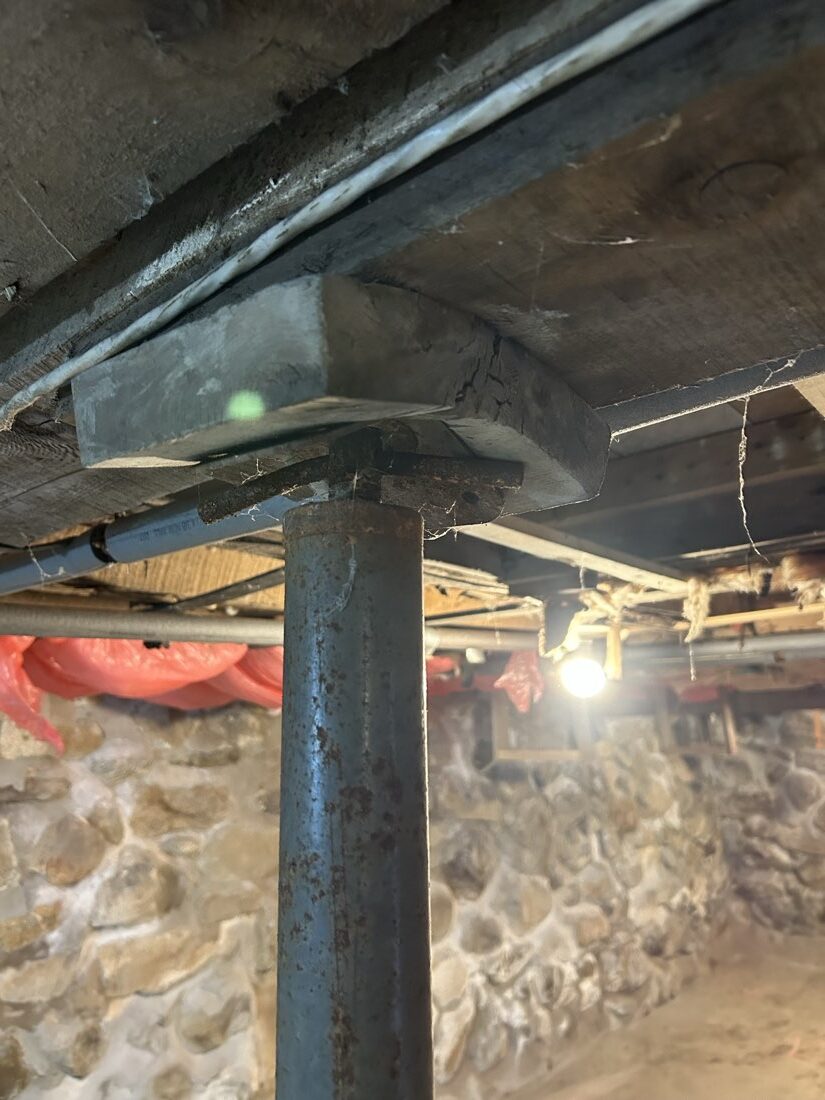
The median house here was built in 1958, and about 4 in 10 are single-family. The rest is the duplexes, converted colonials and multi-unit stock that fills in around the Port City’s older neighborhoods, and older foundations here were built for a New Hampshire that got less rain, not the one we have now.
Portsmouth gets around 65 inches of snow a year at its own station, more than towns thirty minutes inland, and it comes off the roof and out of the yard as meltwater every spring whether the ground is ready for it or not. That moisture sits in the soil against your foundation, and saturated soil pushes water through concrete under pressure long before it ever looks like standing water in the yard.
Concrete is not waterproof. It is porous, and hydrostatic pressure from saturated soil forces water through hairline cracks, through the floor wall joint, and through the block itself if the wall is cinder block rather than poured. A basement can be bone dry all summer and flood every March, because the mechanism is groundwater pressure, not rainfall on the day of the flood.
How the Forever Dry System keeps it dry
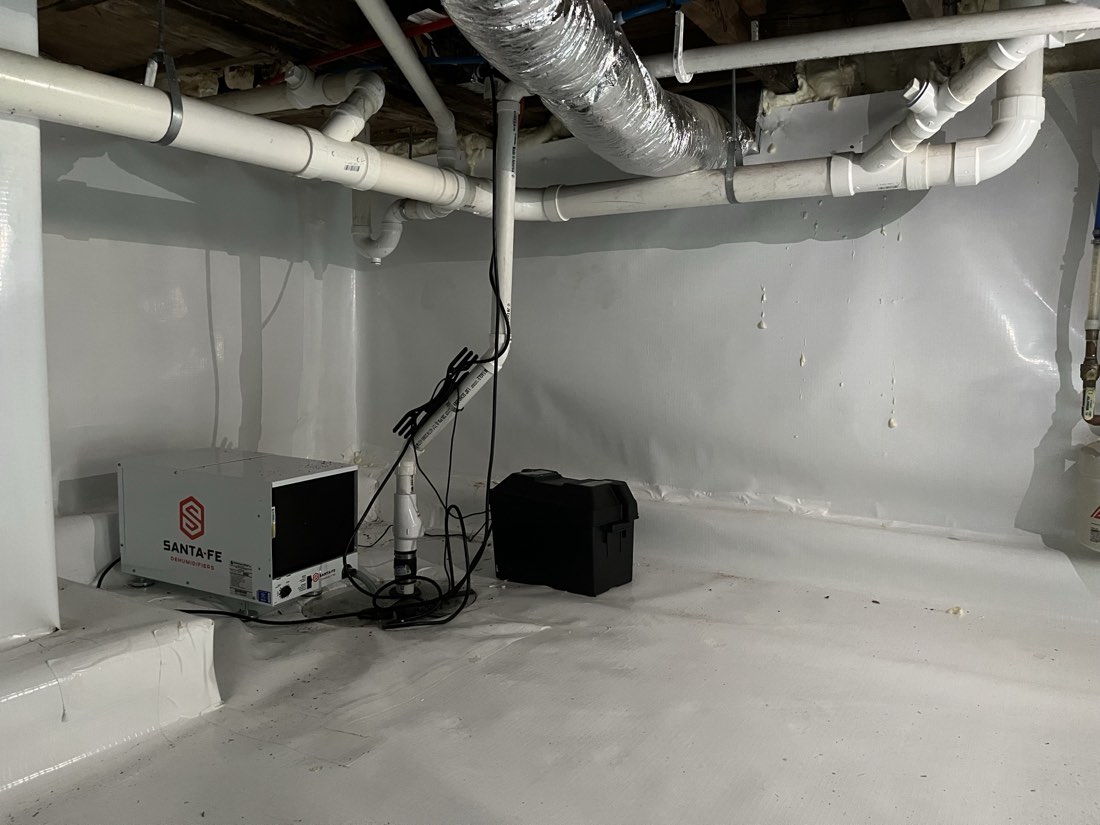
Four things, working together. Full-perimeter interior drainage cut into the floor wall joint catches water before it ever reaches the living space. A sump pump, sized to the house, moves that water back outside. A wall vapor barrier, what our crew calls the WhiteCap wall system, stops moisture from wicking through the block itself. A dehumidifier keeps the air dry so mold never gets the humidity it needs to start.
It is not one product, it is a system, and skipping a piece is how a homeowner ends up paying twice. We will tell you if your basement genuinely does not need all four, and we will tell you if it does.
What we hear from Portsmouth homeowners
The complaint we hear most in this city specifically: a finished or partly-finished basement that started smelling like mildew before anyone saw a drop of standing water. Portsmouth’s older housing stock means a lot of basements were finished decades ago without a vapor barrier behind the drywall, so the water was getting in the whole time and nobody could see it until the smell showed up. By the time you can smell it, the wall behind the drywall has usually been wet for a while.
We will always check behind a finished wall before we tell you what is actually wrong. Guessing from the smell alone is how homeowners end up paying to fix the wrong thing.
Frequently asked questions
My house is on a hill. Why is the basement still flooding?
Elevation keeps surface water from running downhill into your yard. It does nothing about moisture already saturating the soil against your foundation walls, and that pressure is what pushes water through concrete from the outside in. Hill or no hill, saturated soil against the foundation is what your basement actually feels.
Is it the rain, or is it something else?
Usually something else. A basement that floods every time it rains hard has a surface drainage problem, gutters or grading, and that is a cheaper fix than a full system. A basement that floods on a schedule that does not match the rain, or stays damp between storms, has a groundwater problem, and that is what the Forever Dry System is built for. We will tell you which one you have before we recommend anything.
Do you have to break up my whole basement floor?
No. The drainage system runs along the perimeter at the floor wall joint, not across the middle of the slab. Most of the floor stays untouched.
How long does the work take?
Most waterproofing jobs run a few days, not weeks. We will give you a specific timeline once we have seen the scope.
What a recent customer said
I thought I would wait a couple of months and a couple of rainstorms to give my review. Going back to the actual week of work: that was amazing. Angel arrives and takes charge. What followed was five guys moving heaven and earth to get my leaky mess fixed. Our house sits on the top of a very tall hill. The basement should not flood but with rising water tables our basement was flooding regularly, the water seeping through the concrete walls. Mold was forming. Our basement is now a clean space that does not flood. It has rained plenty since then and the basement is dry as a bone.
Claudia Chase, 5 stars, Google review
Get a free inspection
Free inspection, free estimate, and a written quote in your hands within 24 hours.
Sources: Census ACS 2023 5-yr (B25035, B25003, B25024, B01003) for housing age and tenure. NCEI 1991-2020 climate normals via currentresults.com for snowfall. USGS NWIS for local hydrology (Winnicut River watershed). CallRail 365-day call data. Review quoted verbatim from a public 603 Basement Solutions Google review.
Common questions about basement waterproofing
- I am purchasing a house built into a hill with a walkout basement. I am concerned about drainage. What should I use to keep water from my basement?
- I want to waterproof my basement, but first I have to stop water coming from the floors and walls. How do I stop the water from floors and walls?
- If our basement walls leak only when it rains hard, can we fix it from the inside instead of digging up the yard?
- If there is rainwater seepage getting into my basement, is it covered by homeowners insurance?
- If your basement is prone to flooding, should you install French drains, a sump pump, an ejector pump, or all three?
- If your home has no footing, how dangerous is it for the foundation?
- Is basement waterproofing really necessary, or is it just an extra service?
- Is it better to install a French drain or to just dig a small ditch
- Is it worth it to do exterior waterproofing of a home, and will it stop cracks and leaking in a basement?
- Is moisture seeping through a basement’s walls a sign that
- My dehumidifier is collecting 6 gallons of water per day from my basement. Is that normal, and what does it mean?
- Should I install a French drain to deal with water in my basement?
Portsmouth basement waterproofing — local context
In Portsmouth (Rockingham County), your basement fights tidal water, not just rain. The Piscataqua is a tidal estuary running ~4 knots through Portsmouth Harbor — one of the swiftest rivers in the U.S. (Wikipedia, citing USGS/NOAA) — so the water table rises and falls with the harbor. The City's own Coastal Resilience Initiative models tidal flooding along the Piscataqua and Sagamore Creek and plans for ~2.5 ft of sea-level rise by 2100, lifting the coastal water table against your foundation. Near-shore lots sit on USDA-NRCS Squamscott marine soils — fast on top, then perching water on dense clay subsoil. FEMA also maps AE/VE flood zones along the waterfront, with floodplain permits run by City Planning (1 Junkins Ave). For Portsmouth's old fieldstone foundations, we install the interior Forever Dry System — full-perimeter drain, a ½ hp sump per 120 ft, wall vapor barrier, and a dehumidifier. We don't dig outside; interior is the durable fix. Basement waterproofing runs $3,000–$30,000.
What a recent customer said
With the crazy wet weather and super high water table this year. Had water just seeping in through the Wall/Floor Joint in basement, that would just NOT stop. … But was leaking in at several points along a 30ft wall. 603 Basement was just a bit more. BUT they put in their patented Channel solution along the entire base of the wall, along with Sump Pump And let me tell you. . IT really worked. — John Weber, 5★ (Google review)
Frequently asked questions
Why do Portsmouth basements stay wet even when it isn't raining?
Because Portsmouth is tidal. The Piscataqua River is a tidal estuary running about 4 knots through the harbor (Wikipedia, citing USGS/NOAA), so the coastal water table rises and falls with the tide and pushes against your foundation. The City's Coastal Resilience Initiative plans for roughly 2.5 ft of sea-level rise by 2100, which only raises that water table further. That's groundwater pressure, not weather — so an interior perimeter drain and sump that manage the water table beat any one-time patch.
Why does water pool against foundations on Portsmouth's near-shore lots?
Many waterfront and North Mill Pond lots sit on USDA-NRCS Squamscott marine soils — very deep, poorly drained soils where water moves fast through the sandy upper layer, then slows on the dense clay-rich subsoil (22–35% clay). Water perches on that clay and presses against the foundation. Our Forever Dry System collects that water with a full-perimeter interior drain and routes it to a ½ hp sump per 120 ft, rather than fighting it from outside.
Is my Portsmouth home in a flood zone, and who handles permits?
FEMA maps high-risk AE flood zones along Portsmouth's waterfront, North Mill Pond, and Sagamore Creek, plus oceanfront VE zones; check the FEMA Map Service Center or NH Flood Hazards Viewer for your parcel. Floodplain permits run through the City Planning Department at 1 Junkins Ave, (603) 610-7216 (City of Portsmouth Floodplain Regulations, Zoning §10.620). We handle the interior waterproofing; the City handles any floodplain permitting.