
Radon is a radioactive gas you can’t see, smell, or taste, and yes, it’s dangerous. The EPA calls it the second leading cause of lung cancer in the United States and the leading cause among people who never smoked. New Hampshire’s granite bedrock makes our basements high-risk. The only way to know your level is a test.
What radon actually is
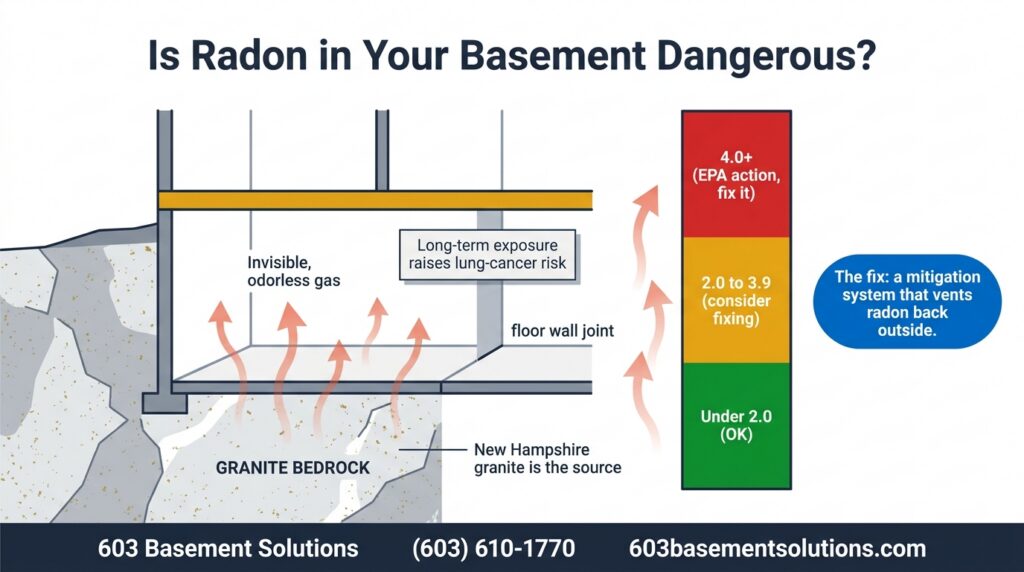
Radon is a natural radioactive gas. It comes from uranium breaking down in the soil and rock under your house, and it seeps up through cracks in the slab, the floor wall joint, sump openings, and gaps around pipes. Then it collects in the lowest part of the home, which in New Hampshire is almost always the basement.
You won’t notice it. No smell. No color. No taste. That’s the whole problem. A house with a dangerous radon level looks and feels exactly like a house with none, right up until it shows up on a test.
The EPA tracks radon because breathing it over years damages lung tissue. Outdoors it scatters into the air and stays low. Indoors it has nowhere to go, so it builds up. (EPA, A Citizen’s Guide to Radon.)
Why New Hampshire basements are radon hot spots
New Hampshire sits on granite. It’s the Granite State for a reason. Granite and the soils that come from it are naturally higher in uranium than a lot of the country, and uranium is where radon starts. More uranium in the ground under your foundation means more radon working its way up into the basement.
The EPA puts most of New Hampshire in Radon Zone 1, its highest-risk category, where indoor levels are predicted to average at or above the action level. (EPA, Map of Radon Zones.) That doesn’t mean every single home is high. It means the odds here are worse than most places, so testing isn’t optional paranoia. It’s just smart for a NH homeowner.
Older fieldstone and dirt-floor basements make it easier still. There’s no poured slab to slow the gas down, so it comes right in. Our crew sees plenty of both.
How dangerous is radon, really
Here’s the straight version. The EPA estimates radon causes about 21,000 lung cancer deaths in the United States every year. It’s the second leading cause of lung cancer overall, behind smoking, and the number one cause among people who never smoked. (EPA, A Citizen’s Guide to Radon.)
The risk isn’t a today problem. Radon doesn’t give you a headache this afternoon. It’s a long-exposure problem: years of breathing elevated levels raise your odds of lung cancer, the same way years of a bad habit would. Smokers in a high-radon home carry the highest risk of all, because the two multiply.
We’re not going to hand you a scary number about years off your life. We’ll just say what the EPA says. It’s a real cause of a real disease, it’s common in our part of the country, and it’s fixable. That last part matters most.
Can you feel radon? The truth about “radon symptoms”
No. There are no radon symptoms. You cannot feel it, and there’s no cough or ache that tells you your basement has it.
A lot of folks search for radon symptoms hoping their body will warn them. It won’t. The only symptoms tied to radon are the symptoms of the lung cancer it can cause years down the road, and by then the damage is done. That’s exactly why testing exists. You can’t sense this one, so you measure it instead.
How to test your basement for radon
Testing is cheap and easy, and it’s the only honest way to know your number.
You’ve got two routes. A short-term test kit from a hardware store sits in your basement for a few days and gives you a rough reading. Or a certified contractor runs a monitor and gives you a measured result you can act on. Either way, the test runs in the lowest livable level of the home, with windows and doors kept closed the way you’d normally live.
At 603 our radon test is $50. It’s a real fee, not a free gimmick, but we credit that $50 toward the job if you decide to move forward. We’re a state-certified radon mitigation company (cert RMS-113966), licensed and insured, and we self-perform the work in-house.
| 603 radon service | Price |
|---|---|
| Radon test | $50, credited toward the job if you proceed |
| Radon mitigation system | $900 to $6,000; most homes land $1,950 to $2,250 |
Your radon level, and what to do about it
Radon is measured in picocuries per liter, written pCi/L. The higher the number, the more gas you’re breathing. Here’s how the EPA reads those numbers.
| Your test result | What it means | What the EPA says to do |
|---|---|---|
| Below 2.0 pCi/L | Lower risk (no level is truly risk-free) | No action needed; retest down the road |
| 2.0 to 3.9 pCi/L | Elevated | Consider fixing; the EPA says you may want a system |
| 4.0 pCi/L or higher | At or above the EPA action level | Fix it. Install a mitigation system |
(Thresholds per EPA, A Citizen’s Guide to Radon.)
If your test comes back under 2, you don’t need us. Keep the result, retest every few years, and move on with your life. We’d rather tell you that than sell you a system you don’t need. If it’s 4 or over, that’s the EPA’s line in the sand, and it’s worth getting handled.
How radon mitigation actually works
The fix is simpler than people expect. A radon system doesn’t scrub the air inside your house. It stops the gas from getting in.
The standard fix is called sub-slab depressurization. We run a sealed pipe down through the basement slab, put a quiet fan on it, and vent the radon up and out above the roofline before it can ever reach your living space. The fan runs continuously and pulls the gas straight from the soil under the floor. (EPA, Consumer’s Guide to Radon Reduction.) For a dirt-floor or fieldstone crawl space, we use a sub-membrane version: a sealed barrier over the ground with the same depressurization pipe underneath.
If your basement has a water problem too, radon and water often come in through the same cracks and the same floor wall joint, so it makes sense to handle both at once. We do that regularly, and you can read how a drainage system and a radon system work together on our page about how to properly waterproof a basement with a radon mitigation system.
Our radon systems carry a 10-year warranty on the system and its components. One honest note. We don’t guarantee a specific radon number unless we put it in writing, because your final level depends on your house, your soil, and how it’s built. You can see the full setup on our radon mitigation systems page.
Frequently asked questions
Does radon go away on its own?
No. As long as there’s uranium in the soil under your house, and in New Hampshire there usually is, radon keeps coming. It’s continuous. The gas doesn’t dissipate or use itself up, which is why you need a system that vents it out rather than waiting it out.
My neighbor tested low. Do I still need to test?
Yes. Radon varies house to house, even on the same street, because it depends on your soil, your foundation, and the cracks in your specific slab. (EPA.) A low reading next door tells you almost nothing about your own basement. The only way to know your level is to test your house.
Is radon only a basement problem?
Radon enters at the lowest level and is usually highest there, but it can rise into the rest of the home. Fixing it at the source in the basement is what protects the whole house, which is why mitigation focuses down there.
Will a radon fan make my basement cold or loud?
The fan runs all the time and vents outside, and most homeowners barely notice it. It’s designed to move air quietly. It can pull a little conditioned air along with the radon, but that tradeoff is minor next to what it keeps out.
Can you fix radon and a wet basement at the same time?
Yes, and it’s often smart to. Water and radon tend to use the same entry points, so combining a drainage system with a radon system means one crew, one trip, and one sealed basement. See our combined radon and waterproofing writeup for how that works.
What this means for your home
Radon is invisible, it’s common under our granite, and it’s a real health risk the EPA takes seriously. It’s also one of the most fixable things in your basement. Test first. If your number’s low, great, you’re done. If it’s high, a mitigation system handles it for good.
Want to know your number? Call us at (603) 610-1770 or book your free inspection and we’ll get you tested.
By Chris Pagliccia, 603 Basement Solutions. State-certified radon mitigation, RMS-113966. Serving New Hampshire, Maine, and Massachusetts.
Sources: EPA, A Citizen’s Guide to Radon (health risk, ~21,000 deaths/yr, second leading cause of lung cancer, 4.0 pCi/L action level, thresholds); EPA, Map of Radon Zones (New Hampshire Zone 1); EPA, Consumer’s Guide to Radon Reduction (sub-slab depressurization).