
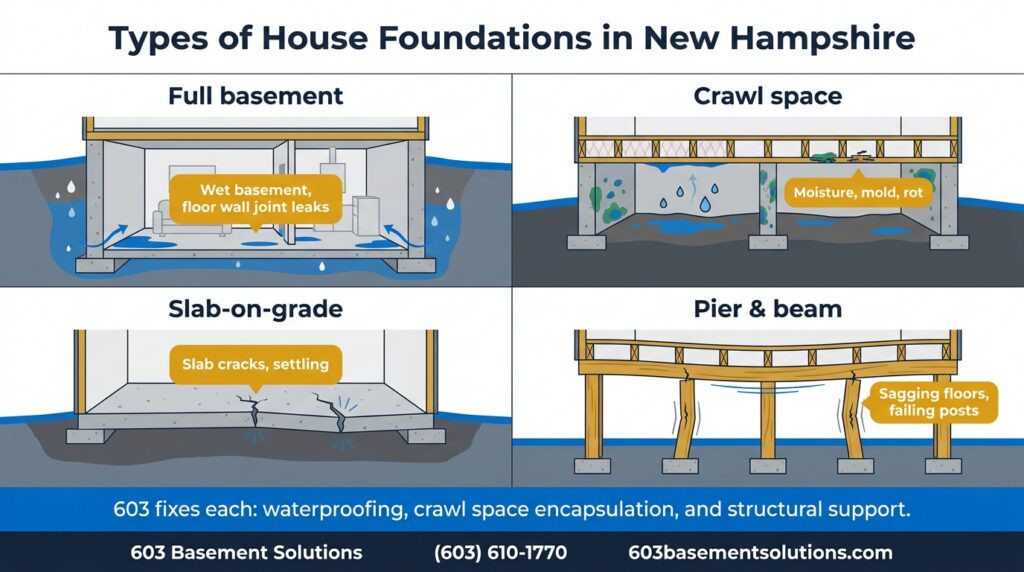
Most New Hampshire homes sit on one of four foundations: a full basement (poured concrete, block, or older fieldstone), a crawl space, a slab-on-grade, or pier-and-beam. Each one fails in its own way up here, from bowing walls and water to wood rot and radon. Below is what to watch for by type.
The foundation types you’ll find in NH homes
Four main types cover almost every house in the state. Which one you have usually comes down to when the house was built and where it sits on the lot.
Older farmhouses tend to have fieldstone or a crawl space. Postwar homes lean block. Newer builds are mostly poured concrete or slab. A house on a hillside or over ledge might mix a couple of these under one roof. Go stand in the lowest level of your home and look at the walls. That tells you most of what you need to know.
Full basement
The full basement is the most common foundation in New Hampshire, and it comes in three flavors.
Poured concrete. The modern standard. Solid walls poured in one shot, strong and fairly water-resistant when done right. When they crack, it’s usually a thin vertical line from the concrete curing and shrinking. Most of those are cosmetic. Some let water in.
Concrete block. Cinder block walls, common in mid-century homes. Block is strong straight down but weaker against side pressure, so this is the foundation most likely to bow or lean when wet soil pushes on it. The tell is a stair-step crack that follows the mortar joints.
Fieldstone. The old ones. Stacked stone and mortar, the foundation under a lot of New Hampshire’s antique homes and farmhouses. The stone itself lasts for centuries. The mortar between the stones does not, so it crumbles, washes out, and lets water and cold air right through. Fieldstone is finicky work, and plenty of contractors won’t touch it. We do. It’s one of our specialties.
Crawl space
A crawl space is a short basement, a foot or two of clearance under the floor instead of a full room. Some are dirt-floored, some have a thin slab.
The problem with crawl spaces is that homeowners forget they exist. Out of sight, out of mind. Meanwhile moisture builds up down there and goes to work on the wood above it. That musty smell in the house? It’s usually moisture in the insulation and the wood, and the mold that grows in it. An unhealthy crawl space can rot your house from the inside out, so it’s not a space to leave unchecked.
Slab-on-grade
Slab-on-grade means the house sits on a single thick pad of concrete poured right on the ground. No basement, no crawl space, no room underneath.
Slabs are simple and there’s no basement to flood, which is the upside. The downside is access. Your plumbing runs through or under the slab, so a leak or a repair means cutting concrete. Slabs can also crack and settle if the ground underneath them shifts or was never compacted well before the pour.
Pier & beam
Pier-and-beam lifts the house off the ground on posts (piers) with beams running across them and the floor built on top. You see it on older homes, additions, porches, and camps.
The weak spot is wood meeting moisture. Damp ground, poor drainage, or a leak lets the beams, the sill, and the posts rot over time. That’s when you get the soft, springy, uneven floor. If your floor feels like it dips in one spot, the support under it is usually the reason.
Common problems by foundation type
Different foundations, different failure points. Here’s the quick map.
| Foundation type | What tends to go wrong |
|---|---|
| Full basement, poured concrete | Shrinkage cracks, water at the floor wall joint, radon |
| Full basement, block | Bowing or leaning walls, stair-step cracks, water, radon |
| Full basement, fieldstone | Crumbling mortar, seepage, cold air, radon |
| Crawl space | Damp, wood rot, musty air, radon |
| Slab-on-grade | Settling cracks, hard plumbing access |
| Pier & beam | Sagging or soft floors, rot at sills, beams, and posts |
Notice radon shows up on almost every line. More on why in a second. If you’re trying to tell a harmless crack from a real one, our guide to the signs of foundation failure walks through it.
What New Hampshire does to each one
Foundations fail faster here than in a lot of the country. The reason is the ground and the weather.
The frost line. Footings have to sit below the frost line, the depth the ground freezes to in winter, which in New Hampshire runs commonly around four feet down, with your town’s building code setting the exact depth. A footing poured too shallow gets shoved around every winter.
Freeze and thaw. Water gets into a crack, freezes, expands, and pries the crack wider. Then it thaws and does it again. We run through that cycle dozens of times a season. It’s brutal on concrete, block, and mortar, and it’s why a small crack you ignored in October is bigger by April.
Granite bedrock. The Granite State earned the name. All that granite means ledge close to the surface (hard to dig, and it can push water and foundations around) and it means radon. Granite releases radon gas as it breaks down, and the EPA puts most of New Hampshire in its highest-risk radon zone. That’s why radon belongs on the problem list for basements, crawl spaces, and slabs alike.
Disturbed backfill. When your house was built, crews dug out the ground, poured the foundation, and shoved the loose dirt back against the walls. That backfill is looser than the packed native soil around it, so it drains slowly and holds water right against your foundation. That’s why water pools at the wall and not out in the yard.
How 603 fixes each foundation
The fix depends on whether the problem is structural, water, air, or all three. Here’s how we sort it.
Structural: cracks, bowing, and settling. For walls that are cracked or pushing in, we inject the crack or add carbon-fiber straps to hold the wall and stop the movement. For a house that’s settling or sinking, we go under it with helical piers driven down to stable ground, or we shore up soft floors with adjustable steel support posts, what most folks call lally columns. Fieldstone gets its own approach, rebuilding and repointing the failed sections. All of it lives under our structural and foundation repair work, and we self-perform the lifting and piering in-house.
One thing we’ll say straight: a thin crack that isn’t leaking and isn’t moving usually doesn’t need us yet. Keep an eye on it. When a full repair is out of budget and the crack’s just weeping a little, sometimes the honest move is to seal that crack and don’t look back. We’ll tell you which one you’ve got.
Water. For a wet basement, the durable fix is interior drainage, not digging up your yard. We install our Forever Dry System: a full-perimeter drain, a sump pump, a wall vapor barrier, and a dehumidifier, all tied together. It’s how we handle water for good, and it’s the core of our basement waterproofing. We don’t do exterior excavation waterproofing. Nik’s seen those fixes fail in a couple of years, so we put our warranty behind the interior system instead.
Crawl space. For a damp crawl space, the fix is encapsulation: sealing the whole space with a 12-mil vapor barrier on the walls and a 20-mil barrier on the floor, dimpled drainage matting underneath, seams sealed with spray foam, plus a dehumidifier and a sump. That’s our crawl space services. Dry the space and the wood stops rotting and the musty smell leaves with it.
Radon. Radon gets its own system, a mitigation setup that pulls the gas from under the slab or membrane and vents it above the roofline. For dirt or fieldstone crawl spaces we install a sub-membrane system that draws the radon out from under the sealed barrier. Testing runs $50, and if you move forward we credit that toward the job.
What the common fixes run
Every job is different, so these are ranges, not quotes. We give you a real number after we see it.
| Common NH fix | 603 range |
|---|---|
| Foundation crack repair | $1,000 to $3,000 |
| Carbon-fiber wall straps | $850 each |
| Helical piers | $2,700 per pier for the first 3, then $2,200 per pier |
| Lally column replacement | $1,300 to $2,500 |
| Interior drainage (basement waterproofing) | $3,000 to $30,000 |
| Crawl space encapsulation | $3,000 to $25,000 |
| Radon mitigation | $900 to $6,000 (most homes $1,950 to $2,250) |
The inspection to figure out which one you need is free.
Frequently asked questions
What’s the most common foundation type in New Hampshire?
The full basement, usually poured concrete in newer homes and concrete block in mid-century ones. Older farmhouses often have fieldstone or a crawl space, and some homes sit on a slab or pier-and-beam. Many houses mix types, especially where an addition was added later.
Are fieldstone foundations a problem?
Not the stone. The mortar between the stones is what fails, crumbling and washing out over the decades, which lets in water and cold air. The fix is repointing and rebuilding the failed sections. Fieldstone is fussy work that a lot of contractors skip, and it’s one of the things we specialize in.
Why is radon a bigger deal in New Hampshire?
Granite. As the state’s granite bedrock breaks down it releases radon gas, and the EPA places most of New Hampshire in its highest-risk radon zone. The gas seeps up through basement floors, crawl spaces, and cracks. Radon is bad for your health over time, so it’s worth knowing your levels.
Can you fix a bowing basement wall without replacing it?
Usually, yes. If the wall is caught before it moves too far, carbon-fiber straps or bracing hold it in place and stop the bowing. Badly failed walls may need more. A free inspection tells us which situation you’re in.
How do I know if my foundation problem is serious?
Watch for movement and water. A crack that’s growing, a wall that’s leaning in, a floor that’s gone soft, or water at the floor wall joint are the ones to take seriously. A thin, dry, stable crack often just needs watching. Our signs of foundation failure guide breaks down which is which.
Does foundation work come with a warranty?
Yes, and terms vary by fix. The Forever Dry System carries a full transferable lifetime warranty, helical piers and crawl space encapsulation carry 25-year warranties, and radon mitigation carries a 10-year warranty on the system. Warranties transfer to the next homeowner as long as no one else has touched the work.
Talk to a local crew who knows NH foundations
Not sure what you’re standing on or what that crack means? We’ll come look, tell you straight, and put it in writing. No pressure, no scare tactics.
Call us at (603) 610-1770 or book your free inspection. We’ll figure out what your foundation needs, and just as important, what it doesn’t!