
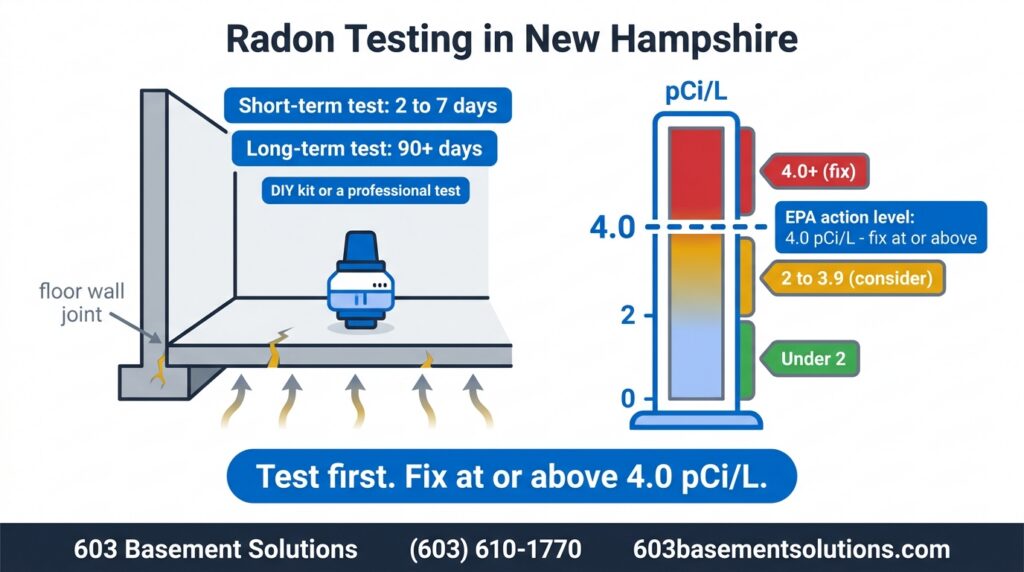
A radon test measures how much radon gas is in the air you breathe, in picocuries per liter (pCi/L). 603 runs a professional test for $50, and we credit that $50 toward the work if you decide to mitigate. The EPA says take action at 4.0 pCi/L or higher. Below that, you’re usually fine.
How radon testing works
Radon is invisible. You can’t smell it, taste it, or see it, so the only way to know your level is to measure it. A test sits in the lowest lived-in level of the house, usually the basement or first floor, and records the radon in that air over a set window of time.
There are two ways to do it. A do-it-yourself kit you buy and mail to a lab, or a professional test run by a certified tech. Both give you a number in pCi/L. That number is the whole point. It tells you whether you can leave things alone or whether it’s worth putting in a system.
Our radon lead is Branden, who’s been doing radon work since 2015. We charge $50 for a professional test. It’s a real fee, not a free gimmick, but if your number comes back high and you decide to move forward, that $50 comes off the mitigation price.
Why New Hampshire homes test high
New Hampshire isn’t called the Granite State for nothing. Granite bedrock tends to hold more uranium than other rock, and radon is what you get when that uranium breaks down underground (EPA). The gas seeps up through soil and works its way into homes through cracks, the floor wall joint, sump pits, and gaps around pipes.
That’s why so much of New Hampshire sits in the EPA’s highest radon zone, the areas where indoor levels are predicted to run above the action level (EPA Radon Zone 1). It doesn’t mean every house is high. It means the odds here are worse than most of the country, so testing is worth it no matter how new or tight your home is.
Winter makes it worse. A sealed-up, heated house pulls soil gas in through the foundation, so levels often read higher in the colder months.
Short-term vs long-term tests
Both measure the same thing. The difference is how long the test runs.
A short-term test runs from a couple of days up to 90 days (EPA). It’s the fast way to get a number, and it’s what most people use for a first check or a home sale. A long-term test runs longer than 90 days (EPA) and gives you a better picture of your year-round average, since radon swings with the seasons and the weather.
If you’ve never tested, start short. The EPA suggests a short-term test first, and if it comes back elevated, you follow up rather than wait months for an answer while the gas is still in the house.
DIY kit vs a professional test
A DIY kit is fine for a first look. They’re cheap, you can grab one at a hardware store, and the lab result is a real number. If you just want to know roughly where your house stands, a kit does the job. You don’t need us for that.
A professional test is the better call in two cases. One, you’re buying or selling and the number has money riding on it. Two, your DIY result came back near or above the action level and you want a clean, certified reading before you spend on a system. A certified tech follows the placement and closed-house rules exactly, which matters when the result decides a repair.
603 is state-certified for radon (certification RMS-113966). So when you need a number you can stand behind, that’s what the $50 test gets you.
Testing around a home sale
Radon comes up a lot during a sale. In New Hampshire, buyers and their inspectors routinely ask for a radon test during the inspection period, and the result can factor into what gets negotiated. Sellers often test ahead of listing so there are no surprises at the table.
None of this is legal advice, and disclosure rules can change, so confirm the specifics with your agent or attorney. What we can tell you is the practical part: a short-term test is the usual choice on a sale timeline because it turns a number around in days, not months.
What your number means
Your result comes back in pCi/L. Here’s how the EPA reads it.
At 4.0 pCi/L or higher, the EPA recommends you fix the home with a mitigation system. Between 2.0 and 4.0 pCi/L, the EPA says consider fixing it. Below 2.0, there’s no action recommended, though the EPA is clear that no level of radon is completely risk-free.
Why it matters at all: radon is the second leading cause of lung cancer in the United States, and the leading cause among people who don’t smoke (EPA). It builds up slowly over years, which is exactly why a one-time test is worth the small cost.
If your number is under 4.0, you’re in good shape. You don’t need a system today.
From test to mitigation
If your number lands at or above the action level, the fix is a radon mitigation system. In most homes that means a sub-slab depressurization setup, which pulls the gas from under the slab and vents it up and out above the roofline before it can get into your living space. For dirt or fieldstone crawl spaces we run a sub-membrane version instead.
We self-perform our radon work in-house, so the same certified crew that reads your number installs the system. Our radon systems carry a 10-year warranty on the system and its components. We don’t guarantee a specific radon level unless we put that in writing.
If you want the detail on the systems themselves, see radon mitigation systems. And if you’ve got water and radon both, they often get solved together, which we walk through in how to waterproof a basement with a radon mitigation system.
What radon testing and mitigation cost in New Hampshire
| Service | 603 NH cost |
|---|---|
| Radon test | $50, credited toward the work if you proceed |
| Radon mitigation (only if you need it) | $900 to 6, 000 * *; mosthomesland * *1,950 to $2,250 |
The test is the cheap, easy part. Mitigation is only in the picture if your number is high, and plenty of homes test fine and pay for nothing but the $50.
Frequently asked questions
How long does a radon test take?
A short-term test runs from a couple of days up to 90 days (EPA), and for a home sale it’s often just a few days. A long-term test runs longer than 90 days and gives you a better year-round average.
Is a DIY radon test accurate?
A DIY kit gives you a real lab number and is fine for a first check. For a home sale, or when the result is close to the action level, a certified professional test is the safer call because the placement and closed-house rules get followed exactly.
What radon level is considered dangerous?
The EPA recommends fixing your home at 4.0 pCi/L or higher, and considering a fix between 2.0 and 4.0. No level is completely risk-free, but under 2.0 the EPA recommends no action.
Do I still need to test if my house is new or has no basement?
Yes. Radon can get into any home regardless of age, style, or whether it has a basement, and much of New Hampshire sits in the EPA’s highest radon zone. The only way to know your level is to test.
Does 603 credit the $50 test fee?
Yes. The $50 is a real fee, but if your number comes back high and you decide to move forward with mitigation, we credit that $50 toward the job.
Is 603 certified to test for radon?
Yes. We’re state-certified for radon work (certification RMS-113966), and our radon lead Branden has been doing this since 2015.
Get your number
Testing is $50, and it’s credited toward the work if you decide to move forward. Not sure where you stand? Get the test, get the number, and go from there.
Call us at (603) 610-1770 or schedule your radon test online and we’ll get you a real reading you can trust!
Sources: U.S. Environmental Protection Agency (EPA), “A Citizen’s Guide to Radon” and EPA Map of Radon Zones (action level 4.0 pCi/L; 2.0 to 4.0 “consider fixing”; radon as a decay product of uranium; second leading cause of lung cancer; short-term tests 2 to 90 days, long-term tests over 90 days; New Hampshire counties in Radon Zone 1). 603-specific pricing, warranty, certification (RMS-113966), and crew details confirmed by 603 Basement Solutions.