

By Chris Pagliccia, 603 Basement Solutions
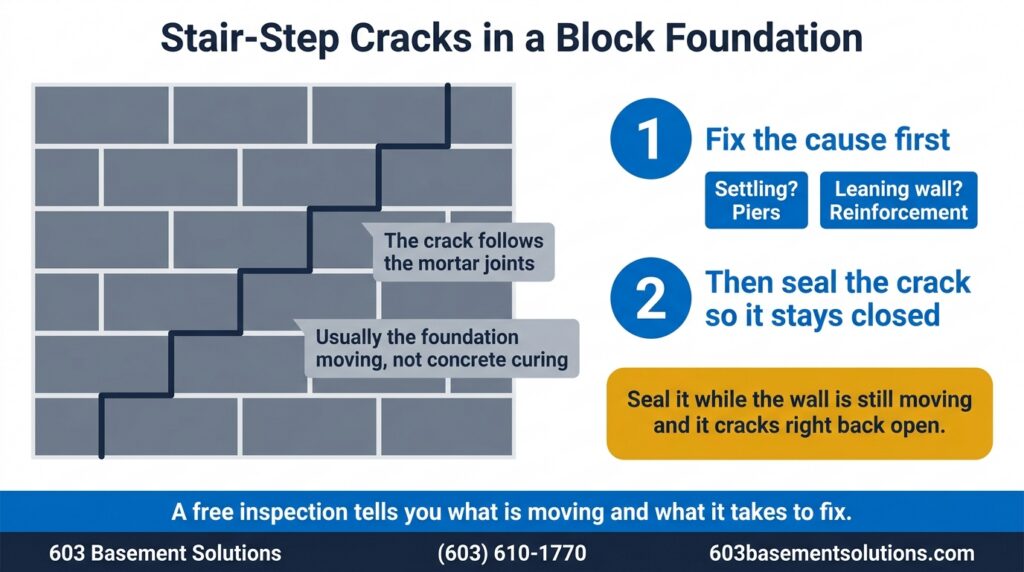
A stair-step crack runs diagonally through the mortar joints of a block or brick wall, climbing like a staircase. It usually means one part of your foundation is settling faster than the rest, or wet soil is pushing on the wall from outside. Width, sideways displacement, and whether it’s still growing tell you how serious it is.
What a stair-step crack actually is
Look close at the crack. If it steps along the joints between the blocks or bricks, up and across, up and across, that’s a stair-step crack. It follows the mortar because mortar is the weak line in the wall. Concrete block and brick are strong straight down. The seams between them are where a wall gives first.
That shape matters. Stair-step means the wall is moving as a unit and the joints are letting go one by one. A crack running straight through the middle of the blocks is a different animal.
Either way, the crack is a symptom. The real question is what’s moving the wall.
What the crack is telling you
Two things drive a stair-step crack. Sometimes both at once.
One side is settling
The most common cause is differential settlement. That’s a fancy way of saying part of the foundation sank and part didn’t. When one corner or one stretch of wall drops, the wall tears along its weakest line, and you get that diagonal staircase. The crack is usually wider at the top or the bottom, wherever the wall is pulling apart most.
Why does soil settle unevenly here? A few reasons. The disturbed backfill around a foundation, the loose soil that got dug out and packed back when the house was built, never compacts as tight as the ground it replaced. It settles on its own timeline. Add New Hampshire’s freeze and thaw, frost heave lifting and dropping the soil every winter, and a poorly drained spot that stays wet and soft, and one part of the wall ends up with less support than the rest.
The soil is pushing in
The other cause is lateral pressure. Saturated soil against the outside of the wall gets heavy and pushes inward. That push can open the mortar joints in the same stair-step pattern, especially in a block wall.
This is where drainage ties back in. When water can’t get away from the foundation and sits in that disturbed backfill, the soil load against the wall goes up. Over years, that steady push bows the wall or shears the joints. If your stair-step crack comes with a wall that’s leaning or bulging inward, lateral pressure is the likely story.
Serious or cosmetic? Three things to check
Not every stair-step crack is an emergency. Some are old, they moved once, and they’ve sat still for a decade. Here’s how we size one up.
Width. Hairline cracks you can barely catch a fingernail in are usually minor. Once a crack is wide enough to slip a coin or a pencil into, it’s telling you the wall moved a real amount.
Displacement. Run your hand across the crack. If both faces of the wall are still flush, the wall shifted but stayed in plane. If one side has pushed out past the other, so there’s a lip you can feel, that’s active structural movement and it needs eyes on it.
Growth. This is the big one. A crack that’s held the same for years is far less worrying than one you can watch change. Mark both ends with a pencil, write the date, and measure the width. Check it again in a few months. If it’s spreading, the cause is still working on your wall.
| What you see | Probably just watch it | Probably needs a fix |
|---|---|---|
| Crack width | Hairline, thin as a coin’s edge | Wide enough to slip a coin or pencil in |
| Displacement | Both faces still flush | One side pushed out past the other |
| Growth over time | No change across several months | Getting longer or wider, measurably |
| Wall shape | Flat and plumb | Bowing or leaning inward |
| Water | Dry crack | Water seeping through it |
If everything sits in the left column, you likely don’t need to rush into a big repair. Watch it, keep water away from the foundation, and check back. If anything lands in the right column, get it looked at before it gets worse. Water problems and wall movement don’t heal on their own. They only go the wrong way.
How we fix it
The fix depends on what’s moving the wall, which is why the inspection comes first. There’s no single answer that fits every stair-step crack.
If it’s settlement, the wall needs support from below. We drive helical piers down through the soft soil to solid load-bearing ground, then transfer the foundation’s weight onto them. That stops the sinking and, where the soil allows, can bring the settled section back up. This is the real repair for a foundation that’s dropping. Poly Level polyurethane can lift a sunken slab or walkway, but a settling foundation wall is a piering job.
If it’s lateral pressure, the wall needs reinforcement against the push. For a wall that’s moved a little, carbon-fiber straps bond to the inside and hold it from bowing further. For a wall under heavier load, a steel power brace does the job. Both stabilize the wall where it stands.
The crack itself gets sealed with injection once the movement is handled. Sealing a crack while the wall is still moving just cracks it again, so we address the cause first, then close the crack.
One more honest note. If an inspection shows a hairline stair-step that hasn’t budged in years, both faces flush, no water, we’ll tell you to watch it and save your money. We’re not going to talk you into piers you don’t need.
What it costs in New Hampshire
These are 603’s own NH ranges. Your actual price depends on how much of the wall is affected and which fix the inspection calls for.
| Repair | What it handles | 603 NH price |
|---|---|---|
| Crack injection | Sealing the crack once movement is handled | $1,000 to $3,000 |
| Carbon-fiber straps | Reinforcing a wall that’s moving inward | $850 each |
| Power brace | Steel bracing for a bowing wall | $1,300 per brace |
| Helical piers | Stabilizing or lifting a settling foundation | $2,700 per pier for the first 3, then $2,200 each |
| Typical piering job | Full settlement repair | About $12,000 to $18,000+ (6-pier minimum) |
| Foundation inspection | Figuring out which fix you actually need | Free |
The inspection is where it starts, and ours doesn’t cost you anything. A structural engineer’s stamped report runs more in the general market, roughly $1,200 to $2,000 and often around $1,500, at $100 to $500 an hour, if your situation calls for one.
Frequently asked questions
Are stair-step cracks in a foundation serious?
Sometimes. A hairline crack that’s stayed put for years, with both wall faces flush and no water, is usually minor. A crack that’s wide, offset so one side sticks out, or still growing, points to active movement and should be inspected. Width, displacement, and growth are the tells.
What causes stair-step cracks in a block wall?
Two things, often together. Differential settlement, where one part of the foundation sinks faster than the rest, tears the wall along its mortar joints. And lateral pressure, where wet soil pushes on the wall from outside. New Hampshire’s frost heave and slow-draining disturbed backfill feed both.
How do I know if a stair-step crack is still moving?
Mark both ends of the crack with a pencil, write the date next to it, and measure the width. Come back in a few months and measure again. If the crack has lengthened or widened, it’s active and the cause is still working. If nothing’s changed, it’s more likely an old crack that already moved.
Can you just fill a stair-step crack?
You can seal it, but only after the movement is handled. Inject a crack while the wall is still settling or bowing and it’ll crack again. We fix the cause first, with piers for settlement or reinforcement for a leaning wall, then close the crack so it stays closed.
Does homeowners insurance cover foundation cracks?
Most policies exclude cracks from settlement, soil movement, and normal wear, which covers the usual stair-step crack. Coverage depends entirely on your policy and the cause, so read yours and call your carrier.
Do I need a structural engineer or a contractor?
For a straightforward stair-step crack, a foundation contractor’s inspection tells you what’s moving and what it takes to fix. If the situation is complex or a lender or town wants a stamped report, that’s when an engineer comes in. Our inspection is free, so it’s a no-cost place to start.
Get it looked at before it grows
A stair-step crack is worth understanding, not panicking over. Watch the width, feel for displacement, and track whether it’s growing. If it’s holding steady, keep an eye on it. If it’s moving, don’t wait, because a wall that’s still shifting only gets more expensive to fix.
Not sure which one you’ve got? That’s what the free inspection is for. We’ll tell you whether you need a repair or just need to watch it. Call us at 603-610-1770 or book your free inspection and we’ll take a look.
Related reading: signs of foundation failure in NH · structural and foundation repair · how our foundation inspection works