
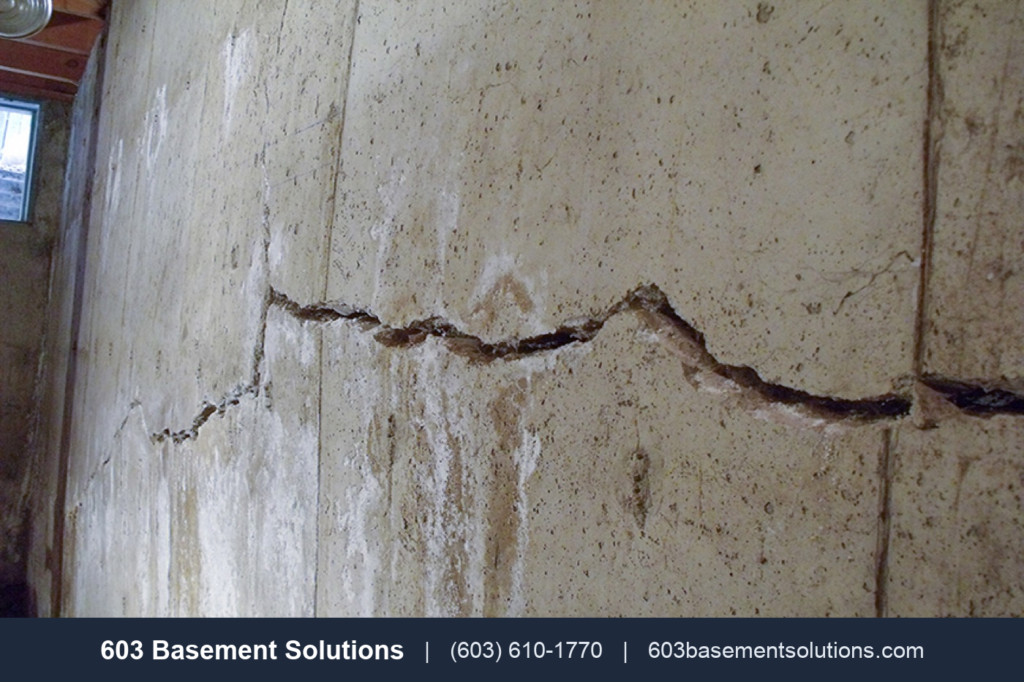
The clearest signs a foundation is failing are a horizontal crack across a wall, stair-step cracks in block or brick, any crack wider than about a quarter inch or actively growing, walls that bow or lean inward, doors and windows that suddenly stick or will not latch, floors that sag, bounce, or slope, a gap opening where the wall meets the ceiling or floor, a chimney pulling away from the house, and, in older fieldstone homes, rotting sill beams or failing posts and lally columns. These are structural signs, not just water signs, and they mean the ground or the support under your house is moving. In New Hampshire most of it traces back to one thing: the freeze-thaw cycle and a high water table working on old foundations that were never built to today’s standards. Some signs you can watch for a season. Others, like a wall bowing inward or a crack that grows week to week, mean it is time for an inspection now.
The signs, ranked from “watch it” to “act now”
You do not need every symptom on this list to have a problem. One that keeps getting worse is enough. Here they are, roughly in the order we treat them, with what each one looks like, what is likely happening underneath, and how urgent it tends to be.
Horizontal cracks across a foundation wall (act now)
A crack that runs sideways across a wall is the one we worry about most. It usually means the soil outside is pushing in on the wall harder than the wall can hold. In a block wall it often shows up partway down, where the pressure peaks. Vertical and diagonal cracks are common and frequently minor. A horizontal crack is different. It points to lateral pressure, and it can be an early stage of a wall that is starting to bow. If you see one, get it looked at. This is not a watch-and-wait sign. (More: when foundation cracks need action.)
Stair-step cracks in block or brick (act now if widening)
In a concrete-block or brick foundation, pressure and settling often crack the wall along the mortar joints in a stair-step pattern, climbing diagonally from a corner. A thin, old, stable stair-step crack may have happened years ago and stopped. One that is widening, or that you can fit a coin into, means the wall is still moving. Stair-step cracks near a corner often go with settlement at that corner of the house. Track the width. If it is growing, have it inspected.
A crack wider than about a quarter inch, or one that is growing (act now)
Width and movement matter more than length. A hairline crack you can barely catch a fingernail in is usually nothing. Once a crack opens past about a quarter inch, or you can watch it grow from one season to the next, the foundation is telling you something is moving. A simple way to check: mark the ends of a crack with a pencil and date it, or bridge it with a strip of painter’s tape, and look again in a month. If the mark moves or the tape tears, that is active movement, and active movement gets an inspection.
Walls that bow, lean, or buckle inward (act now)
A wall that is no longer straight is a serious sign. Sight along the wall, or hold a level against it. If the middle bulges into the basement, or the top is leaning in, soil pressure outside has overcome the wall. This is the failure mode a horizontal crack warns about, one stage later. A bowing wall does not fix itself, and it tends to keep going. Depending on how far it has moved, the fix can be carbon fiber straps, wall anchors, or steel beams. If a wall is visibly leaning or buckling, treat it as urgent and call for an inspection. (More: bowing foundation walls in New Hampshire.)
Doors and windows that suddenly stick or will not latch (worth checking soon)
When a foundation settles unevenly, the framing of the house racks slightly out of square, and the first place you feel it is in the doors and windows. A door that used to swing fine and now drags at a corner, or a window that suddenly sticks, can mean the floor and walls above have shifted. Old houses move a little with the seasons, so one sticky door in humid August is not an alarm. A door that gets steadily worse, or several that go off at once, paired with cracks, points to settlement underneath.
Floors that sag, bounce, or slope (worth checking soon)
A floor that dips in the middle of a room, bounces when you walk across it, or rolls a marble to one side usually means the support underneath is giving out. In an older NH home that often comes back to the basement: a rotting sill or beam, a post that has settled, or a lally column that is rusting and sinking into the slab. A little unevenness in a century-old house is normal. A floor that is getting softer, springier, or more sloped over time is not, and the cause is almost always down in the basement. (More: what to do about uneven or sagging floors.)
Gaps where the wall meets the ceiling or floor (worth checking soon)
If you see a gap opening between the top of a basement wall and the floor framing above it, or between the bottom of a wall and the slab, the wall or the framing is moving away from where it started. The same goes for a gap appearing over a doorway or where two walls meet upstairs. These separations track with settlement and with walls tipping. A hairline gap that has been there forever and never changes is one thing. A gap that is opening up is worth an inspection.
A chimney pulling away from the house (act now)
A masonry chimney sits on its own footing, and when that footing settles, the chimney leans or pulls away from the wall of the house, leaving a widening gap. You may see it from outside, or notice flashing tearing at the roofline. A separating chimney is both a structural and a safety issue, because a heavy masonry stack that is leaning can eventually fall. If your chimney is visibly pulling away, get it evaluated promptly.
Rotting sill beams and failing posts or lally columns (act now in older homes)
This one is specific to older homes, and the Seacoast has plenty of them. The sill is the wood beam that sits on top of the foundation and carries the house. In a damp basement, especially an old fieldstone one, that sill and the main carrying beam can rot, and the posts or steel lally columns under the beam can rust out at the base or settle into a failing slab. The signs show up upstairs as sagging, sloping floors. A soft, crumbly, or sawdusty sill, a beam you can push a screwdriver into, or a rusted, leaning column means the support is failing and the load needs to be carried again. This is structural, and it does not wait well. (More: rotting sill beams and failing lally columns.)
Crumbling fieldstone or mortar (watch, then act)
Many older Exeter and Seacoast homes have fieldstone or rubble foundations: stacked stone with mortar between. Over a century of freeze-thaw, that mortar washes out, the joints open, and individual stones can loosen or fall in. You will see crumbling, sandy mortar at your feet, daylight or soil showing between stones, or a wall section that has started to bulge. A little loose pointing is common and can be repaired. A wall that is losing stones or bellying inward is failing and needs a structural look. (More: crumbling fieldstone foundation walls.)
Why older New Hampshire homes fail specifically
Most foundation failure in this region comes back to one idea: the ground around and under your house moves, and an old foundation moves with it. A few local factors make that worse here, and they stack up in older homes.
- Freeze-thaw, over and over. A New Hampshire winter freezes the ground, then thaws it, then freezes it again, many times a season. Water in the soil expands when it freezes, and that cycle slowly pries at masonry, opens mortar joints, and works cracks wider year after year. (This Old House describes the same freeze-thaw mechanism cracking foundation walls in cold climates.)
- Frost heave. When wet soil under or beside a footing freezes, it can lift. If part of the foundation heaves and part does not, the house moves unevenly, and that is what cracks walls and racks door frames.
- A high water table and saturated, expansive soil. Much of the Seacoast and southern NH sits on soil that holds water, with clay and ledge not far down. Saturated soil swells, then shrinks as it dries, and the push-pull stresses the foundation.
- Hydrostatic pressure. When the water table rises in spring, saturated soil presses water and weight against the walls and up under the slab. That sideways pressure is what bows a block wall inward and drives a horizontal crack.
- Original fieldstone and rubble foundations. Stone-and-mortar walls were built by hand, are not reinforced, and rely on mortar that century-old weather has been washing out. They are strong for their age, but they fail differently than poured concrete: by losing mortar and stones.
- Undersized or shallow footings. Older homes were often built on footings that are smaller, shallower, or less even than a modern foundation. A footing that sits above frost depth, or that is too small for the load, settles and heaves more.
None of this means an old NH house is doomed. It means these homes move, and the job is to catch the movement that matters before it becomes a failed wall.
Structural or cosmetic: how worried should you be?
This is the part homeowners most want answered, so here is the plain version. The difference is mostly about direction, width, and whether the crack is moving.
Usually cosmetic (watch it)
- Thin, dry hairline cracks you can barely catch a fingernail in.
- Vertical or near-vertical cracks in a poured wall, narrower than about an eighth of an inch, that are not getting wider.
- Fine cracks at the corners of windows and doors that have been the same for years.
- A little loose pointing in old fieldstone mortar, with no stones moving.
These are worth marking and watching, not panicking over. Date them and check again in a few months.
Treat as potentially structural (get it inspected)
- Any horizontal crack across a wall.
- Stair-step cracks in block or brick that are widening.
- A crack wider than about a quarter inch, or one that is actively growing.
- A wall that bows, leans, or bulges inward.
- Several sticking doors or windows, a floor that is sloping more over time, or a chimney pulling away.
- A soft or rotting sill, or a rusted, leaning post or lally column.
The simple rule we use: an eighth of an inch is the line where a crack is worth a professional look, and a quarter inch or any horizontal or actively growing crack means do not wait. Independent guides draw the same line: This Old House flags horizontal cracks and any crack wider than about a quarter inch as the ones to have a structural engineer assess. When in doubt, a structural engineer’s evaluation is a reasonable first step, and a good contractor will tell you when you need one.
What the fix usually involves
If a sign turns out to be structural, the good news is that fixing a foundation rarely means replacing the whole foundation. It means stabilizing the part that is moving and, where possible, bringing it back toward level. Here is a neutral overview of the common methods, so you know what you are hearing about when someone quotes you.
- Carbon fiber straps. Thin, very strong straps bonded to the inside of a wall that has just started to bow. They hold the wall and stop further movement. Used for walls with limited bow.
- Wall anchors or tiebacks. Steel anchors set out in the yard soil and connected through the wall, so they can pull a bowing wall back over time and hold it. Used when there is room outside to place the anchors.
- Steel I-beams (braces). Vertical steel beams set against the inside of the wall and fixed top and bottom, bracing a wall that has moved more. Used for heavier bowing where straps are not enough.
- Helical or push piers, with underpinning. Steel piers driven down past the unstable soil to firm ground or ledge, then used to support and often lift a settling foundation back toward level. This is the fix for settlement and sinking, not for water alone. (More: when to call a pro for a sinking foundation; helical pier cost in NH.)
- Sill, beam, and lally column replacement. Temporarily supporting the house, removing the rotted sill or beam and the failed posts or columns, and rebuilding the support so the floors above carry properly again. This is the older-home fix for sagging, sloping floors. (See sill beam and lally column replacement cost.)
Many failures are also a water problem underneath: the soil pressure that bowed the wall came from a high water table, so the lasting fix often pairs the structural repair with managing the water around the foundation. That is where our Forever Dry System comes in, as the water-management half of the job. For the water side on its own, see the companion guide below.
To go deeper on cracks specifically, see Foundation Crack Repair in New Hampshire. For the water signs of a wet or leaky basement (a separate topic from this structural guide), see Basement Waterproofing.
What structural repair costs
Structural foundation repair is quoted after an inspection, because the price depends on what is moving, how far, and why. For rough planning only, here is a ballpark for a typical New Hampshire structural job. It is a ballpark, not a quote.
| Work | Typical range (NH-specific) | What it covers | Source |
|---|---|---|---|
| Structural repair (piering / underpinning) | About $2,000 to $3,000 per pier; most jobs $12,000 or more (6-pier minimum) | Stabilizing and sometimes lifting a settling or sinking foundation. A structural job, not a crack seal. | 603, typical NH job |
Methods like carbon fiber straps, wall anchors, steel beams, and sill or lally column replacement are priced by what your wall or beam actually needs, so we do not publish a fixed per-method price here. We quote each job after a free inspection.
One honest note on the whole category: no company in this market publishes fixed structural prices online. Across the companies we reviewed in greater Manchester and southern NH (Groundworks, Erickson, Crack-X, Reliable, and 603), none publish fixed prices online. Each quotes after a free inspection (company sites, accessed June 2026). Get written quotes and compare the scope and the warranty side by side. For more on repairing non-structural cracks (a much smaller job than a structural fix), see our Foundation Crack Repair page.
A self-inspection checklist
You can run this yourself in twenty minutes, with a flashlight, a level, a quarter, and a pencil. Note anything you find and how it changes over a few months.
- Walk the basement walls. Look for horizontal cracks, stair-step cracks in block or brick, and any crack wider than a quarter (a quarter is just under an inch, so a crack a quarter-inch wide is plenty visible). Mark and date the ends of anything you find.
- Check if the walls are straight. Hold a level vertically against each wall, or sight along it. Note any wall that bulges or leans into the basement.
- Look at the sill and beam. Find the wood beam on top of the foundation and the main carrying beam. Press a screwdriver into it in a few spots. Soft, spongy, or crumbly wood is rot.
- Check the posts and lally columns. Look at the base of each steel column and wood post for rust, leaning, or sinking into the slab.
- In a fieldstone basement, check the mortar. Look for sandy, crumbling mortar at your feet, open joints, daylight or soil between stones, or a bulging section.
- Walk the floors upstairs. Note any room that dips, bounces, or slopes. Roll a marble or a ball if you are not sure.
- Test the doors and windows. Note any that have started sticking, dragging at a corner, or refusing to latch.
- Walk the outside. Look at the chimney for a gap or a lean, and check that the soil slopes away from the house, not toward it.
If you find one or two stable, hairline things, mark them and watch. If you find a horizontal crack, a bowing wall, a soft sill, a rusted column, or anything that is clearly growing, that is the list that earns an inspection.
Frequently asked questions
How do I know if my foundation needs repair? Look for the signs that mean movement, not just age: a horizontal crack across a wall, stair-step cracks in block that are widening, any crack wider than about a quarter inch or actively growing, a wall bowing inward, doors and windows that suddenly stick, floors that sag or slope, or a chimney pulling away. One stable hairline crack is usually fine to watch. Any of the moving signs, especially a horizontal crack or a bowing wall, means it is time for an inspection.
Are foundation cracks always serious? No. Thin, dry, stable cracks, especially vertical ones in a poured wall narrower than about an eighth of an inch, are common and often harmless. The cracks that matter are horizontal cracks, stair-step cracks that are widening, cracks wider than about a quarter inch, and any crack you can watch grow from season to season. Width and movement matter far more than length. Mark and date a crack, then check it in a month to see if it is active.
Why do so many old New Hampshire homes have foundation problems? Because of the climate and how the homes were built. New Hampshire’s freeze-thaw cycle and frost heave work on the foundation all winter, the regional water table runs high and saturates the soil, and many older Seacoast homes sit on unreinforced fieldstone or shallow, undersized footings that were never built to modern standards. Those factors stress the foundation year after year. It does not mean an old house is failing, but it does mean these homes move, and the moving signs are worth watching.
What does it cost to fix a failing foundation in New Hampshire? Structural repair is quoted after an inspection, because the price depends on what is moving and why. For rough planning, structural piering runs about $2,000 to $3,000 per pier, so a typical New Hampshire structural job takes six or more piers and runs $12,000 to $18,000 or more. Methods like carbon fiber, wall anchors, steel beams, and sill or column replacement are priced by what the job needs. 603 gives a written quote after a free inspection.
Should I call a structural engineer or a foundation contractor first? Either is reasonable, and for major movement a structural engineer’s evaluation first is a sound step, because an engineer has no repair to sell and can write an independent diagnosis. A good foundation contractor will tell you honestly when a job is big enough to want an engineer’s report. For a single stable crack, neither is usually needed yet. For a bowing wall or serious settlement, get the diagnosis in writing before you commit to any repair.
Get a free inspection
If you are seeing any of these signs in Exeter or anywhere on the Seacoast, the fastest way to know whether it is something to watch or something to fix is to have someone who does this every day take a look. We have done thousands of these in older New Hampshire homes, and our crew, Chris, Nik, and Branden, will walk it with you and tell you straight what you are dealing with, in plain English, with a written quote.
603 Basement Solutions offers a free inspection with a written quote. No pressure, and if it is one stable crack you can just keep an eye on, we will tell you that too.