
A foundation inspection is a walk-through of your basement, crawl space, and foundation walls by someone who repairs them for a living, to find out whether what you are seeing (a crack, a bowing wall, a sticking door, a damp corner) is cosmetic or structural, and how urgent it is. At 603 Basement Solutions the inspection is free, and you get a written quote within 24 hours. Most paid structural-engineer inspections in the country run $1,200 to $2,000, around $1,500 on average. Ours does not cost you that, because for us the inspection is how we earn the work, not the work itself.
What a foundation inspection actually covers
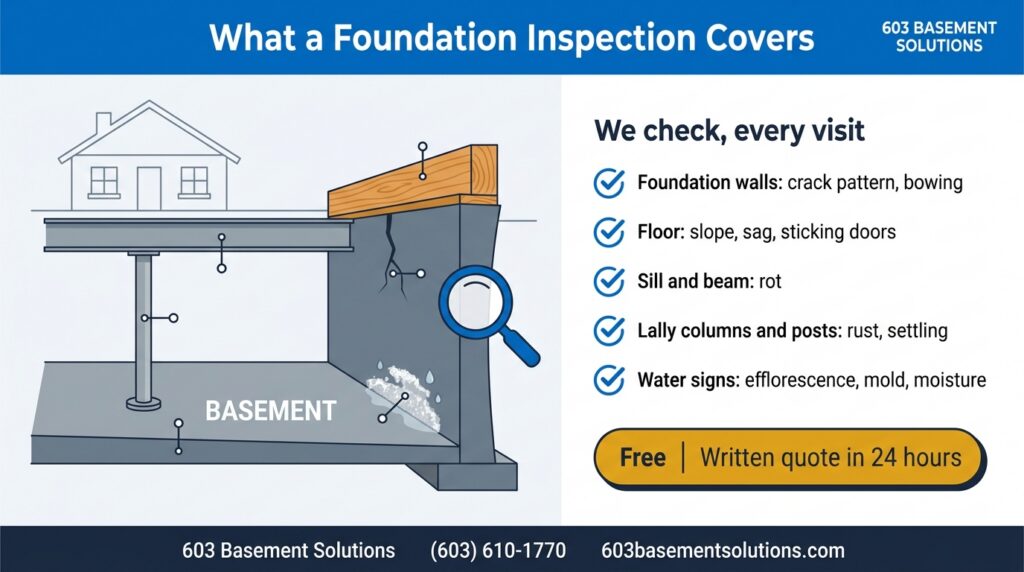
A good inspection is not someone glancing at a wall and quoting a number. It is a structured look at the parts of your house that carry load and the parts that let water in. On a 603 visit we go through the same checklist every time, because the signs interact: a wet corner and a leaning wall are not two problems, they are usually the same problem.
Here is what gets checked.
The foundation walls
We read every wall for cracks, and the pattern of the crack matters more than the fact that one exists. Inspectors note crack width, direction, and whether it is growing, because that is what separates a harmless shrinkage line from a structural one (JES Foundation Repair).
- A clean horizontal crack across the middle of the wall is a lateral-pressure sign, and on a block or CMU wall it usually means the soil outside is pushing the wall in. That is the one we treat as serious.
- Poured concrete walls more often crack vertically (shrinkage as the concrete cured) or diagonally. Those are not automatically structural, but a diagonal crack running from the corner of a window or door opening gets a closer look.
- Stair-step cracks following the mortar joints in block or brick point to differential settlement, one part of the foundation dropping faster than another.
We also check whether the wall is bowing or leaning inward. Most professionals treat a wall that has moved roughly an inch or more as a serious structural condition, not a watch-and-wait one (USANova). If we see that, we will talk through the structural fixes that hold a wall and stop the movement. We cover those in depth on our page on bowing foundation walls and horizontal cracks, and on our foundation crack repair page.
Settling and the floor
Settling shows up underfoot before it shows up on a wall. A real inspection measures floor slope rather than eyeballing it, because a level placed across the slab shows exactly how much elevation change there is and whether the drop is in one spot or spread across the room (Helicon). We look for floors that sag, bounce, or slope, gaps opening where the wall meets the floor (the floor wall joint), and doors or windows that suddenly stick or will not latch, which is often the first thing a homeowner notices when a foundation starts to move.
The support posts and columns
In a lot of older New Hampshire homes the main carrying beam sits on lally columns (the steel posts in the basement). We check those for rust at the base, for posts that have shifted off plumb, and for any that have been shimmed or “fixed” with a stack of blocks. A failing column transfers its problem to the floor above as a sag or a bounce. If a column needs replacing or adding, we cover what that involves on our lally column page.
The sill and the wood
Where the wood frame meets the top of the foundation is the sill (the sill beam or sill plate). In older Seacoast and fieldstone homes this is a classic failure point: years of moisture wicking up from a damp basement rot the sill, and the framing above loses its bearing. We probe the sill for soft, punky, or visibly rotted wood, and check the band joist and the bottoms of posts for the same. When the sill is gone, it gets replaced before anything resting on it can be trusted. See our rotting sill beam page.
The crawl space and the water story
Structural problems and water problems share a root cause here in New Hampshire, so we read the water signs too: standing water, efflorescence (the white mineral crust on block), mold, and high humidity. A structural engineer’s checklist includes moisture intrusion and soil-movement signs for exactly this reason (Stone Building Solutions). In a crawl space we are looking at the same things in tighter quarters: a wet dirt floor, rotting framing, and supports sitting in damp.
Why New Hampshire makes this worse
Most of what we find traces back to two local forces. The freeze-thaw cycle drives water into the soil around your foundation, freezes it, and the expanding ice pushes against the wall, then thaws and lets the soil settle, over and over through the winter. New Hampshire winters run that cycle dozens of times a season. Add a high water table and old foundations that were never built to current standards, and you get the lateral pressure that bows block walls and the moisture that rots sills. The mechanism is well documented: water in frost-susceptible soil freezes, expands, and forms ice lenses that push against and heave whatever is above them (Frost heaving, Wikipedia). That is why a NH foundation inspection is not the same as one in a warm-climate slab market.
Signs you need a foundation inspection
You do not need to wait for something to fall down. Any one of these is a reason to get eyes on the foundation. Several of them together is a reason to do it now, because settlement is rarely judged on one symptom alone (Angi).
- A horizontal crack running across a basement wall, or a stair-step crack in block or brick.
- Any crack wider than about a quarter inch, or one that keeps growing, reopens after you patch it, or runs diagonally from the corner of a door or window.
- A wall that bows, bulges, or leans inward.
- Doors and windows that suddenly stick or will not latch, especially several on the same side of the house at the same time.
- Floors that sag, bounce, or slope, or a gap opening up where the wall meets the floor or ceiling.
- Soft, rotting, or punky wood at the sill, or lally columns that are rusting, shifting, or propped up with blocks.
- A damp, musty, or actively wet basement or crawl space, white efflorescence on the block, or mold.
- A chimney pulling away from the house, or nails popping out of the drywall upstairs.
There are also two moments when an inspection is worth doing even with no symptoms: before you buy a home, so a foundation problem does not become your problem after closing, and before you list one, so the buyer’s inspector does not get to set the price for you. A pre-listing check takes the guesswork, and the buyer’s negotiating room, off the table (Rocket Mortgage).
For the fuller, ranked version of these symptoms, from “watch it” to “act now,” see our guide to the signs of foundation failure in an older New Hampshire home.
What to expect from a 603 inspection
Here is how it actually goes.
- You call or book. Phone is (603) 610-1770. Tell us what you are seeing and roughly when it started. If doors started sticking last spring, that timing tells us something.
- We come to you. We walk the basement, the crawl space, and the foundation walls inside and out. We measure floor levels, read the cracks, check the sill, the columns, and the water story, and we take photos so you can see what we are seeing.
- We tell you straight. If it is cosmetic, we will say so and you will not get a sales pitch. If it is structural, we will show you why and walk you through the fix and the order it needs to happen in.
- You get a written quote within 24 hours. Itemized, with the scope spelled out, so you can compare it against anyone else.
When the fix involves the structural work, we self-perform it with our own crew. The helical and push piers that stabilize a settling foundation, the carbon-fiber and bracing that hold a bowing wall, the sill and column work, that is our people, not a subcontractor we hand you off to. We hold ourselves to it because our name is on both the inspection and the repair. (We are licensed and insured; New Hampshire does not issue a general contractor license number.) If piers turn out to be the answer, our helical piers page explains how they work and how we install them.
What a foundation inspection costs
For us, zero. The 603 foundation inspection is free, and the written quote comes within 24 hours. That is the real offer, not a teaser.
For context on what these inspections cost elsewhere: a paid structural-engineer foundation inspection starts at $1,200 but can run easily up to $2000, averaging roughly $1,500 with engineers charging $100 to $500 per hour for visits that usually take one to two hours. Larger homes, finished basements, and pier-and-beam foundations push that higher because they are harder to access and slower to read.
A paid engineer’s report is the right call when you need a stamped, independent opinion for a lender, a lawsuit, or a permit. For figuring out whether you have a problem and what to do about it, a free inspection from the crew that would do the repair gets you the same diagnosis and an actual price, at no cost. The repair itself is where the money goes, and we will not know that number until we have looked. The honest answer to “what will it cost to fix” is that it depends entirely on what we find, which is the whole reason the inspection comes first.
Frequently asked questions
Is a 603 foundation inspection really free?
Yes. The inspection costs you nothing, and you get a written, itemized quote within 24 hours. There is no fee and no obligation to hire us. We make our money on the repair, so the inspection is how we earn that work, not a service we charge for.
How long does a foundation inspection take?
Usually about one to two hours for a typical home, in line with how long professional inspections run generally (This Old House). A larger house, a finished basement, or a hard-to-reach crawl space can take longer.
Do I need a structural engineer or is a contractor inspection enough?
For deciding whether you have a problem and what the fix is, a free inspection from a foundation contractor gets you a clear diagnosis and a real price. You need a licensed structural engineer’s stamped report when a third party requires an independent opinion: a mortgage lender, an insurance claim, a permit, or a legal dispute (Angi). The two are not in conflict; a contractor inspection often comes first, and we will tell you if your situation calls for an engineer’s stamp.
Are all foundation cracks a problem?
No. Hairline cracks under about an eighth of an inch are usually normal, and poured-concrete walls commonly get thin vertical shrinkage cracks as the concrete cures (Rocket Mortgage). What gets our attention is a horizontal crack across the wall (a lateral-pressure sign, especially in block), a crack that is wider than a quarter inch, one that is actively growing, reopens after patching, or runs diagonally from a door or window corner. That is the difference an inspection sorts out.
When should I get a foundation inspection?
Get one as soon as you notice a warning sign: a horizontal or stair-step crack, a bowing wall, doors that suddenly stick, sloping or bouncing floors, a rotting sill, or a wet basement. Also get one before you buy a home, so a foundation issue does not transfer to you, and before you sell, so a buyer’s inspector does not use it to drive your price down (Rocket Mortgage).
What areas does 603 cover for foundation inspections?
We cover the New Hampshire Seacoast, Rockingham County, southern Maine, and northeastern Massachusetts, working out of East Kingston, NH. Call (603) 610-1770 to book a free inspection.
603 Basement Solutions. Free foundation inspection, written quote in 24 hours, structural work self-performed by our own crew. (603) 610-1770. Serving the NH Seacoast, Rockingham County, southern Maine, and northeastern Massachusetts. Licensed and insured.