

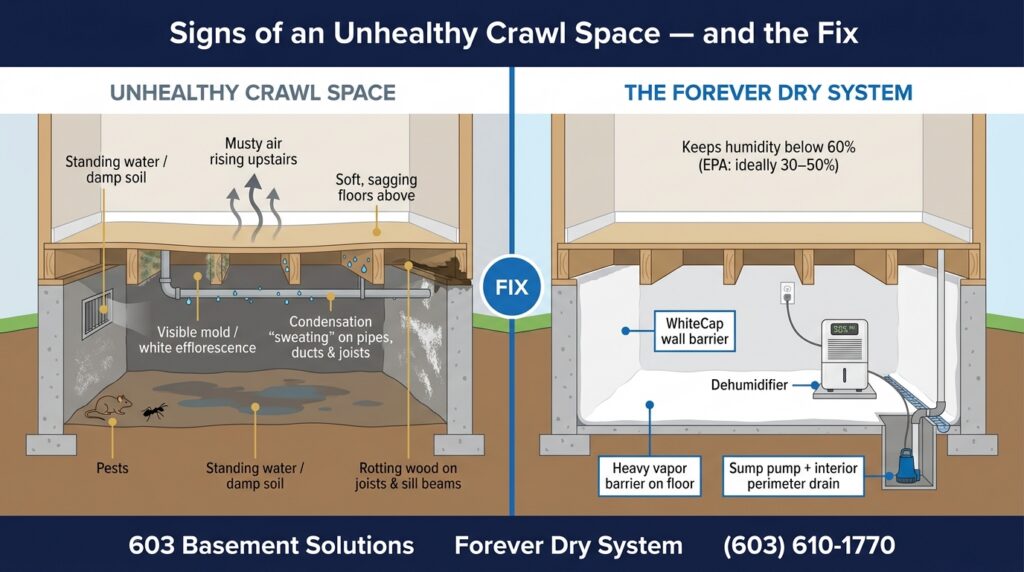
An unhealthy crawl space shows up as standing water or damp soil, a musty earthy smell, visible mold or white efflorescence, condensation or “sweating” on pipes and framing, soft or sagging floors above, rotting wood, pests, and rising heating and cooling bills. In New Hampshire, a high water table, spring snowmelt, and the freeze-thaw cycle make these signs common, especially in older Seacoast homes with a dirt-floor or fieldstone-foundation crawl space. Almost all of it comes back to one thing, moisture that never dries out, and almost every sign is fixable by controlling that moisture rather than just cleaning up after it.
The Quick Version
Here is the whole checklist up front. If your crawl space has even a couple of these, it is holding too much moisture and worth a look.
- Standing water or damp soil, or a dirt floor that never dries out
- A musty, earthy smell in the crawl space or drifting up into the rooms above
- Visible mold or white powdery efflorescence on framing, subfloor, or walls
- Condensation or “sweating” on pipes, ductwork, and joists, especially in summer
- Soft, bouncy, or sagging floors in the rooms above
- Rotting or darkened wood on the joists, subfloor, or sill beams
- Pests (rodents, carpenter ants, termites) drawn to damp wood and easy access
- Rising heating and cooling bills with no other explanation
The sections below explain what each sign means, why New Hampshire makes it worse, and what actually fixes it.
Sign 1: Standing water, damp soil, or a dirt floor that never dries
A wet crawl space floor is the most direct warning sign there is. If you see standing water after rain or snowmelt, or the soil stays dark and damp between storms, the space is taking on more water than it can shed.
A bare dirt or gravel floor is a moisture source all by itself. Ground moisture rises straight up unless the floor is covered. The EPA puts it plainly: “Put a plastic cover over dirt in crawlspaces to prevent moisture from coming in from the ground.” That bare-earth condition is exactly what we find under a lot of older Seacoast homes in Exeter, Portsmouth, and Dover. New Hampshire piles on: the Seacoast and the low-lying parts of Rockingham County sit on a high water table that keeps soil damp year round, and spring snowmelt only makes it worse.
The fix is to stop the water and then seal the floor. The Department of Energy is specific: “Install a 6-mil polyethylene vapor diffusion barrier across the crawlspace floor to prevent soil moisture from migrating into the crawlspace.” Where the space actually takes on water, the barrier alone is not enough; you also need drainage and a sump pump to move the water out.
Sign 2: A musty, earthy smell anywhere in the house
That damp, basement-y smell is the smell of mold and moisture, and it does not stay in the crawl space.
Air does not sit still in a house. Warm air rises and pulls air up from the lowest level, so a meaningful share of the air you breathe upstairs starts down in the crawl space. That is why a musty crawl space can make a whole first floor smell off, and why a candle upstairs never really fixes it. The smell is a symptom; the source is below. When a space stays damp, mold grows, and that is what you are smelling. Until the moisture is under control, it comes back. You can read more about the dangers of an ignored, unhealthy crawl space.
Sign 3: Visible mold, white efflorescence, or fuzzy growth
If you can see mold, the space has been damp for a while. Mold needs a surface and sustained moisture, and a crawl space offers both.
There is a clock on it. The EPA notes that water-damaged materials should be dried within a day or two: “It is important to dry water-damaged areas and items within 24-48 hours to prevent mold growth.” A persistently damp crawl space never gets that dry-out, so mold takes hold and stays. The same guidance says to keep indoor relative humidity “below 60 percent (ideally between 30 and 50 percent),” so a hygrometer reading above about 60 percent is an objective warning sign, even before you can see any growth.
You may also see white, powdery deposits on masonry. That is efflorescence, the mineral salt left behind when water moves through concrete or block and evaporates. It is not mold, but it proves water has been passing through the wall.
Here is the part most people get wrong: you do not fix crawl space mold by cleaning it, you fix it by fixing the moisture. The CDC says it directly: clean up the mold and “fix the moisture problem,” and “keep humidity levels in your home as low as you can.” Cleanup without sealing and dehumidifying is how it comes right back.
Sign 4: Condensation or “sweating” on pipes, ducts, and joists
If the pipes, ductwork, or floor framing in your crawl space look wet or beaded with water even when nothing is leaking, that is condensation, a moisture warning sign.
The mechanism is dew point. The Department of Energy explains it: “Once air has reached its dew point, the moisture that the air can no longer hold condenses on the first cold surface it encounters.” The EPA flags the same thing as a sign to act on: “If you see condensation or moisture collecting on windows, walls or pipes act quickly to dry the wet surface.”
This one is very much a New Hampshire summer problem. On a warm, humid Seacoast day, hot outside air pours into a vented crawl space and hits the cool joists and ductwork, which are still close to ground temperature. The air cools, hits its dew point, and condenses right on the wood. Day after day, that is how a vented crawl space grows mold over a summer. Sealing the space off from that humid air and running a dehumidifier stops the sweating.
Sign 5: Soft, bouncy, or sagging floors above the crawl space
When the floor in a room over the crawl space feels soft, bounces when you walk across it, or visibly dips, the support underneath is giving out, and in an older NH home the cause is usually moisture below.
A few things can be happening at once. Sustained moisture weakens or rots the joists and subfloor that hold the floor up, and support posts can shift when they sit on damp, soft ground. New Hampshire adds frost heave, where the deep seasonal frost line lifts and shifts the soil and posts under the house and racks the framing. A little unevenness in a century-old house is normal, but a floor getting softer, springier, or more sloped over time is not. The only way to know which cause is yours is to get under the house and look.
Sign 6: Rotting or darkened wood on joists, subfloor, or sill beams
Darkened, soft, crumbling, or spongy wood in the crawl space means rot has started. Wood rot is caused by decay fungi, and decay fungi need one thing above all: sustained moisture in the wood. Wood that is kept dry does not rot. Keep it dry, and you protect the joists, subfloor, and sill beams that carry the house.
This is a recurring problem in older NH homes with fieldstone foundations, where the sill beam and support posts sit close to damp ground. A rotting sill beam is one of the most common things we find under those Seacoast houses, and it traces straight back to a crawl space that stayed wet too long. The fix is the same as everything else here: get the moisture out and keep it out, before a beam or joist has to be repaired or replaced.
Sign 7: Pests drawn to damp wood and easy access
Rodents, carpenter ants, and termites all like what an unhealthy crawl space offers: moisture, softened wood that is easy to chew, and an open dirt-floor space to nest in. So finding pests is also a moisture signal, and sealing and drying the space makes it far less inviting.
Sign 8: Rising heating and cooling bills
If your energy bills are creeping up with no other explanation, the crawl space can be the quiet reason. Damp air is harder and more expensive to heat and cool than dry air, so a humid crawl space makes your HVAC work harder all year. And as covered above, a good share of the air you pay to condition upstairs started down in the crawl space. Sealing and drying it takes that load off the house. You can read more about how crawl space encapsulation saves you money on heating and cooling.
Why a damp crawl space is a health issue, not just a comfort one
A crawl space that is growing mold can affect the health of the people living above it. Worth stating plainly, without scare tactics: the CDC is clear about the symptoms. Mold exposure can cause “a stuffy nose, sore throat, coughing or wheezing, burning eyes, or skin rash.” Some people react more than others: “People with asthma or who are allergic to mold may have severe reactions,” and “immune-compromised people and people with chronic lung disease may get infections in their lungs from mold.”
So the people most worth protecting are anyone with asthma, a mold allergy, a weakened immune system, or chronic lung disease. And since that crawl space air rises into the rooms above, a moldy crawl space is an air-quality problem for the whole house. The way to lower the risk is the same as everything else on this page: get the humidity down and keep it down. Of the signs above, standing water, a musty smell, visible mold, sagging floors, and rotting wood all mean “get it looked at”; sweating pipes, pests, and rising bills are “worth checking soon.” Any one that keeps getting worse is reason enough to call.
Why New Hampshire crawl spaces get this way
New Hampshire is harder on a crawl space than the national average, for reasons rooted in the local climate and housing stock.
The freeze-thaw cycle. Water in the soil and foundation cracks freezes, expands, and thaws all winter, working moisture deeper into the crawl space and stressing fieldstone foundations.
Frost heave. The deep seasonal frost line lifts and shifts soil, gravel floors, and the posts that sit on them, which can rack framing and leave floors out of level.
A high water table. Across the Seacoast and the low-lying towns of Rockingham County, the water table sits high enough to keep soil damp year round and put standing water on the floor after rain or snowmelt.
Older Seacoast housing stock. Many homes in Exeter, Portsmouth, Dover, Hampton, Stratham, and Kingston sit on fieldstone foundations with dirt or gravel crawl space floors, the bare-earth condition the EPA flags as a ground-moisture source. Put it all together and the wet shoulder seasons, March through May, are when most Seacoast homeowners first notice the musty smell, the standing water, or the damp floor.
How 603 fixes it for good
We fix an unhealthy crawl space by controlling the moisture, not by cleaning up after it. That is the difference between a space that stays dry and one that is musty again by next spring.
For a crawl space that needs it, we install a fully sealed crawl space encapsulation: a premium 12-mil WhiteCap vapor barrier on the walls, a heavier 20-mil WhiteCap vapor barrier on the floors, and dimpled drainage matting underneath the 20-mil floor so any water drains through to the sump. We seal every seam of the vapor barrier system with high-quality spray-foam insulation, then pair it with a sump pump to move water out and a dedicated dehumidifier to hold the humidity low enough that mold and wood rot cannot get going. It lines up with the building science on this page: cover the bare dirt, seal out soil moisture, stop the dew-point sweating, and keep relative humidity down where the EPA and CDC say it belongs.
You can see the full scope of our crawl space services, or read up on what crawl space encapsulation is and how it protects your home from moisture and radon. What does it cost? Crawl space encapsulation runs from $3,000 to $25,000, depending on the size of the space and how much water intrusion there is. We give you a written quote with real numbers after a free inspection, so you are never guessing. We back the encapsulation with a 25-year warranty on the liner, the wall barriers, and our workmanship. We are a licensed and insured New Hampshire company and a state-certified radon mitigation contractor. And because we are local, when the dehumidifier or sump pump needs service down the road, the crew that installed it is the one who comes back.
Frequently asked questions
What are the signs of an unhealthy crawl space? Standing water or damp soil, a musty earthy smell (often noticed upstairs), visible mold or white efflorescence, condensation or “sweating” on pipes and joists, soft or sagging floors above, rotting wood, pests, and rising energy bills. Most trace back to one cause: too much moisture that never dries out. The EPA notes indoor humidity should stay below 60 percent and that wet areas should dry within 24 to 48 hours to prevent mold.
Why does my crawl space smell musty? A musty smell is due to the presence of moisture in the insulation and the wood. Because air rises and pulls up from the lowest level, that crawl space air and its smell travel into the rooms above. Air fresheners do not fix it for long, because the source is the moisture below. The lasting fix is to seal the space and keep the humidity down.
Is a damp crawl space actually bad for my health? It can be. The CDC says mold exposure can cause a stuffy nose, sore throat, coughing or wheezing, burning eyes, or skin rash, that people with asthma or a mold allergy may have severe reactions, and that immune-compromised people and people with chronic lung disease can get lung infections from mold. Because crawl space air rises into the living space, a moldy crawl space is also an air-quality issue for the whole house.
Why does my crawl space sweat in summer? That is the dew point at work. When warm, humid New Hampshire summer air meets the cool joists, ductwork, and pipes in a vented crawl space, the air cools to its dew point and water condenses on those cold surfaces. The Department of Energy describes moisture condensing “on the first cold surface it encounters.” Sealing the space off from the humid air and running a dehumidifier stops it.
Will covering the dirt floor with plastic fix a wet crawl space? A 6-mil polyethylene vapor barrier is a key step, and it is what the Department of Energy recommends to stop soil moisture from migrating up. But a barrier alone is not always enough. If the space takes on standing water from a high water table or spring snowmelt, you also need drainage and a sump pump to move the water out, plus a dehumidifier. And cleaning existing mold without fixing the moisture does not last: the CDC’s guidance is to clean up the mold and fix the moisture problem, or it grows right back. A free inspection sorts out the right combination for your home.
Get a free inspection
If your crawl space is wet, musty, sweating, or growing mold, the fix starts with knowing exactly what is going on under your house. 603 Basement Solutions gives you a free inspection and a written quote back within 24 hours. No pressure, and no selling you a bigger job than the space needs. If you are in Exeter, Portsmouth, Dover, or anywhere across the Seacoast, give us a call: (603) 610-1770.
Ready to experience your dream basement? We will tell you straight what your crawl space needs, and what it does not.
Related: Crawl space services · What is crawl space encapsulation? · The dangers of an ignored, unhealthy crawl space · How encapsulation saves you money on heating and cooling