
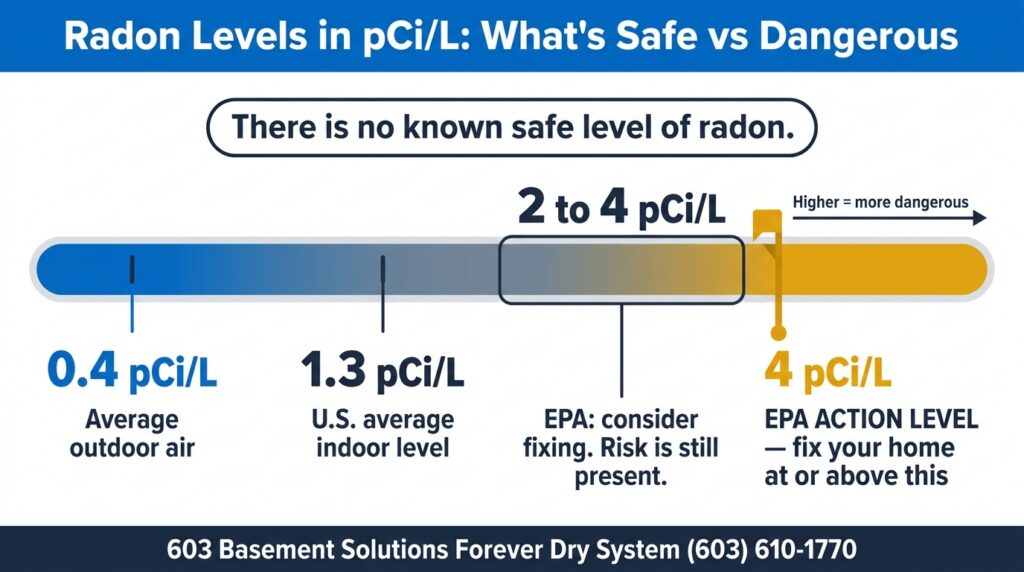
The EPA action level for radon is 4 pCi/L: if your home tests at or above that, the EPA recommends you fix it. There is no known safe level of radon, and New Hampshire’s granite bedrock makes it a real concern statewide, which is why every home here should be tested no matter what town it sits in.
Radon is an invisible, odorless radioactive gas. You can’t see it, smell it, or taste it, and the only way to know your level is to test. Below we walk through what counts as a safe radon level, what counts as dangerous, why NH homes tend to run higher, and how the gas gets into your basement in the first place.
We’re 603 Basement Solutions, a state-certified radon mitigation contractor on the Seacoast. We test and mitigate radon in-house across New Hampshire, Maine, and Massachusetts. Here’s the straight version of what you need to know.
The Quick Version
- The EPA action level is 4 pCi/L. Fix your home if you test at or above it. (Source: EPA)
- Consider a fix between 2 and 4 pCi/L too. There is no known safe level.
- The U.S. average indoor level is about 1.3 pCi/L; outdoor air averages about 0.4 pCi/L.
- Radon is the second leading cause of lung cancer overall and the number one cause among non-smokers, tied to about 21,000 deaths a year in the U.S. (Source: EPA)
- NH’s granite bedrock makes radon a real risk statewide. The only way to know your number is to test.
What is a “safe” radon level?
There is no known safe level of radon. The EPA is clear that any exposure carries some risk, and even levels below 4 pCi/L still pose some risk. So “safe” is really about how low you can get it, not a line where the danger turns off.
That said, the EPA does give you working thresholds. Radon is measured in picocuries per liter of air, written pCi/L. Here’s how the EPA reads those numbers.
| Your radon level | What the EPA recommends |
|---|---|
| 4 pCi/L or higher | Fix your home. This is the action level. |
| Between 2 and 4 pCi/L | Consider fixing your home. Risk is still present. |
| About 1.3 pCi/L | The U.S. average indoor level. |
| About 0.4 pCi/L | The average level in outdoor air. |
Source for all four rows: A Citizen’s Guide to Radon, U.S. EPA.
A few things to take from that table. First, your home is going to have some radon in it. The goal of mitigation isn’t zero, it’s getting the level down as low as you reasonably can, and at minimum below the 4 pCi/L action line. Second, the gap between a “consider it” reading of 2 to 4 and the U.S. average of 1.3 is small, which is why testing matters. You can’t eyeball this. A house that looks and feels fine can still test high.
Why radon is dangerous
Radon is the second leading cause of lung cancer in the United States, behind only smoking, and it’s the number one cause among people who have never smoked. The EPA and the Surgeon General estimate radon is responsible for about 21,000 lung cancer deaths in the U.S. every year. The CDC puts it at more than 21,000.
Here’s the part that makes it sneaky. Radon doesn’t make you cough or give you a headache the way a gas leak might. There’s no smell and no immediate symptom. The damage is long-term: you breathe the gas in over years, the radioactive particles decay in your lungs, and the risk of lung cancer climbs with the dose and the time. That’s why a finished, lived-in basement raises the stakes. The more hours you spend down there, the more exposure you’re getting.
We’re not telling you this to scare you. The risk is real, but it’s also one of the most fixable health hazards in a house. You test, and if the number is high, you mitigate. Sources: EPA, Health Risk of Radon and CDC, About Radon.
Why New Hampshire homes are higher risk
New Hampshire sits on granite and metamorphic bedrock, and that rock is naturally uranium-bearing. Uranium decays into radon over time. That’s the geology behind the Granite State’s reputation as a high-radon state: the gas is being generated right under your feet, and it works its way up into homes through the soil.
A few NH-specific things stack on top of that geology and make our basements worth testing:
- Older fieldstone and rubble foundations. A lot of the Seacoast and Rockingham County housing stock predates poured concrete. Unsealed fieldstone foundations and cracked slabs give radon plenty of open pathways into the basement.
- Freeze-thaw and frost heave. NH winters crack slabs and foundation walls over the years. Every new crack is a potential radon entry point, which is one reason periodic retesting makes sense even if you tested clean before.
- High water table. Across Exeter, Hampton, Stratham, and Portsmouth, a lot of homes have a sump pit because the water table sits high. That open pit is a classic radon entry point, and any mitigation has to seal and depressurize it.
- Private wells. Many NH homes draw from private bedrock wells instead of municipal water. Radon can dissolve into well water and then get released into the air when you shower or run the laundry, so there’s a secondary exposure path here that town-water homes don’t have.
- Finished basements. Finished lower levels are common on the Seacoast. Radon matters most where people actually spend time, so an untested finished basement is exactly where you’d want to check.
Now, the honest caveat. There are widely cited NH-specific radon statistics floating around, things like the share of NH homes that test above the action level and the estimated state average. We’re not going to print a number we couldn’t verify from the original state source. What we can say plainly: because of the granite bedrock, NH is widely considered a high-radon state, and that’s reason enough to test your home.
Where radon risk is highest in NH
Short answer: high enough that you should test no matter where you live. The EPA publishes a map of radon zones, but it’s explicit that the map should not be used to decide whether an individual home needs testing. Their guidance is simple: no matter where you live, test your home, because it’s easy and inexpensive. (Source: EPA Map of Radon Zones.)
That’s the key point for NH homeowners. Two houses on the same street can test very differently, because radon depends on the specific soil, the foundation, and the cracks under that particular home, not on a regional average. A zone map can’t tell you what’s happening in your basement. A test can.
We know southeastern and eastern New Hampshire, including Rockingham County, tend to get talked about as higher-risk areas. There are specific town and county figures in circulation, but those trace back to state data we couldn’t independently confirm, so we’re leaving the hard numbers out rather than repeat something we can’t stand behind. If you’re in Exeter or the next town over and you’re wondering about your home specifically, the answer is the same as it is everywhere: test it.
For more on how those numbers work, see our guide to understanding radon levels and what’s safe versus dangerous.
How radon gets into your basement
Radon is a gas that comes up out of the ground, so your basement is its front door. The CDC describes radon as a naturally occurring gas released from rocks, soil, and water that gets into homes through small cracks or holes. In a typical NH basement, the entry points are:
- Cracks in the slab and foundation walls. The most common path. Hairline cracks you’d never notice are wide open to a gas.
- The sump pit. An open or loosely covered sump basin connects directly to the soil and the water table. On the Seacoast, where high water tables make sumps common, this is a major one.
- Fieldstone and rubble foundations. Older NH homes with unsealed fieldstone walls have countless gaps between stones, and radon moves through all of them.
- Gaps around pipes and the floor-wall joint. Anywhere the slab meets the wall, or a pipe penetrates the floor, is a potential pathway.
- Well water. As covered above, radon dissolved in private well water can off-gas into the air indoors during showers and laundry.
If any of this sounds like the same list of openings that let water into a basement, that’s because it is. The cracks, the sump, and the unsealed fieldstone that let radon in are the same ones we deal with when we waterproof. For the basics of the gas itself, our explainer on what radon is and why it’s the invisible threat in your home covers it.
How to test for radon
Testing is the only way to know your level. You can’t see or smell radon, and there’s no home symptom that reliably tells you it’s there. Here’s how testing works.
- Short-term tests sit in your home for a few days and give you a fast snapshot. They’re a good first step.
- Long-term tests stay in place for more than 90 days and give a better picture of your year-round average, since radon levels swing with the seasons and how the house is sealed up.
- Confirm before you act. A single reading, especially a short-term one, usually gets confirmed with a follow-up test before you commit to mitigation. Results are reported in pCi/L, the same unit as the EPA thresholds above.
- Test every home, every zone. Per the EPA, location on a zone map doesn’t get you off the hook. Every home should be tested.
You can test yourself with a kit, or have it done professionally. As a state-certified radon mitigation contractor, we offer in-house radon testing for $50 as well as mitigation, so the same crew that measures your level can fix it if it comes back high. We’re one of several local companies that handle radon (Erickson and Groundworks do too), so get a couple of opinions and compare.
How radon is fixed
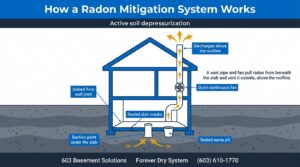
The standard fix is a system called active soil depressurization. In plain terms, a vent pipe and a fan create negative pressure beneath your foundation slab, which pulls radon out from under the house and vents it outside above the roofline before it can get into your living space. It’s a proven method, and it’s the one used in most homes. Sources: EPA, A Citizen’s Guide to Radon and This Old House.
Sealing matters too. A good mitigation job seals the cracks in the slab, tightens up the sump cover, and closes the gaps where the gas was getting in, so the fan can do its job efficiently. That’s the overlap with our day-to-day work: the same sealing and sump detailing that keeps a basement dry also helps a radon system pull a clean vacuum under the slab. If your basement has water issues and a radon reading at the same time, it often makes sense to look at both together. You can read more about our approach to radon mitigation in New England, and the details of our radon mitigation service on our main page.
What radon mitigation costs
Radon mitigation in New Hampshire generally runs between $900 and $6,000, depending on the size of your home, the foundation type, and how many entry points have to be sealed. A simple slab on the low end, an older fieldstone basement with multiple pathways toward the higher end. The exact number depends on your home, which is why we’d rather look at it first and give you a written quote within 24 hours than guess at it here. Our mitigation systems carry a 10-year warranty on system integrity and components. One honest note: we don’t promise a specific post-mitigation radon number unless we put it in writing, because the final level depends on your house. We’re radon-certified (cert RMS-113966), and the good news is that mitigation is one of the more affordable health fixes a house can need. For more on the cost side, see our breakdown of the average cost of a radon mitigation system.
Frequently asked questions
What is a dangerous radon level?
The EPA action level is 4 pCi/L. At or above that, the EPA recommends you fix your home. But there’s no known safe level, and the EPA suggests considering a fix even between 2 and 4 pCi/L. So treat anything at or above 4 as a clear signal to act, and anything in the 2 to 4 range as worth addressing. (Source: EPA, A Citizen’s Guide to Radon.)
What is the average radon level in a home?
The U.S. average indoor radon level is about 1.3 pCi/L, and outdoor air averages about 0.4 pCi/L. Your home could be well above or below that average, which is why an average doesn’t replace testing your own house. (Source: EPA.)
Is radon worse in New Hampshire?
NH is widely considered a high-radon state because it sits on uranium-bearing granite bedrock, and uranium decays into radon. That said, radon risk comes down to the individual home, not the region, so the EPA recommends testing every home regardless of location.
Can radon come in through my well water?
Yes. Many NH homes use private bedrock wells, and radon can dissolve into well water and then release into the air when you shower or do laundry. It’s a secondary exposure path on top of the gas that comes up through the soil and foundation.
How is radon removed from a home?
The standard method is active soil depressurization: a vent pipe and fan create negative pressure under the foundation, pulling radon out from beneath the house and venting it outside above the roofline. Sealing slab cracks and the sump pit helps the system work better. (Sources: EPA and This Old House.)
How often should I retest for radon?
Retesting makes sense periodically, especially in NH, because freeze-thaw cycles and frost heave open new cracks in slabs and foundation walls over time, and those are new entry points. It’s also worth retesting after any major foundation or basement work, or after installing a mitigation system to confirm the level dropped.
Get a free inspection
Worried about radon in your basement? We’ll take a look, no pressure. As a state-certified radon mitigation contractor, 603 Basement Solutions offers free on-site inspections, in-house radon testing ($50), and mitigation across New Hampshire, Maine, and Massachusetts, and we’ll get you a written quote within 24 hours. The on-site inspection and written estimate are free; the radon test itself is $50.
Call us at (603) 610-1770 for a free on-site inspection and written estimate (radon testing is $50). If you’re in Exeter or the next town over, we’ve probably worked on your street.
New Hampshire sits on granite, so radon runs high here. Testing is cheap and we will tell you your number straight.
Read more about radon mitigation, or see what we do in Manchester · Portsmouth · Exeter.
Call 603-610-1770 or book your free inspection. Free estimate, written quote within 24 hours.