
Quick Answer
603 installs helical piers for existing foundation repair at $2,700 per pier for the first three, then $2,200 per pier after that. A typical New Hampshire structural piering job lands between $12,000 and $18,000 all in. The total comes down mainly to how many piers it takes to stop the settling and carry the house.
This page owns the cost question for a house that has already moved. If you are planning an addition, deck, porch, garage, or new foundation, use our new-construction helical pier guide. New work starts with a designed load path; repair work starts with measuring an existing structure.
Why Homeowners Choose 603 for Helical Piers
603 self-performs every lift in-house. The crew that scopes the repair is accountable for the installation, torque records, and warranty. A single settling corner takes fewer piers than a long failing wall, which is why an on-site count matters more than a generic average.
Helical pier cost by number of piers
| Number of piers | 603 installed price |
|---|---|
| 3 | $8,100 |
| 5 | $12,500 |
| 6 | $14,700 |
| 8 | $19,100 |
| 10 | $23,500 |
603 price schedule: $2,700 per pier for the first three, then $2,200 per additional pier. The totals above use that schedule; they are not industry averages. Your final count comes from the on-site foundation inspection.
How much do helical piers cost per pier?
At 603 the rate is $2,700 per pier for the first three, then $2,200 per pier after that. That covers the pier itself, the hydraulic install, and the steel bracket that ties it to your footing.
The per-pier number is the easy part. The count is what moves your total, and that gets decided on site, not off a price list.
What about cost per linear foot?
People search “helical pier cost per linear foot,” but that is not really how the job gets priced. The job is priced per pier, not per foot of wall. Depth is folded into the pier price: our pricing starts from a 14-foot pier, and the crew keeps going until the torque reading says the pier has reached soil that will carry the house. What you actually pay for is a finished, load-tested pier in the ground, priced one pier at a time.
How many helical piers do I need?
That depends on how much of the foundation is failing and how the weight is carried. Piers go in at regular spacing along the failing section. A dropping corner might take 3. Most structural piering jobs we quote start around 6, which is why a typical NH job lands in that $12,000 to $18,000 band. A long failing wall can need more. Nobody can give you the real count without measuring the movement on site, and that part is free.
Helical piers for a deck vs a foundation
These are two very different jobs. Holding up a settling house is underpinning, priced at the per-pier rate above. Setting piers for a new deck is new construction, a lighter job with no house to lift and far less digging. If you are pricing piers for a deck, a porch, or a new build, that is its own job. See helical piers for new construction and additions for that side of it.
What drives the price up or down
Two homes with the same crack can get very different bids. Here is what moves the number:
- How many piers. The biggest driver by far. More failing wall, more piers.
- Depth to solid soil. Shallow firm soil means shorter, faster piers. Deep soil means more steel and more time on the machine.
- Access. An open yard is quick. A pier the crew has to hand-dig in a tight spot takes longer and costs more.
- Soil and load. Ledge, dense fill, or a heavy two-story house can change pier size and count.
- Engineering and permits. Bigger jobs may need a stamped engineer’s report and a permit, and we tell you up front when yours will.
- Lift vs. stabilize. Stopping the movement is one price. Lifting the house back toward level is more involved.
Ask whether extra depth changes the per-pier price. That should be clear in writing before work starts.
Can you DIY helical piers?
For a small job, sort of. The little helical posts at the hardware store are fine for a shed or a small deck. For a settling house, no. Real underpinning needs an engineer, a hydraulic drive head, and torque readings to prove each pier reached load-bearing soil. That is not a weekend project, and getting it wrong under a house gets expensive fast. Honest version: buy the little post for the shed, call somebody for the house.
What a helical pier actually is
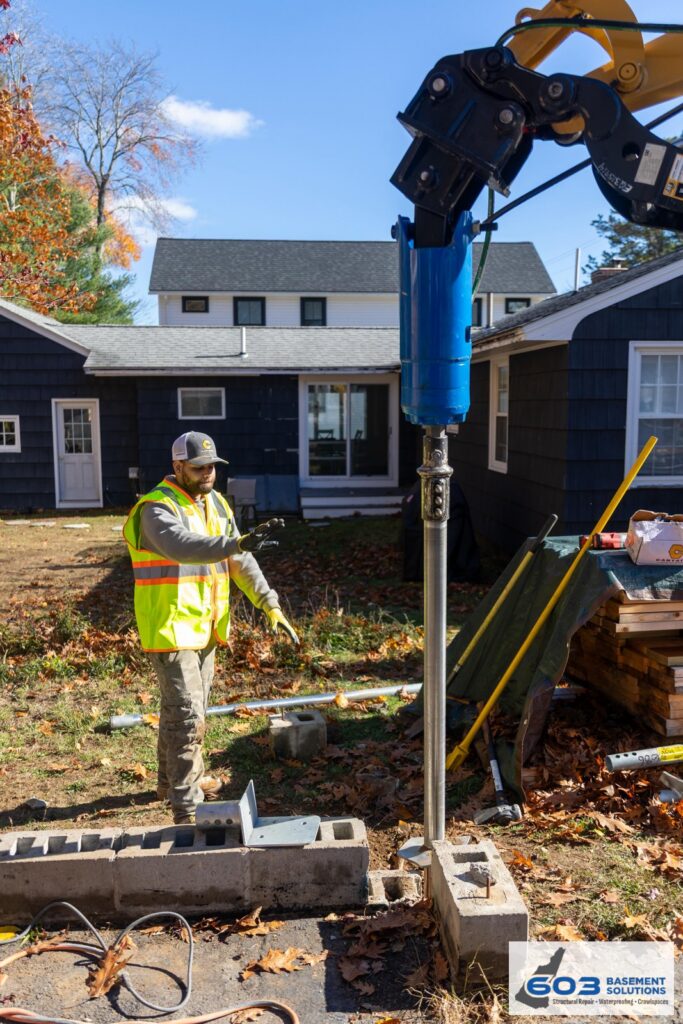
A helical pier is a steel shaft with one or more screw-shaped plates near the bottom. You will also see it called a helical pile, a screw pile, or a screw pier. Those are the same product, so a helical pile cost and a helical pier cost are the same number, and ours is the one above. Engineers and commercial work tend to say pile; residential contractors in the States tend to say pier. A crew drives it into the ground with a hydraulic motor, turning it like a giant screw until the plates reach soil firm enough to carry your house. A steel bracket then ties the pier to your foundation, and the weight of the home transfers off the bad soil and onto the pier.
Two things make them a go-to fix for a settling foundation. The capacity is measured, not guessed: the harder the soil pushes back as the pier turns, the more it holds, and the crew watches that torque as they install. And they work year-round, because there is no concrete to pour and cure, which matters in a state where the ground freezes for months. Push piers are the other steel option, better suited to heavy or multi-story homes with poured footings; see structural & foundation repair for how they compare.
How the install works
For most homeowners it is faster and less disruptive than they expect, usually a matter of days, not weeks:
- Assessment. A 603 estimator inspects the foundation, measures the movement, and works out how many piers you need and where.
- Layout and small excavation. The crew marks the pier spots and digs a compact hole down to the footing at each one.
- Drive the piers. Each pier screws into the ground until it hits the torque that proves it reached load-bearing soil.
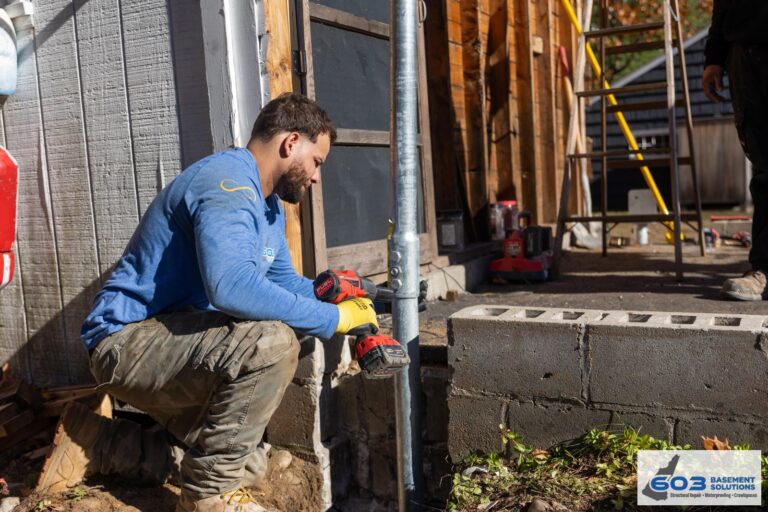
- Attach the brackets. A steel bracket connects each pier to your footing.
- Transfer the load, and often lift. The home’s weight shifts onto the piers. Where it is safe, the foundation is raised back toward level.
- Backfill and clean up. The holes get filled, the area restored, and the crew walks you through the finished work.
The repair is designed to stabilize the treated area on verified bearing. Because 603 runs the work with its own crew, the people who measured the problem are accountable for the installation.
How long helical piers last, and the warranty
603 backs helical-pier work with a 25-year engineered-performance warranty. It can transfer to a new owner as long as another contractor or the homeowner has not altered the installed work. Keep the proposal, installation record, and warranty with the house records.
Are helical piers worth it?
If measurements show active settlement, compare the repair with continued movement in the treated area. Cracks, sticking doors, and sloping floors can keep changing. Piers are designed to stabilize that movement, and a controlled lift may recover some position where the structure allows it.
Helical pier cost in New Hampshire, Maine & Massachusetts
603 Basement Solutions installs helical piers across New Hampshire, southern Maine, and northeastern Massachusetts, out of East Kingston, NH, at $2,700/pier for the first three, then $2,200/pier. We self-perform the whole install, so no subcontractor is driving your piers. The only way to get your real number is a free on-site assessment where we count the piers your home actually needs. Call 603-610-1770 or schedule your free inspection.
Frequently asked questions
How much does it cost to install helical piers?
603 installs at $2,700 per pier for the first three, then $2,200 per pier after that. Your total depends mostly on how many piers your foundation needs: a single-corner fix is a few piers, and a typical NH structural piering job runs $12,000 to $18,000 or more all in.
How many helical piers do I need?
It depends on how much of the foundation is failing and how the load sits. A dropping corner might need 3, and most jobs we quote start around 6. A 603 estimator confirms the count on site.
How much do helical piers cost for a deck?
A lot less than a foundation repair, because there is no house to lift and far less digging. That work is priced as new construction; see our new-construction helical pier guide, and we quote it after a look at the site.
How much does a helical pile cost?
The same as a helical pier, because they are the same thing. At 603 that is $2,700 per pile for the first three, then $2,200 per pile after that. A typical New Hampshire structural piering job lands between $12,000 and $18,000 once you count how many the house actually needs. If a quote you are comparing says pile and ours says pier, you are comparing like for like.
How deep do helical piers go?
As deep as it takes to reach soil firm enough to carry the house, and our pricing starts from a 14-foot pier. The crew confirms it by the torque the pier reaches during the install, not by a fixed depth.
Can I install helical piers myself?
Small hardware-store helical posts are fine for a shed or a small deck. Underpinning a house is not a DIY job; it needs an engineer and hydraulic equipment to install and verify each pier.
Are helical piers worth it?
For an actively settling foundation, yes. They stop the movement for good, often recover some level, and 603’s work carries a 25-year transferable warranty.
How long do helical piers last?
Galvanized steel driven into stable soil lasts for decades. 603 backs the install with a 25-year engineered, transferable warranty.
Can helical piers be installed in winter?
Yes. There is no concrete to cure, so 603 installs them year-round, including a New England winter.
Schedule your free foundation assessment →
See also: structural & foundation repair · helical piers service · helical piers for new construction · lally column cost