
603 Basement Solutions logo

Horizontal Crack in a Basement Wall? What It Means and How to Fix It

A foundation wall bows when the soil and water outside push against it harder than the wall can resist. In New Hampshire that sideways pressure usually comes from saturated soil (hydrostatic pressure), freeze-thaw and frost heave, and expansive clay soils. A bowing wall is a structural problem, not a cosmetic one, and it needs a professional look.

If you have noticed a wall in your basement curving inward, a horizontal crack running across it, or a bulge that was not there last year, you are not imagining it and you are not overreacting. That wall is telling you the ground outside is winning. The good news is that bowing walls are a known problem with known fixes, and most of them do not mean tearing out your foundation. Here is what is actually happening, why the Seacoast is hard on basement walls, and how a wall like yours gets stabilized.

The Quick Version

What a horizontal crack in a basement wall means

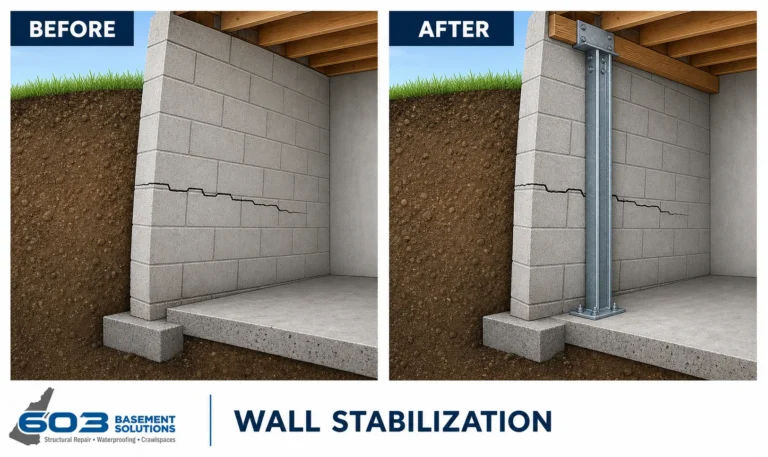
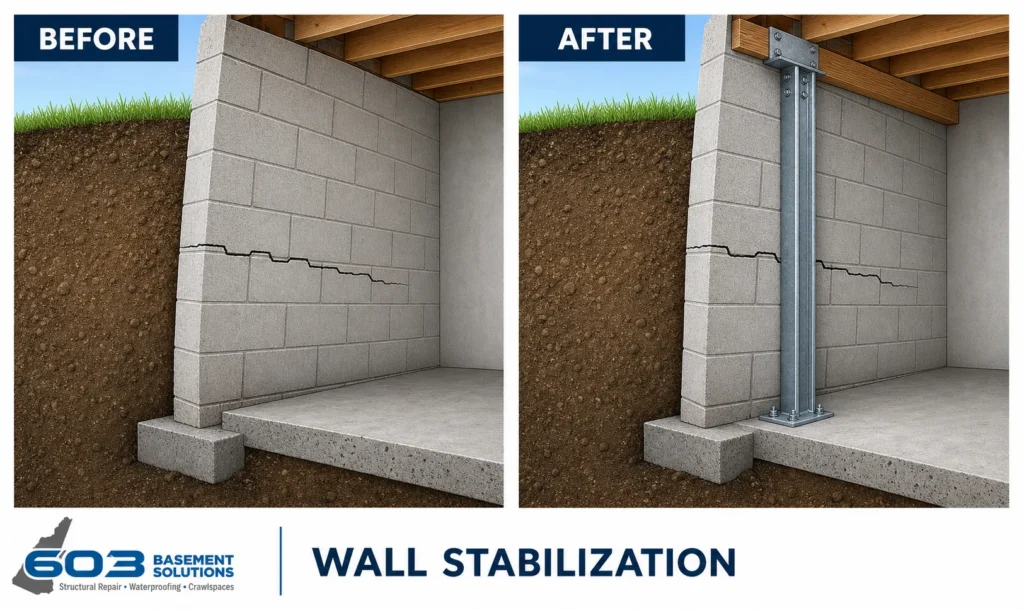
A horizontal crack running across a basement wall almost always means the wall is bowing inward under pressure from the soil and water outside it. It is a structural warning sign, not a cosmetic one, and it usually shows up first about midway up the wall, where the bending stress is highest. The crack is not the thing you fix. The pressure bending the wall is. The good news: caught early, most horizontal cracks are stabilized without replacing the foundation, often with carbon fiber straps installed from the inside. As This Old House puts it, horizontal cracks are “usually caused by the lateral pressure exerted by the soil surrounding the foundation,” and “if left unaddressed, horizontal cracks can lead to bowing or bulging walls.”

  • Why it bows: sideways pressure from soil and water outside the wall, not normal aging. This Old House calls horizontal cracks the lateral-pressure warning sign and says they can lead to “bowing or bulging walls.”
  • The NH drivers: saturated soil and a high water table (hydrostatic pressure), frost heave and freeze-thaw (the soil freezes, expands, and pushes), and clay-rich soils that swell when wet.
  • It is structural. This Old House is blunt: “Any noticeable inward bending or bowing of foundation walls is a serious issue that requires professional inspection.” Patching the crack or painting the wall does not relieve the pressure.
  • How it gets fixed: carbon fiber straps for minor bowing, and steel I-beam braces or wall anchors and helical tiebacks into stable soil for more severe movement. The two most involved options are rebuilding the wall (the most expensive) and, second to that, an auxiliary wall (we build a new wall against the original). The lasting fix pairs structural repair with drainage so the water that caused it does not come back.
  • Do this now: slope the soil away from your foundation and extend your downspouts out. Then get it inspected.

Now the detail.

How to tell if your foundation wall is actually bowing

Most bowing walls show the same handful of warning signs. You can usually spot them yourself with a flashlight and ten minutes.

A horizontal crack across the wall. This is the classic early sign. When soil pushes sideways on a poured concrete or block wall, the wall bends, and the bending stress is greatest about midway up. That is where it cracks first, in a roughly horizontal line. This Old House puts it plainly: “Horizontal cracks are usually caused by the lateral pressure exerted by the soil surrounding the foundation.” Left alone, that same pressure keeps working. As This Old House warns, “If left unaddressed, horizontal cracks can lead to bowing or bulging walls, compromising the foundation’s structural integrity.”

A visible inward bulge or lean. Stand at one end of the wall and sight down its length, or hold a straight edge or string line against it. A wall that curves inward in the middle, or leans in at the top or bottom, is bowing. This is the sign you cannot ignore. This Old House: “Any noticeable inward bending or bowing of foundation walls is a serious issue that requires professional inspection.”

A stair-step crack in a block wall. In a concrete block (cinder block) wall, lateral pressure can also show up as cracking that follows the mortar joints in a stair-step pattern, climbing diagonally from corner to corner. It is the same force, just tracing the weakest path through the blocks.

Doors and windows that suddenly stick. When a foundation wall moves, the framing above it moves too. A basement door or a first-floor window that used to open fine and now binds in the jamb can be a sign the wall below it has shifted.

If you want help reading the bigger picture of what these symptoms add up to, our overview of structural and foundation repair walks through how the pieces connect.

Why New Hampshire foundations bow: the real causes

A wall bows because of pressure from outside. In New Hampshire, that pressure comes from a few sources that often stack on top of each other.

Hydrostatic pressure from saturated soil

This is the big one. When the soil around your foundation soaks up water, it gets heavier and it expands, and that swollen soil pushes sideways against the wall. That sideways push from water-logged ground is called hydrostatic pressure, and it is a primary driver of bowing. This Old House describes the same mechanism behind horizontal cracks: “When soil becomes saturated with water, it expands and pushes against the foundation walls, creating horizontal cracks.” The more often your soil sits saturated, the more often your wall takes that load.

Frost heave and freeze-thaw

New Hampshire winters add a second force. When water in the soil freezes, it does not just freeze in place. Moisture migrates and collects into bodies of ice called ice lenses, and those lenses grow and wedge the surrounding soil apart. The Wikipedia entry on ice lenses describes it this way: ice “continues to collect in the ice layer or ice lens, wedging the soil or rock apart,” and the resulting frost heave “can distort and crack pavement, damage the foundations of buildings and displace soil in regular patterns.” Every freeze pushes. Every thaw releases. Repeat that cycle through a Seacoast winter and spring, and the wall gets worked back and forth all season.

Expansive (clay-rich) soils

Some soils swell more than others. Clay-rich soils absorb water and expand, then shrink back as they dry out. That swelling adds its own lateral push against the foundation, and the repeated swell-and-shrink keeps loading and unloading the wall. Parts of southern New Hampshire and Rockingham County have clay-bearing and poorly draining glacial-till soils, which hold water and drain slowly instead of letting it run off.

Poor grading and downspouts that dump at the wall

A lot of bowing comes down to where your roof and surface water goes. If the ground slopes toward your house, or a downspout empties right next to the foundation, you are concentrating water exactly where you do not want it, raising the pressure against the wall. The fix is cheap and it works. This Old House recommends you “keep gutters clean and make sure downspouts extend at least 5 to 10 feet away from the foundation,” and “ensure the ground around your home slopes away from the foundation to prevent water from pooling and seeping into the soil.”

Older fieldstone and stone-and-mortar foundations

Plenty of older New England homes sit on fieldstone, rubble, or stone-and-mortar foundations rather than poured concrete or block. These walls resist lateral pressure differently. They can bow, bulge, or push inward in their own way, and diagnosing movement in a stone wall is not the same job as reading a crack in a poured wall. In the older village centers around here, this is a common picture.

Why the NH Seacoast climate makes this worse

National advice about bowing walls tends to ignore what actually happens in a New Hampshire winter and spring. Here, the climate is a big part of the story.

Hard freeze-thaw cycling. On the Seacoast, the ground does not just freeze once and stay frozen. It freezes and thaws repeatedly through winter and into spring. Each cycle drives frost heave and reloads the wall. A wall already under pressure from saturated soil gets that pressure pumped at it over and over.

Frost depth and the building code. Foundations and footings here are built below the frost line for a reason: the zone of soil that freezes and thaws above that line is exactly where frost-heave pressure acts. New Hampshire’s residential building code is based on the International Residential Code; the state adopted the 2021 IRC, effective July 2024. We are referencing the IRC generally here rather than quoting a frost-depth number, because the exact local figure should come from the code or your inspector, not a blog.

Snowmelt plus spring rain. Spring is the high-risk window locally. Snowmelt and spring rain saturate the soil right as the frost is leaving the ground, which is the worst-case combination for a wall that is already under load. A bowing wall that looked stable in February can move in April.

A high coastal water table. Near the coast and in low-lying Seacoast lots, the water table sits high, and it climbs higher after a wet spring or a coastal storm. That keeps the soil saturated longer and raises the hydrostatic pressure pushing on your basement walls.

Old stone foundations in the historic towns. Homes in towns like Exeter, Kingston, Stratham, and Portsmouth often have fieldstone or stone-and-mortar foundations that move differently than modern poured walls. If you own one of these, you already know they have their own personality. They need a different read than a 1990s poured-concrete basement.

How bowing foundation walls get fixed

Here is the part most homeowners want to know: can it be fixed without replacing the foundation? Usually, yes. The right method depends on how far the wall has moved. The most common structural approaches, from least invasive to most, are below.


Method Best for How it works Invasiveness
Carbon fiber straps Minor inward bowing High-strength straps are epoxied vertically to the wall to reinforce it and hold it from bowing further Lowest. No excavation; installed from inside
Steel I-beam braces Moderate bowing Steel I-beams (sometimes called braces) are bolted to the floor and the framing and set against the wall to brace it and apply corrective force Medium.
Wall anchors / helical tiebacks More severe bowing Anchors or helical tiebacks are installed into stable soil out away from the wall and connected back to a plate on the wall, holding it and allowing gradual correction Higher than carbon fiber straps and steel I-beam braces
Auxiliary wall More severe bowing than the above 3 A new structural wall is built against the existing wall so the new wall carries the load instead of the failing one High. Second only to a full rebuild, and the new wall takes up some basement space
Rebuilding the wall Most severe bowing The damaged foundation wall is removed and a new wall is built in its place, the only method that replaces the wall outright Highest. The most involved and most expensive option

Carbon fiber straps are the least invasive of the three. The straps are epoxied to the wall and act as reinforcement to hold a wall that has bowed a small amount. There is no digging, and the work happens from inside the basement. This is the go-to for a wall caught early.

Wall anchors and helical tiebacks reach past the problem. They are installed into stable soil away from the wall, where the ground is not the thing causing the push, and then tie back to the wall to hold it and, over time, allow it to be drawn back toward straight. If you have seen our note on the average cost of installing helical piers, tiebacks come from the same family of steel-into-stable-soil methods, just aimed sideways at a bowing wall instead of down under a settling footing.

With steel I-beam braces, the beams are bolted to the floor and the floor framing above and set against the wall to brace it. Heavier movement usually needs anchors, tiebacks, or beams that can apply real corrective force, not just reinforcement.

For the most severe cases there are two heavier options. Rebuilding the wall is the most involved and most expensive. Just under that is an auxiliary wall, where we build a new wall against the original to take the load. Both are rare, and 603 self-performs all of these methods in-house.

One honest note on matching the method to the damage: a small amount of bowing can often be held with carbon fiber, while more severe bowing typically needs anchors, tiebacks, or steel beams. We are describing that match qualitatively on purpose. The exact inch threshold where carbon fiber stops being appropriate is a measurement an engineer or inspector makes on your specific wall, not a number to memorize from an article.

Why patching the crack does not fix it

This matters, so it gets its own line. Sealing a crack or rolling on waterproof paint does not relieve the pressure that is bowing the wall. It treats the symptom and leaves the lateral load in place. The crack is a sign the wall is bending; a structural fix is what actually stabilizes it. If you only seal the crack, the pressure keeps pushing and the wall keeps moving. (Sealing a non-structural crack on a wall that is not bowing is a different, perfectly reasonable job. Our foundation crack repair page covers that case, and our guide on foundation cracks and when New Hampshire homeowners should act helps you tell the two situations apart.)

Fix the water, or it comes back

A structural repair stops the wall from moving. It does not, by itself, remove the water pressure that caused the movement. That is why the lasting approach pairs the structural fix with drainage: relieve the wall, then control the water around it so the same pressure does not rebuild. That is the logic behind the Forever Dry System, which combines a full-perimeter interior drain, a sump pump, a wall vapor barrier, and a dehumidifier so the saturated-soil pressure that bowed the wall has somewhere to go instead of back against your foundation.

What you can do right now (and what not to do)

You do not have to wait for an inspection to take pressure off the wall. A few of these are free.

Do this:

  • Slope the soil away from the foundation. Build up the grade so the ground tips away from the house, not toward it. This Old House: “Ensure the ground around your home slopes away from the foundation to prevent water from pooling and seeping into the soil.”
  • Extend your downspouts. Get roof water away from the wall. This Old House recommends downspouts “extend at least 5 to 10 feet away from the foundation.”
  • Watch the wall. Take a photo with a tape measure or a level against the bow. If it moves between now and your inspection, that is useful information.

Do not do this:

  • Do not just paint or patch the crack and call it solved. That hides the warning sign without touching the pressure causing it.
  • Do not wait it out because it looks small. A bowing wall is structural, and this is exactly the kind of problem that is cheaper and less invasive to fix when it is caught early. Once it has moved far enough, the lower-cost options stop being on the table.
  • Do not assume it means a new foundation. It almost never does.

How 603 handles a bowing wall in your home

Here is how we approach it. First, we come look, for free, and we tell you straight what we see. If the bow is minor and the basement is otherwise sound, we will say so. We are not going to talk you into a full structural rebuild to fix a wall that needs a couple of carbon fiber straps and better drainage. That honesty is the whole point of how we work. 603 self-performs structural bowing-wall repair in-house and installs all five methods based on what the wall actually needs.

When you call, you get a free inspection and a written estimate, with a quote within 24 hours. Our crew, Chris, Nik, and Branden, will walk you through what is happening to your wall and what each fix involves, in plain language, before anyone signs anything. And because a bowing wall is almost always a water-pressure problem at its root, we look at the whole picture: stabilize the wall, then control the water with the Forever Dry System so the pressure that caused the bow does not get to do it again.

What does it cost? It depends on how far the wall has moved and which method the wall needs. Carbon fiber straps run $850 each and a power brace is $1,300 each. Heavier work, like wall anchors, steel beams, a full wall rebuild, or an auxiliary wall, is priced by what the wall actually needs, and we put a written number in front of you first. The wall stabilization systems we install carry a 25-year warranty against further inward movement within design tolerances, so the fix holds.

603 Basement Solutions is fully insured. If you are in Exeter or the next town over, we have probably worked on your street. We cover the Seacoast and Rockingham County, into Maine and Massachusetts.

Frequently asked questions

What does a horizontal crack in a basement wall mean?

It usually means the wall is bowing inward under lateral pressure from saturated soil and water outside the foundation. A horizontal crack is the early structural warning sign, not a cosmetic one, and it typically appears about midway up the wall where the bending stress is greatest. This Old House calls horizontal cracks “usually caused by the lateral pressure exerted by the soil surrounding the foundation.”

Is a horizontal crack in a basement wall serious?

Yes, more so than a thin vertical crack. A horizontal crack signals the wall is bending under sideways pressure, which is structural. It should be looked at by a professional rather than just sealed, and the earlier it is caught, the less invasive the fix usually is.

How do you fix a horizontal crack in a basement wall?

You stabilize the wall, not just the crack. For minor bowing, carbon fiber straps epoxied to the wall hold it from the inside (603 installs these for $850 each). Moderate bowing needs wall anchors or helical tiebacks; more severe movement needs steel I-beam braces. Sealing the crack alone does not relieve the pressure, so the wall keeps moving. The lasting fix pairs the structural repair with drainage so the water pressure does not rebuild.

Why is my foundation wall bowing?

Because the soil and water outside the wall are pushing against it harder than the wall can resist. That sideways force, called lateral pressure, comes mainly from saturated soil (hydrostatic pressure), from frost heave when the ground freezes and expands, and from clay-rich soils that swell when wet. It is not normal aging. This Old House notes that horizontal cracks, the early warning sign, are “usually caused by the lateral pressure exerted by the soil surrounding the foundation.”

Is a bowing basement wall dangerous?

It is serious. A bowing wall is a structural issue, not a cosmetic one, and it needs a professional inspection rather than a do-it-yourself patch. This Old House is direct about it: “Any noticeable inward bending or bowing of foundation walls is a serious issue that requires professional inspection.” The earlier it is looked at, the less invasive the fix usually is.

Can a bowing foundation wall be fixed without replacing the foundation?

Usually, yes. Most bowing walls are stabilized with carbon fiber straps for minor bowing, with wall anchors or helical tiebacks installed into stable soil for moderate bowing, or with steel I-beam braces for more severe movement. Replacing the whole foundation is rarely what a bowing wall calls for.

Why does New Hampshire make bowing walls worse?

The climate. The Seacoast freezes and thaws repeatedly through winter and spring, which drives frost heave and reloads the wall again and again. Snowmelt and spring rain saturate the soil right as the frost leaves the ground, and a high coastal water table keeps that soil wet. Older homes on fieldstone foundations and clay-bearing soils in parts of southern NH add to it.

Will sealing the crack stop my wall from bowing?

No. Sealing the crack or applying waterproof paint treats the symptom and leaves the pressure that is bowing the wall in place. The crack is the wall telling you it is bending. A structural fix is what stabilizes it, and pairing that with drainage keeps the water pressure from rebuilding.

What is the first thing I should do about a bowing wall?

Take pressure off it and get it looked at. Slope the soil away from the foundation and extend your downspouts so less water collects against the wall, then schedule a professional inspection. Do not just paint or patch the crack, and do not wait, because bowing walls are cheaper and easier to fix the earlier they are caught.

Get a free inspection

If a wall in your basement is bowing, cracking across the middle, or bulging inward, let us take a look before it moves any further. We will inspect it, tell you honestly how far it has gone, and give you a written estimate with no pressure and no obligation. You get a quote within 24 hours.

Call (603) 610-1770 or reach out for your free inspection. We cover the Seacoast and Rockingham County, and if you are in Exeter or the next town over, we have probably worked on your street. Ready to experience your dream basement? Let’s get the wall solid first.

Scroll to Top