
Real 603 crawl space encapsulation
Musty smell coming up through the floor? In an older Amherst home, that’s almost always the ground, not a one-off leak. A lot of Amherst’s village and farmstead homes go back to the 1700s and 1800s, and homes of that era often sit over a dirt or low fieldstone crawl space that wicks moisture straight out of the soil (Amherst Library, Dating Old Houses). Southern Amherst sits in the Souhegan River valley, and that valley floor is sand and gravel that carries groundwater easily (USGS SIR 2020-5137). So the dirt under your crawl space stays damp right through the wet spring and the snowmelt. Encapsulation is the fix. We seal the space off from the wet ground and the humid air, then keep it dry with a sump pump and a dehumidifier.
In Amherst, crawl space encapsulation usually runs $3,000 to $25,000. The number moves with the size of the space, the shape the wood is in, and whether you need drainage underneath. Free inspection, free estimate, and a quote within 24 hours.
What crawl space encapsulation is
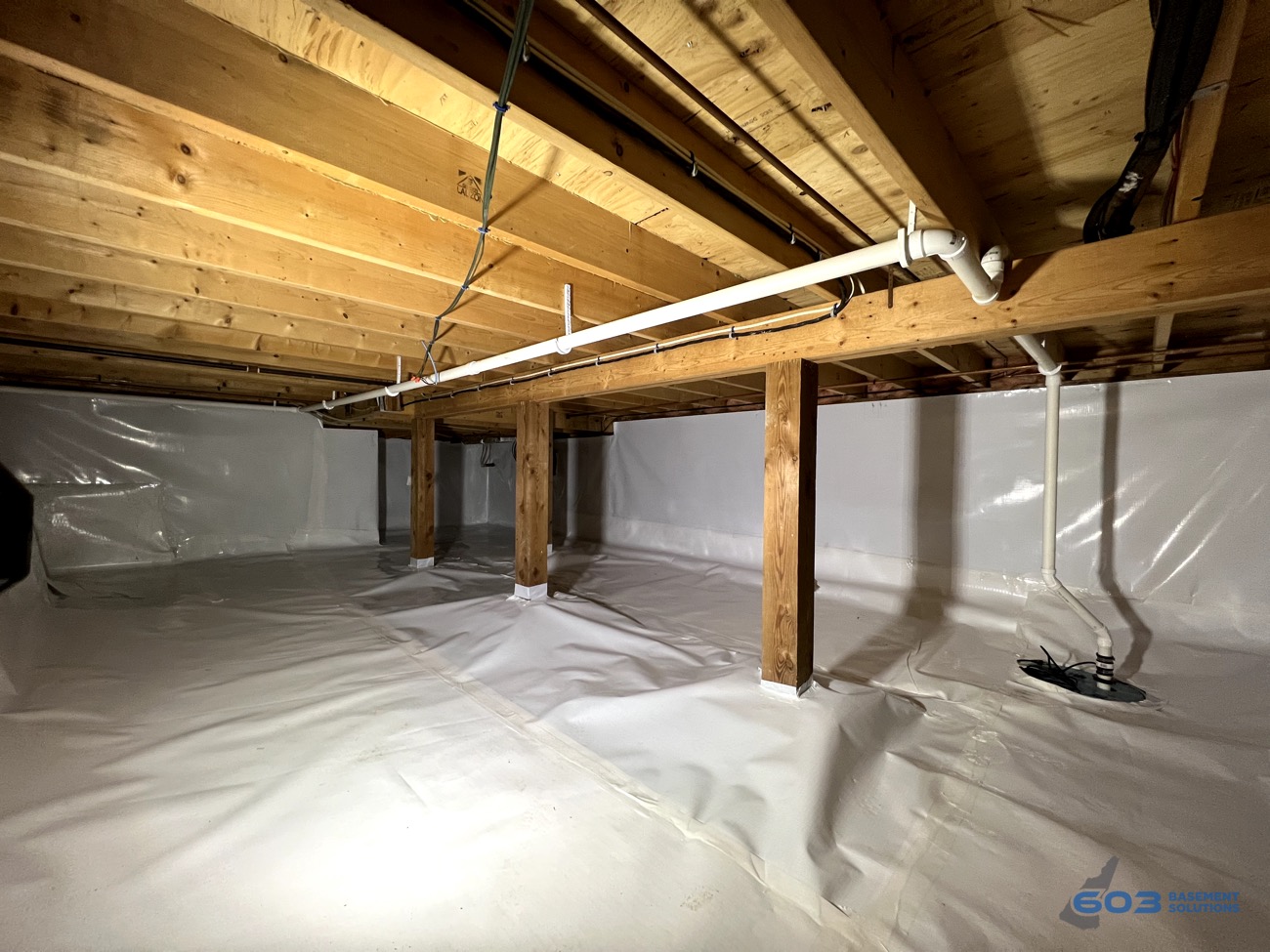
Encapsulation seals your crawl space off from the wet ground and the humid outside air, then keeps that sealed space dry. Here is exactly what we put in:
- 12-mil vapor barrier on the walls.
- 20-mil vapor barrier on the floor.
- Dimpled drainage matting under the floor barrier, so any water that does get in drains to the sump instead of pooling.
- Every seam sealed with spray-foam insulation.
- A dehumidifier and a sump pump to pull the moisture out and keep it out.
That musty smell you notice first? It’s not the smell of mold. It’s moisture trapped in the insulation and the wood, and mold is what grows in that moisture. Seal the ground, dry the air, and the smell leaves with it.
This is crawl space encapsulation, our own crawl-space product. It’s not the Forever Dry System, which is our basement waterproofing system. We match the fix to the space.
Why Amherst crawl spaces stay wet
Three things gang up on a crawl space in this town.
First, the ground holds water right against your house. Southern Amherst sits in the Souhegan River valley, and that valley floor is alluvium and glacial sand and gravel sitting on thin till over bedrock (USGS SIR 2020-5137; USGS GQ-881, Milford quadrangle). Sand and gravel like that is wide open, so it carries groundwater easily, and a dirt crawl space sitting on it wicks the moisture straight up.
Second, the old homes were never built to keep it out. Amherst’s housing runs from 1700s and 1800s village and farmstead homes through later subdivisions (Amherst Library, Dating Old Houses). The older ones often have a dirt or low fieldstone crawl space with nothing between the soil and the floor above. The ground just breathes its moisture into the wood.
Third, the weather feeds a vented crawl space instead of drying it. Amherst gets roughly 53 inches of snow a year, plus a heavy spring snowmelt (NCEI 1991-2020 normals, nearest stations Massabesic Lake 52.8 in and Nashua 52.9 in, via Current Results). Warm, damp summer air vents in, hits the cooler ground, and condenses. The snowmelt and the wet spring keep the soil soaked underneath. So a vent doesn’t help you here. It just keeps the air wet.
What Amherst’s homes are built like
Amherst grew in two waves, and the foundation under your house usually tells you which one it came from. The village center, around the Historic District and the common, holds some of the best-preserved late-1700s and early-1800s homes in New England (Wikipedia, Amherst NH). Homes of that era, out in Amherst Village, Cricket Corner, Ponemah, and along Walnut Hill, often have a fieldstone or dirt crawl space. That’s exactly where the ground moisture, the rot, and the musty smell start.
Then the farms turned into subdivisions, and the town filled in fast through the mid-1900s (Wikipedia, Amherst NH). The typical Amherst home today dates to 1978 (U.S. Census ACS 2024 5-year, table B25035, via Census Reporter). Those mid-century homes are more often poured concrete or block, sometimes over a partial crawl space. If yours is an older fieldstone or dirt crawl space, we install a sub-membrane system that seals the ground and, when you need it, ties into radon control.
Amherst: local context
- Town: Amherst, Hillsborough County, NH (ZIP 03031), in the Souhegan Valley between Milford and Merrimack (Wikipedia, Amherst NH).
- Soil: The Souhegan valley floor through southern Amherst is alluvium and glacial sand and gravel over thin till on bedrock; that sand and gravel is highly permeable and carries groundwater readily (USGS SIR 2020-5137; USGS GQ-881, Milford quadrangle).
- Water: The Souhegan River crosses southern Amherst on its way from Milford to Merrimack (Wikipedia, Souhegan River); Beaver Brook drains central town and Baboosic Brook and Baboosic Lake sit on the east side (Wikipedia, Baboosic Brook).
- Climate: Roughly 53 inches of snow a year, with a heavy spring snowmelt (NCEI 1991-2020 normals, nearest stations Massabesic Lake 52.8 in and Nashua 52.9 in, via Current Results).
- Housing: Spans 1700s and 1800s village and farmstead homes through later subdivisions; the typical home dates to 1978, the median home value is about $537,600, and about 92 percent of homes are owner-occupied (U.S. Census ACS 2024 5-year, tables B25035 / B25077 / B25003, via Census Reporter). Homes of the older era often have dirt or fieldstone crawl spaces.
- Radon: Hillsborough County is EPA Radon Zone 2 (Moderate, predicted 2 to 4 pCi/L), not Zone 1; only Carroll County is Zone 1 in NH (EPA Map of Radon Zones, New Hampshire). Measured indoor tests run higher: across 5,528 pre-mitigation tests, Hillsborough County’s average came to 5.3 pCi/L, above the EPA 4.0 action level (American Lung Association / CDC tracking, NH radon report). EPA recommends testing every home. For a dirt or fieldstone crawl space, we can add a sub-membrane radon system under the same barrier.
Seal your crawl space and keep it dry
Amherst’s old village homes often have dirt or fieldstone crawl spaces that wick ground moisture. 603 seals them with a 12/20-mil barrier, sump, dehumidifier.
What it costs in Amherst
Crawl space encapsulation in Amherst runs $3,000 to $25,000. Where you land depends on the square footage, how wet the space is, the shape the wood and insulation are in, and whether you need drainage matting and a sump under the floor barrier.
| Service | 603 range (NH) |
|---|---|
| Crawl space encapsulation | $3,000 to $25,000 |
| Radon mitigation (if added) | $900 to $6,000, most homes around $1,950 to $2,250 |
| Radon test | $50 (credited toward the job if you proceed) |
We come out, crawl the actual space, and give you a real number. No guess over the phone. Free inspection, free estimate, quote within 24 hours.
Why homeowners pick 603
We’re a local, owner-run crew, not a national franchise. Chris is the Captain of the ship and he’s on every job. Nik is the Wizard behind the curtain running operations. We’re BBB A+ accredited (2022), rated 4.9 stars across 250 Google reviews, state-certified for radon mitigation, and licensed and insured. We’ve helped 5,000-plus homeowners across New England.
Crawl space encapsulation comes with a 25-year warranty on the liner, the wall barriers, and the workmanship. Sell the house and the warranty goes to the next owner, as long as nobody else has touched the work.
What a recent customer said
Gerald and his crew did an excellent job, first cleaning out all the debris and the dislodged insulation in the crawlspace. they were very communicative and understood my concerns and handled them professionally. When they were finished laying the sublayment and the top vinyl covering, carefully taping all the seams they put insulating foam around the perimeter, sealing the top of the vinyl. Gerald communicated two issues that were not part of the contract that I will subsequently take care of myself. Great job, very satisfied.
Alex C Arcisz, ★★★★★, Google review
Frequently asked questions
Is crawl space encapsulation worth it for an older Amherst home?
For most older Amherst homes, yes. The town’s 1700s and 1800s village and farmstead homes, out around Amherst Village, Cricket Corner, Ponemah, and Walnut Hill, often have a dirt or fieldstone crawl space sitting on the permeable sand and gravel of the Souhegan valley. It wicks moisture up and grows mold and rot. Encapsulation seals that space with a 12-mil wall barrier and a 20-mil floor barrier, then dries the air with a dehumidifier and a sump pump. In Amherst it usually runs $3,000 to $25,000.
Does a 1700s or 1800s Amherst home with a dirt crawl space need encapsulation?
Usually, yes. Homes of that era often have a dirt or low fieldstone crawl space with nothing between the soil and the wood above, so ground moisture climbs straight into the floor framing. For those we install a sub-membrane system that seals the ground and, when you need it, ties into radon control. We inspect the space first and tell you straight whether you need full encapsulation or just some targeted moisture control. If it’s the smaller job, that’s what we’ll quote.
Should I add radon mitigation when I encapsulate my Amherst crawl space?
Worth testing. Amherst is in Hillsborough County, EPA Radon Zone 2 (moderate, predicted 2 to 4 pCi/L), but measured tests run higher: across 5,528 pre-mitigation tests, the county’s average came to 5.3 pCi/L, above the EPA 4.0 action level. EPA recommends testing every home. For a dirt or fieldstone crawl space, we can put a sub-membrane radon system under the same vapor barrier. A radon test is $50, and that $50 goes toward the work if you proceed.
Ready to get started?
Free inspection, free estimate, and a written quote in your hands within 24 hours.
Common questions about crawl spaces
- I had my crawl space encapsulated and outside vents sealed. Why have my radon levels gone up?
- I was told of an add-on for my crawl space encapsulation: insulation under the 20 mil white casing. Is that preferred?
- If a house already has a vapor barrier, is there a need for another one?
- If the humidity in your crawl space is 60-70% but in your house it’s lower, do you still need to fix the crawl space?
- Is a little water in a crawl space normal?
- Is a vapor barrier necessary under the subfloor?
- Is there a good ROI on crawlspace encapsulation?
- My home is on a crawl space; the problem is the $20k price tag. Is encapsulating a crawlspace worth the money?
- What are the potential disadvantages of having a crawl space under your house?
- What are the reasons for some houses having basements or crawl
- What are the top reasons for immediate house foundation repair and crawl space encapsulation?
- What challenges should I expect fixing squeaky floors in a house with a short crawl space?