
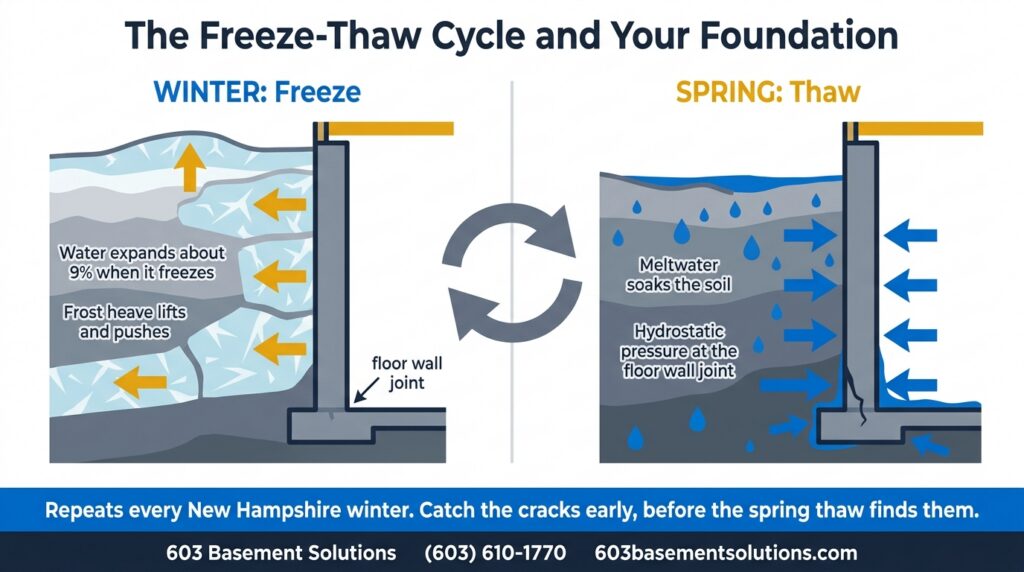
The freeze-thaw cycle is water getting into your foundation, freezing, and expanding about 9% as it turns to ice. That ice widens any crack and pushes on the wall. Then it thaws, water runs back in, and the whole thing repeats all winter. Over a few New Hampshire winters, that’s what cracks a foundation.
How the freeze-thaw cycle actually works
Water is sneaky. It finds the tiny gaps in concrete, the pores, a hairline crack you’d never notice, and it settles in.
Then the temperature drops. That trapped water freezes, and here’s the part that does the damage: water expands roughly 9% when it turns to ice. It’s got nowhere to go, so it pushes outward on the concrete around it. A hairline crack gets a little wider. A pore opens up a little more.
Then it warms up, the ice melts, and more water seeps into the slightly bigger gap. Freeze again. Push again. Melt again.
One cycle barely moves the needle. But New Hampshire doesn’t give you one cycle. We get dozens of them between November and April, some winters more, as the temperature crosses the freezing line day after day. That’s the machine. Small damage, repeated a hundred times, until it’s not small anymore.
Frost heave, in plain terms
Frost heave is the same idea working in the soil instead of the concrete.
The ground around your foundation holds water. When that water freezes, it forms ice lenses that swell and lift everything above them. Soil, slabs, footings, walkways, all of it can rise. Then spring comes, the ice melts, and everything drops back down. Not always evenly.
That up-and-down movement is rough on anything rigid. A concrete slab or a footing doesn’t flex. It cracks. We’ve written more about frost heave on its own, so we’ll keep it short here and stay on the bigger picture.
What the spring thaw does: hydrostatic pressure
Winter cracks things. Spring floods them.
When the frost finally leaves the ground and the snowpack melts, all that water has to go somewhere. A lot of it heads down and pools in the soil right against your foundation. Once the soil is saturated, that standing water starts pressing on your basement wall from the outside. That sideways push is hydrostatic pressure, and it’s relentless. It doesn’t take a break.
Here’s the local wrinkle most homeowners don’t know about. The soil touching your foundation is disturbed backfill, the dirt that got dug out and dumped back in when your house was built. It’s looser than the native soil farther out, so it drains slowly and holds water right up against the wall. Exactly where you don’t want it.
So a wall that got quietly weakened all winter meets its hardest test in April, right when the water table is at its highest.
Why New Hampshire foundations get it worse
Plenty of places freeze. New Hampshire stacks the odds against your foundation in a few specific ways.
A deep frost line. The frost line is how far down the ground freezes in winter. Up here it runs deep, often around four feet in much of the state, which is why footings and frost walls (the foundation walls built to sit below the frost line) have to go down so far. The deeper the frost reaches, the more of your foundation is inside the freeze zone. Your town’s building code sets the exact required depth.
Granite and ledge. We’re the Granite State for a reason. Water sits on top of rock and ledge instead of draining away, so it stays near the foundation longer, ready to freeze.
Real snowpack. We hold snow for months. When it melts, it doesn’t trickle off, it dumps a lot of water into the ground over a short stretch.
A hard spring thaw. That combination, deep frost plus a heavy snowmelt, means our thaw is more of a flood than a drip.
Disturbed backfill. Same as above. The loose fill around your foundation holds that meltwater against the wall.
None of these is unusual on its own. Together, they’re why a foundation that would be fine in a milder climate starts talking to you here.
What freeze-thaw actually causes
You won’t see the cycle. You’ll see what it leaves behind.
- Cracks. The most common one. Vertical or diagonal cracks in poured walls, stair-step cracks in block. Some stay hairline. Some open up.
- Bowing or leaning walls. Years of outside pressure can push a wall inward. It might bow in the middle or lean in at the top.
- Heaving. Slabs, footings, and floors that lift from frost, then don’t fully settle back.
- Leaks at the floor wall joint. This is the seam where your basement wall meets the floor, and it’s the number-one spot water shows up after a thaw. When the ground outside is saturated, water finds that joint and comes through.
One important thing: a single thin crack in a dry basement is usually nothing to panic over. Concrete cracks. What you’re watching for is a crack that grows, a crack that leaks, or a wall that’s changing shape. If you’re not sure which you’ve got, our guide to the signs of foundation failure walks through what’s cosmetic and what’s not.
How to protect your foundation
Freeze-thaw runs on water. Take the water away from your foundation and you starve the whole cycle. Most of that is drainage, and a lot of it you can handle yourself.
Move water off the house. Clean gutters. Extend the downspouts so they dump at least a few feet out, not right at the wall. This is the cheapest, highest-payback thing on the list, and you don’t need us for it.
Fix your grading. The ground should slope away from your foundation, not toward it. Low spots against the house collect the exact water that freezes and thaws against your wall.
Seal small cracks early. A hairline crack you seal this fall is a crack that can’t take on water, freeze, and widen this winter. Waiting turns a small job into a bigger one.
Handle the water that still gets in. When outside drainage isn’t enough and water keeps coming through, the durable fix is interior drainage that catches it and moves it to a sump pump. That’s our basement waterproofing work, the Forever Dry System, and it carries a full transferable lifetime warranty. We stay away from exterior excavation. Nik’s seen those digs fail in a couple of years, and interior drainage lasts.
If a wall has already started to bow or a crack is structural, that’s a different conversation. That’s structural and foundation repair, and it needs eyes on it before anyone quotes a fix.
What repairs run
Prices depend on what the freeze-thaw cycle actually did, so these are ranges, not a quote. We give you a firm number after we look.
| Situation | Typical fix | 603 range |
|---|---|---|
| One hairline crack, basement dry | Seal it, keep an eye on it | Crack repair 1, 000–3,000 |
| Crack leaking at the floor wall joint | Interior drainage plus crack seal | Basement waterproofing 3, 000–30,000 |
| Wall starting to bow | Carbon-fiber straps | $850 each |
| Wall pushed in hard | Steel power brace | $1,300 per brace |
The theme holds across all of it: caught early, it’s a crack repair. Left alone through a few winters, it’s a wall.
When to call 603
Call when the crack is growing, when water shows up at the floor wall joint after a thaw, or when a wall looks like it’s leaning or bowing. Those don’t fix themselves, and freeze-thaw only pushes them the wrong way.
The inspection is free and there’s no pressure. Someone from our crew comes out, tells you straight whether you’re looking at a seal-it-and-forget-it crack or something structural, and you get a quote within 24 hours. We’ve helped over 5,000 homeowners across New Hampshire, Maine, and Massachusetts keep their basements dry and their foundations solid. Google rates us 4.9 across 257 reviews, and we’re BBB A+.
Frequently asked questions
Does freeze-thaw really crack a concrete foundation?
Yes, over time. One freeze won’t do it. But water expands about 9% every time it freezes, and New Hampshire hands your foundation dozens of freeze-thaw cycles a winter. That repeated pressure is what widens cracks and stresses walls year after year.
What’s the frost line in New Hampshire?
The frost line is how deep the ground freezes, and in much of New Hampshire it runs around four feet. Your town’s building code sets the exact figure, which is why footings and frost walls have to be set below it.
Should I seal a foundation crack in winter or wait for spring?
Sooner is better. An open crack takes on water, and that water freezes and widens the crack. Sealing a small crack before the freeze-thaw season is the cheapest time to deal with it. If it’s already leaking or growing, don’t wait for spring, get it looked at.
Will homeowners insurance cover freeze-thaw foundation damage?
Usually not. Most homeowners policies exclude gradual foundation cracking, earth movement, and long-term water damage, which is what freeze-thaw is. It’s worth reading your own policy or asking your agent.
Can I prevent freeze-thaw damage myself?
A lot of it, yes. Clean gutters, extend the downspouts away from the house, fix grading that slopes toward the foundation, and seal small cracks early. That’s water management, and it’s the front line. When water still gets in after all that, that’s when interior drainage earns its keep.
Ready to check your foundation before winter?
If you’ve got a crack that’s growing or water at the floor wall joint, don’t let another freeze-thaw season work on it. Call us at (603) 610-1770 or book your free inspection. We’ll tell you straight what you’re dealing with, and we’ll stand behind the fix!
By Chris Pagliccia, co-owner, 603 Basement Solutions
Sources: Water expanding roughly 9% on freezing, per the U.S. Geological Survey (USGS) Water Science School. Frost-line and frost-depth requirements follow U.S. Department of Energy / International Residential Code frost-depth guidance, as adopted by New Hampshire and local building codes. 603 pricing and warranty figures are founder-confirmed; foundation-repair scope is set after a free on-site inspection.