
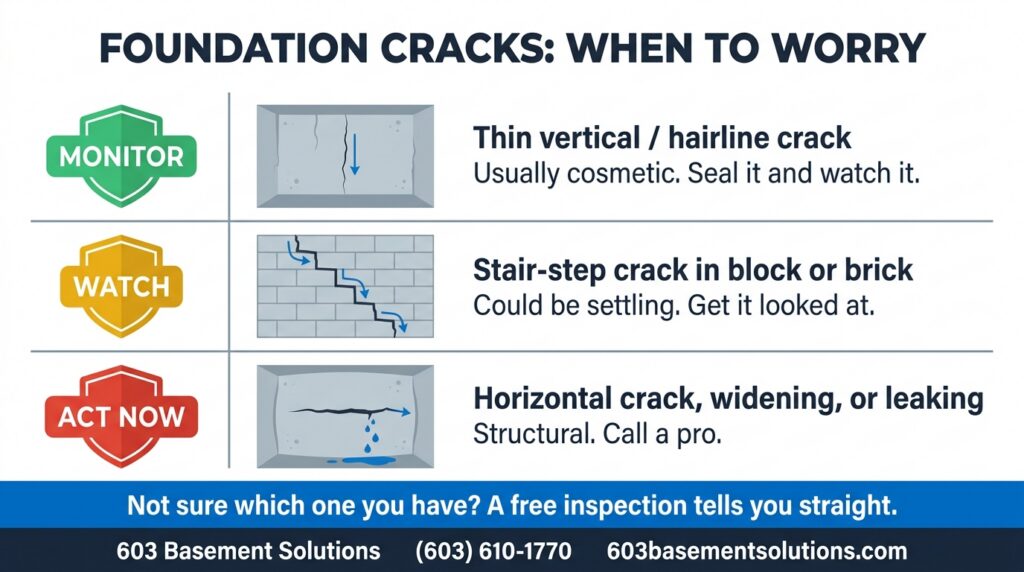
Most foundation cracks are cosmetic. Worry when a crack is horizontal, wider than 1/8 inch, growing, stair-stepped through block, or leaking water, especially after a New Hampshire freeze/thaw cycle. Those signal structural movement or hydrostatic pressure and need a professional inspection. Hairline vertical cracks under 1/8 inch can usually just be monitored.
You went down to grab something and there it is. A crack running up the foundation wall. First thought: is my house falling apart? Usually, no. Concrete cracks. It’s what concrete does as it cures and as the ground around it shifts with the seasons. Most of what we get called about in New Hampshire is harmless.
But some cracks are a warning. The trick is knowing which is which, and this guide walks you through it the way we’d walk you through it at your kitchen table.
When to worry: the five warning signs
Here’s the short version. A crack is worth a real look when it shows any of these:
- It’s horizontal. A crack running side to side across the wall is the one that gets our attention fastest.
- It’s wider than 1/8 inch. About the thickness of a nickel’s edge. Under that, usually fine. Over it, watch closely.
- It’s growing. A crack that’s longer or wider than it was last month is telling you something is still moving.
- It steps through the block. A diagonal, staircase-shaped crack following the mortar joints in a block or brick wall.
- It leaks. Water coming through a crack means pressure is pushing it in, and that’s its own problem.
One of these and you should get eyes on it. Two or more and don’t wait. None of these, and you’ve probably got a cosmetic crack you can monitor. We’ll tell you when you don’t need us yet, because you usually don’t.
Crack-type risk table
Use this to sort what you’re looking at. Width, direction, and behavior tell you most of what you need to know.
| Crack type and width | What it usually means | What to do |
|---|---|---|
| Hairline, under 1/16 in, vertical | Concrete curing and shrinkage. Normal | Monitor. Seal only if it seeps |
| Vertical, up to 1/8 in | Minor settling | Mark it, measure it, watch it |
| Wider than 1/8 in, or growing | Active movement | Get it inspected |
| Diagonal from a corner of a window or door | Settling load path | Watch closely, inspect if it grows |
| Horizontal, any width | Soil and water pressure on the wall | Call a pro now |
| Stair-step through block or brick | Differential settlement | Call a pro now |
| Any crack actively leaking water | Hydrostatic pressure | Inspect and waterproof |
If you’re on the “call a pro” rows, that’s what a free foundation inspection is for. No pressure, no charge.
Horizontal cracks: the most serious kind
If you read nothing else, read this. A horizontal crack in a poured or block basement wall is the one we treat as urgent.
Here’s why. A vertical crack is usually the concrete relieving stress as it settles. A horizontal crack means something is pushing on the wall from the outside. That something is soil and water. When the ground around your foundation is saturated or frozen, it presses inward, and a poured concrete wall is strong up and down but weak against that sideways shove. The wall cracks across the middle, and left alone it starts to bow inward.
A bowing wall doesn’t fix itself. It gets worse every wet spring and every hard freeze. The good news: caught early, it’s a repair, not a rebuild. Carbon-fiber straps or steel bracing hold the wall and stop the movement. Wait too long and you’re into rebuilding a section, which is a different job and a different bill.
So if it’s horizontal, don’t monitor it for a year. Get it looked at.
Stair-step cracks in block and brick
If your foundation is concrete block, watch for cracks that climb diagonally, following the mortar joints in a staircase pattern. Those are differential settlement cracks. One part of the foundation has dropped more than the part next to it, and the wall is tearing along its weakest line, the mortar.
A thin stair-step crack that isn’t moving can sometimes just be monitored. A wide one, or one paired with doors that stick and floors that slope, usually means the footing under that corner is sinking. That’s when we start talking about piers to get under the foundation and stop the drop. More on that below.
Vertical and hairline cracks: usually normal
Now the good news, because most of what you’ll find falls here.
Vertical and hairline cracks are the most common cracks in a New Hampshire basement, and most of them are harmless. When a poured foundation cures, it shrinks a little, and it relieves that stress by cracking. You’ll often see thin vertical cracks near the middle of a wall or running down from a corner of a window well. If they’re under 1/8 inch, not growing, and dry, they’re cosmetic.
You don’t need a structural repair for a cosmetic crack. If it’s dry, you can leave it. If it weeps a little during heavy rain or snowmelt, a simple crack injection seals it and you move on. When a full system is out of budget, fill the crack and don’t look back.
The one thing worth doing: be sure it’s staying put. That’s monitoring, and it costs you nothing.
What causes foundation cracks in New Hampshire homes
New England is hard on foundations, and it’s worth knowing why so the cracks make sense.
Freeze and thaw. This is the big one up here. Frost drives down into the soil in winter, sometimes several feet, and frozen wet soil expands. That expansion pushes on your footings and walls, a force called frost heave. Then it thaws, the ground drops, and the cycle repeats every winter. That constant push and release is what widens an old crack a little more each year.
Disturbed backfill. When your house was built, the crew dug a hole, poured the foundation, and shoved the dug-up soil back against the walls. That backfilled soil is looser than the packed ground around it, so it drains slower and holds water right against your foundation. That’s why the water always seems to pool where you least want it.
Our soil. New Hampshire sits on a mix of glacial till, clay pockets, and granite ledge. Clay swells when it’s wet and shrinks when it’s dry, and that movement works on a foundation year-round. Granite ledge doesn’t drain, so meltwater and rain go sideways into that loose backfill and up against your wall.
Hydrostatic pressure. Put all that together and you get standing water in the earth beside your foundation. Water is heavy. It presses on the wall and the floor-wall joint, and it finds the smallest crack to come through. That’s the pressure behind most horizontal cracks and most wet basements.
None of this means your house is failing. It means it lives in New Hampshire. The cause just tells you whether a crack is settling (usually fine) or pressure (worth acting on).
How to monitor a crack yourself
Before you call anyone, you can gather good information in five minutes, and it makes any inspection more useful.
Grab a pencil and a ruler. Mark the ends of the crack and write the date next to each mark. Measure the width at the widest point and write that down. Draw a small line across the crack so you can see if the two sides shift. Then check it again in a month, and after the next big rain or spring thaw.
Same numbers a month later means a stable crack, and you can relax. Longer, wider, or the two sides no longer lined up means it’s active, and that’s your cue to get it inspected. Same goes for any crack that starts letting water in. That’s real data, and it beats guessing.
Cosmetic vs structural: seal it or call a pro
Here’s the split, because not every crack is our job.
A cosmetic crack is thin, vertical or diagonal, not growing, and either dry or barely weeping. You can seal these yourself with an injection kit, or have us inject one when we’re out. It’s a small fix and it stays fixed.
A structural crack is horizontal, stepping through block, wide, growing, or paired with sticking doors and sloping floors. Sealing one of those is like painting over a problem. The seal might stop the water for a while, but the wall is still moving, and the crack will open right back up. Structural cracks need the movement stopped first, then the crack handled. That’s carbon-fiber, bracing, or piers depending on what’s moving.
If you’re not sure which one you have, that’s fine. That’s what the free inspection sorts out. If it’s cosmetic, we’ll tell you to seal it and save your money.
How foundation cracks actually get repaired
Repairs come down to matching the fix to the cause. Here’s what each one is for.
Crack injection. For sealing a crack, we inject it under pressure so the material fills the full depth of the wall, not just the surface. Polyurethane flexes and works well on wet or active cracks. Epoxy is rigid and strong, used on dry structural cracks where we want to weld the concrete back together. This is the fix for leaks and for stable, non-structural cracks.
Carbon-fiber straps. For a wall that’s cracked horizontally and starting to bow inward, carbon-fiber straps anchor to the wall and hold it against the soil pressure. They’re low-profile, they don’t eat your headroom, and they stop the bowing from getting worse.
Power braces. Where a wall needs more hold than straps give, steel braces run floor to ceiling and take the load. Same goal, more muscle, for a wall that’s moved further. When a section is too far gone to brace, an auxiliary (sister) wall built against it carries the load instead.
Helical piers. For a foundation that’s sinking or settling, straps won’t help, because the problem is below the wall. Helical piers are steel shafts driven deep into stable soil, then the foundation is transferred onto them and, where possible, lifted back toward level. This is the fix for the stair-step-and-sloping-floor problem. House sinking? Piers are the solution.
We self-perform this work in-house, and the structural fixes carry real warranties: 25 years on wall stabilization and helical piers, 10 years on crack injection. Structural and foundation repair covers the full range if you want to dig deeper.
What foundation crack repair costs in New Hampshire
Cost depends entirely on what’s actually wrong, so treat these as ranges, not a quote. A leaking crack and a sinking foundation are different worlds.
| Repair | What it’s for | 603 NH price |
|---|---|---|
| Crack injection (poly or epoxy) | Sealing a leaking or non-structural crack | $1,000 to $3,000 |
| Carbon-fiber straps | Bowing wall, lateral movement | $850 each |
| Power brace | Bowing wall needing more hold | $1,300 per brace |
| Auxiliary (sister) wall | A failing wall section | ~$1,350 per linear foot |
| Helical piers | Sinking or settling foundation | $2,700 for the first 3, then $2,200 each |
| Typical NH structural piering job | Full stabilization | ~$12,000 to $18,000+ |
| Foundation inspection | Diagnosis | Free (our own) |
A couple of notes. A single sealed crack is a small job. A full piering project runs higher because it takes a minimum of several piers to stabilize a house, and the total comes down to how many it takes. If you’d rather bring in an independent structural engineer first, that’s a fair move. Their reports typically run $1,200 to $2,000 in the market, at roughly $100 to $500 an hour. Our inspection is free, and we’ll tell you straight if you don’t need the work yet.
For the deep breakdown on the priciest repair, helical pier costs has the full math.
If the crack is mostly a water problem, the real cure isn’t just the crack, it’s keeping the pressure off the wall. That’s what basement waterproofing does, and it’s often the smarter spend than chasing leak after leak.
Frequently asked questions
Will homeowners insurance cover foundation crack repair?
Usually not. Most standard homeowners policies exclude damage from settling, earth movement, and gradual water seepage, which is what causes the majority of foundation cracks. Coverage is more likely when the crack results from a sudden covered event, like a burst pipe or certain plumbing failures. Read your own policy and call your agent before you assume either way.
Are foundation cracks normal in New Hampshire?
Yes, very. Between freeze/thaw cycles, frost heave, clay soil, and granite ledge that won’t drain, thin vertical and hairline cracks are common in local basements. Most are cosmetic. The ones to act on are horizontal cracks, stair-step cracks, anything growing, and anything leaking.
How much does it cost to fix a foundation crack in NH?
A straightforward crack injection runs about $1,000 to $3,000 with us. Structural work costs more because it addresses movement, not just the crack: carbon-fiber straps are $850 each, and a full helical pier project typically lands around $12,000 to $18,000 or more. The only way to know your number is an inspection.
When is a foundation crack an emergency?
Treat it as urgent if a wall is bowing inward, a horizontal crack is widening quickly, you see fresh cracking after a heavy thaw, or a crack is actively pouring water. Those point to active structural movement or serious pressure, and waiting makes the repair bigger.
Can I sell a house with a foundation crack?
You can, but expect it to come up in inspection. A documented repair with a transferable warranty reassures buyers far more than an unaddressed crack. Our structural repairs carry warranties that transfer to the next owner, as long as the work isn’t disturbed by another contractor.
Do hairline cracks need to be sealed?
Not always. A dry hairline crack under 1/8 inch that isn’t growing can simply be monitored. Seal it if it starts to weep water or if you just want it closed up. There’s no need to over-fix a crack that’s holding still and staying dry.
Get a straight answer, free
Not sure whether the crack in your basement is nothing or something? Send us a photo or have us come look. We’ll tell you whether it’s cosmetic or structural, and if it’s cosmetic, we’ll tell you to seal it and keep your money. If it’s more, we’ll walk you through the fix and the warranty in plain terms, no pressure.
We’ve helped over 5,000 homeowners across New Hampshire, Maine, and Massachusetts sort exactly this out, and we’re rated 4.9 stars across 257 Google reviews.
Call us at (603) 610-1770 or book your free inspection today. Let’s find out what you’re really dealing with!
By Chris Pagliccia, 603 Basement Solutions. Licensed and insured.
Sources: crack-width and warning-sign thresholds follow standard residential foundation-inspection guidance; freeze/thaw, frost heave, and hydrostatic-pressure explanations follow standard building science and New Hampshire building-code frost-depth practice; insurance guidance is general and not a coverage promise. 603 pricing and warranties are founder-confirmed.