
Quick Answer
603 Basement Solutions provides broad foundation repair in Rowley, Massachusetts for settled foundations, bowed masonry, changed floor elevations, poor supports, and damaged beams. The result may be a pier layout, wall bracing, corrected support line, sill or beam replacement, crack-specific work, or a recommendation to watch the condition. The on-site inspection and written estimate are free.
Turn a complicated diagnosis into one decision tree
A homeowner should be able to follow why a crack, bow, low floor, or settling corner leads to different work.
We organize the evidence into branches. Each branch ends with a repair, monitoring plan, smaller investigation, or clear exclusion.
Rowley housing context without the guesswork
The 2023 American Community Survey places Rowley’s median housing year at 1977. That townwide estimate does not diagnose one foundation or floor system.
Use the property’s construction record and current measurements. Earlier repairs and additions matter only where the load-path map connects them.

Foundation Problems, Inspection Points, and Possible Repairs in Rowley
| What you are seeing | What 603 inspects | Possible repair |
|---|---|---|
| A chimney or supported projection is pulling from the house | Map connected symptoms before checking bearing below the affected zone | Stabilization below the footing may apply to the measured section |
| A basement wall is moving inward | Document deflection while reviewing masonry condition and water management | Repair may focus on restraint, drainage, rebuilding, or a combination |
| A floor sags near a beam or interior post | Compare floor elevations with beam bearing, columns, sills, and concrete below | Only the component causing the low area should drive the repair scope |
| A vertical, horizontal, or stair-step line raises concern | Record direction, width, displacement, moisture, and changes around it | Repointing, drainage, or stabilization answer different fieldstone conditions |
603 confirms the failed component before pricing work at a Rowley property.
Put the visible clue in the right lane
A stable opening leaks
Keep water entry and wall movement as separate questions.
The wall curves inward
Map displacement, height, restraint, openings, and the treated length.
A floor sags over a beam
Follow load through supports and bearing before choosing columns.
A corner drops
Define the supported footing section before laying out piers.
Begin with the component, not the product
Name wall, floor, beam, sill, column, footing, or foundation section before discussing repair methods.
Then attach measurements and photographs. The decision should remain understandable after product names are removed.
Give every branch a stopping point
A stable crack may lead to a focused seal. A moving wall may lead to bracing or another designed response.
A low floor may need support, repair, monitoring, or further opening. Do not force every branch into a structural installation.
Connect price to the chosen branch
Show quantities, locations, access, temporary support, design, utilities, restoration, and the intended result.
If the evidence changes, return to the decision point. Document why the new branch fits before changing the scope.
Start the decision tree with measured facts
Write wall shape, floor elevation, crack displacement, beam condition, and footing evidence before listing any product.
Group facts by component. Do not combine observations because they appeared during the same season or in the same room.
Each repair branch should cite its facts. A branch without evidence stays an idea, not a scope.
Compare branches with one scope table
Use rows for treated area, quantities, outcome, design, access, temporary work, utilities, restoration, proof, and warranty.
Fill the table for the selected method and the strongest alternative. Empty rows reveal assumptions quickly.
Do not force false precision into monitoring. Its cost and trigger should remain visible.
Use the decision tree as the closeout checklist
Return to every starting fact and selected branch. Match it with installation evidence, final readings, and warranty coverage.
Mark rejected and monitored branches without deleting them. Later changes should begin from the same record.
List any open restoration or observation with an owner and date.
Follow the wall branch only after movement is measured
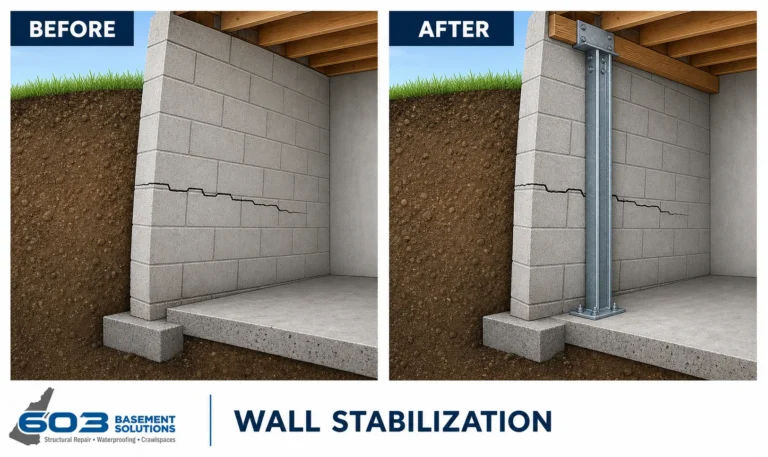
Map the Rowley wall from corner to corner. Add height, displacement, restraint, openings, utilities, and any stable crack-only section.
603 lists power braces at $1,300 each and carbon-fiber straps at $850. The selected wall branch carries a 25-year stabilization warranty within the written boundary.
Follow the floor branch through every support
Use elevations to define the affected area, then inspect joists, beam condition, columns, bases, and footings before selecting units.
A 603 lally column runs from $1,300 to $2,500. Treated floor support carries a 10-year settlement warranty. Beam work and adjustment need separate decisions.
Follow the settlement branch to each bracket
Connect interior and exterior evidence to one Rowley foundation section. Show pier quantity, access, and the stabilization or lift target.
The first three helical piers cost $2,700 each, then $2,200 for each added unit. Engineered work carries a 25-year warranty. Keep restoration visible.
Test the decision with one rejected option
Choose the most plausible alternative and ask which measurement removes it. Record the answer beside the selected branch.
If bracing is chosen, ask why a crack-only repair or monitoring does not fit. If columns are chosen, ask whether the beam needs work.
A useful rejection narrows the scope. It should never become a generic warning about every other method.
Keep the tree available during installation
When concealed work appears, return to the affected decision point. Add the new observation without deleting the original evidence.
Show how the revised method changes quantity, outcome, access, price, or schedule.
At closeout, mark selected, rejected, or still monitored beside every branch.
Write the final decision in plain language
Name the component, location, measured condition, repair, quantity, and intended outcome in one short summary.
Check that summary against the drawing, price, installation photographs, and warranty.
If those records tell different stories, close the mismatch before final acceptance.
Keep the smaller branch visible
When measurements support focused crack work or monitoring, document why broader structural work was not selected.
Add the observation that would reopen the larger branch. Preserve the same wall or floor reference points.
The decision tree should reduce unnecessary work as well as justify necessary work.
Attach the focused scope beside the full structural comparison. The homeowner should see which evidence narrowed the job.
Record any excluded symptom and its next step. A smaller repair should not make a separate concern disappear.
Return to both branches during closeout. Confirm that the completed work stayed inside the selected boundary.
Rowley inspection worksheet
- Build the Rowley decision tree. Start with the observed component and attach its measurements.
- List the viable branches. Include smaller repair, monitoring, support, stabilization, and settlement options when evidence allows.
- Reject methods in writing. Record the measurement or limit that removes an option.
- Close the selected branch. Match installation evidence and final readings to the original decision.
Rowley foundation questions
Can two symptoms follow different branches?
Yes. Keep them separate unless measurements show one load-path connection.
Is monitoring a valid branch?
Yes, when it has fixed points, timing, and an action threshold.
Does a crack always require structural work?
No. Stable crack-specific conditions can use the Foundation Crack Repair service.
Can the plan change during work?
Yes, after the new condition and revised decision are documented.
What 603 brings to the inspection
603 is licensed and insured, has worked in more than 5,000 homes, and self-performs helical-pier installation and structural lifting. The inspection and estimate are free. We normally send the written quote within 24 hours.
We will tell you when the house needs a smaller repair or a period of monitoring. If work is proposed, the scope should name the treated area, quantities, outcome, exclusions, and warranty.
Why Homeowners Choose 603 for Foundation Repair
For a Rowley homeowner comparing contractors, the review and field evidence below show how 603 handles the work.
Get the Rowley load path checked
We will measure the structure, explain the repair boundary, and give you a written scope you can compare.
Sources: U.S. Census Bureau, 2023 ACS 5-year table B25035. The city image caption links its Wikimedia Commons source and license. 603 supplied the confirmed service, pricing, warranty, and operating information. Work imagery shows a 603 repair method. See Structural and Foundation Repair or the Foundation Crack Repair service.