

Quick Answer
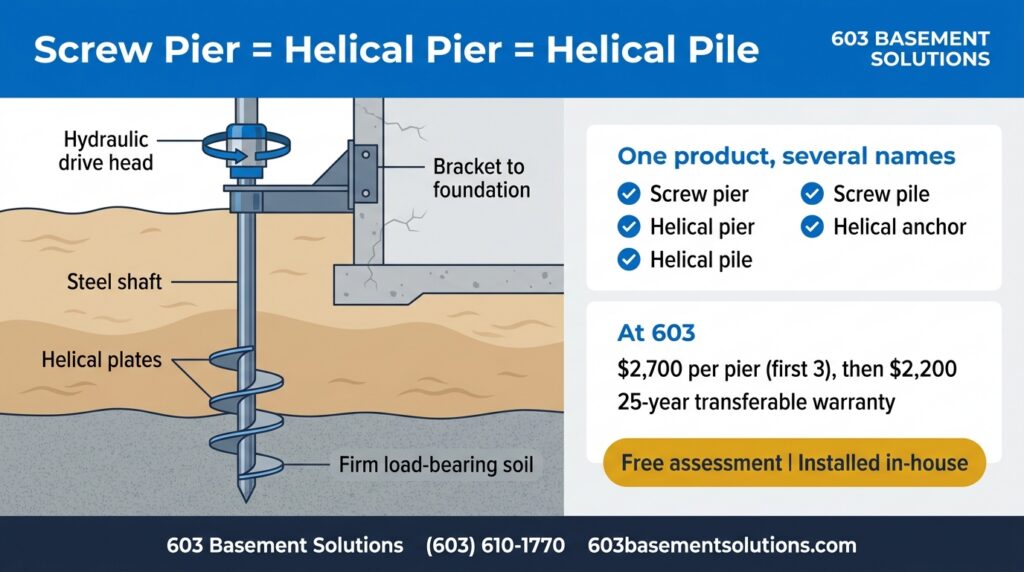
Yes. A screw pier, a helical pier, and a helical pile are the same foundation product under different names. The steel shaft with screw-shaped plates that a crew turns into the ground to support a settling foundation gets called all three (plus “screw pile” and “helical anchor”), and the word you hear depends mostly on the contractor’s region and habit, not on any difference in the part or how it goes in. At 603 Basement Solutions we install them at $2,700 per pier for the first three, then $2,200 per pier after that. Below is why there are so many names for one thing, how the product actually works, and what it costs.
Screw pier, helical pier, helical pile: one product, several names
If you have called a few foundation companies, you have probably heard the same fix described three different ways, and it is fair to wonder whether they are quoting the same thing. They are.
The reference list of names for this single product includes “screw-piles, screw piers, screw anchors, ground screws, helical piles, helical piers, [and] helical anchors” (Wikipedia, “Screw piles”). They all describe a steel shaft with one or more helix-shaped steel plates near the bottom that gets rotated into the soil like a giant screw.
Two small terminology notes that explain the confusion:
- “Pier” vs “pile” is a regional and historical habit, not a product difference. The two words once carried distinct meanings, but today “which term is used seems to vary more by region or personal preference than by any kind of difference in the foundation repair products or the installation method” (My Foundation Repairs). Foundation-repair crews in much of the U.S. lean toward “pier”; engineering and commercial work, and contractors in Canada and the UK, lean toward “pile.”
- “Screw” vs “helical” describes the same shape. The plates spiral around the shaft like the thread of a screw, so a “screw pier” and a “helical pier” are pointing at the exact same component.
So when one company quotes “screw piers” and another quotes “helical piers,” you are comparing the same engineered fix. What actually differs between bids is the number of piers, the depth to firm soil, and who does the work, not the name on the estimate.
How a screw (helical) pier works
A screw pier is a galvanized steel shaft with helix plates welded near the bottom. A crew drives it into the ground with a hydraulic motor, turning it so the plates pull the shaft down until they reach soil firm enough to carry your home. The pier is then connected to your foundation with a steel bracket, and the weight of the house transfers off the unstable soil and onto the pier and the stable layer below.
The detail that makes this product trustworthy is that the capacity is measured during the install, not guessed afterward. As the pier turns, the crew watches how hard the soil resists (the torque). That resistance correlates to how much load the pier can carry, so the crew knows each pier has reached load-bearing ground before they stop. The helix plates “penetrate the soil without augering, displacing the soil, whilst the torque is carefully monitored,” and the final reading confirms the pier has hit its required capacity (Keller North America). The same product can work in compression (holding a structure up) or in tension (anchoring it down), which is why you also hear “helical anchor” for the same part.
This is not a new idea. The screw pile was first described by Irish civil engineer Alexander Mitchell back in 1848, originally to anchor lighthouses and piers in soft tidal ground (Wikipedia, “Screw piles”). The modern residential version is the same principle in galvanized steel.
A second practical advantage matters in New England: because there is no concrete to pour and cure, screw piers can go in during winter as readily as in summer, which is no small thing in a state where the ground stays frozen for months.
Push piers vs helical piers: two different tools
Screw and helical are the same pier. Push piers are not. That pair really is two different products, and people mix them up all the time.
A push pier is a steel tube. Our crew stacks sections and presses them straight down with a hydraulic ram, and the weight of your house is what they push against. The pier keeps going until it reaches firm load-bearing strata and stops moving. That last part is the whole idea. The load rides down the tube to the tip, and the house itself proves the pier found something solid.
Which means a push pier needs weight to work. A heavy home with a poured concrete footing gives it something to press against. A porch, a deck, an addition, or a single-story section usually does not. And you cannot use a push pier on new construction at all, because there is no house sitting there yet.
A screw pier does not care about any of that. It gets torqued into the ground, and the torque reading tells us what it will carry while we are still installing it. That is a real advantage when the load is light, when the good soil is deep, or when the only way to the work is by hand through a bulkhead.
How we pick:
- Push pier: heavy existing home, a poured footing to press against, firm bearing within reach.
- Screw or helical pier: lighter loads, new construction, tight access, or soil where we want a torque number to prove capacity before we walk away.
We install both. Screw piers are what we reach for most, because the torque verification works on more of the houses we see around New Hampshire, Maine and Massachusetts, and they go in where a machine cannot. Push piers get priced by the job rather than off a per-pier sticker, because the count and the depth are what move the number. Cheaper per pier is not the same as cheaper job, and the wrong pier for your soil costs you twice. We will tell you which one your house needs after somebody looks at it.
What screw piers cost
Screw piers are priced per pier, and at 603 the rate is $2,700 per pier for the first three, then $2,200 per pier after that. That per-pier price covers the pier itself, the hydraulic install, and the steel bracket that ties it to your foundation.
Your total comes down mostly to one thing: how many piers it takes to stop the settling and carry your home. A single dropping corner is usually a few piers. A long failing wall or a full perimeter is more. Depth to firm soil, the load of the house, and site access can move the number on bigger jobs.
Because “screw pier” and “helical pier” are the same product, the pricing is identical no matter which word your quote uses. For the full per-pier and per-project cost breakdown, what drives the price up or down, and how the install day unfolds, see our helical pier cost guide. This page is here to settle the naming and confirm the price; that page is the full cost picture.
Why 603 installs screw piers in-house
Most foundation companies sub the structural lift out to a third party. 603 self-performs every helical (screw) pier install with our own crew. The people who measure the problem are the same people who drive the piers and stand behind the result, so nothing gets lost in a handoff between an estimator and an outside contractor.
We back the work with a 25-year engineered performance warranty that transfers to a new owner, as long as the installed work is not altered by another contractor or the homeowner. A documented foundation repair with a transferable warranty tends to read as a selling point, not a red flag, when you list the home.
603 installs screw piers across New Hampshire’s Seacoast, Rockingham County, southern Maine, and northeastern Massachusetts, from our base in East Kingston, NH. The only way to get your real number is a free on-site assessment where we count the piers your home actually needs.
Call (603) 610-1770 or request a free foundation assessment →
See also: helical piers service · structural & foundation repair · full helical pier cost guide
Frequently asked questions
Are screw piers and helical piers the same thing?
Yes. “Screw pier,” “helical pier,” “helical pile,” and “screw pile” all describe the same product: a steel shaft with helix-shaped plates that is rotated into the ground to support a foundation. The different names come from regional and historical habit, not from any difference in the part or how it is installed.
How much do screw piers cost?
603 installs screw piers at $2,700 per pier for the first three, then $2,200 per pier after that. Your total depends mostly on how many piers your foundation needs. For the full cost breakdown and what moves the price, see our helical pier cost guide.
Is a screw pile different from a helical pier?
No. “Screw pile” and “helical pier” are two names for the same engineered product. “Pile” is more common in engineering, commercial, and Canadian or UK usage, while “pier” is common in U.S. residential foundation repair, but the component and the install are the same.
What is the difference between a screw pier and a push pier?
They are different products. A screw (helical) pier is rotated into the ground like a screw, and its capacity is confirmed by the torque it reaches. A push pier is driven straight down using the weight of the house. Screw piers suit a wider range of homes and soils because their capacity is verified during the install.
How deep do screw piers go?
As deep as it takes to reach soil firm enough to carry the home, which varies by site. The crew confirms the right depth during the install by the torque each pier reaches, not by a fixed number.
Can screw piers be installed in winter?
Yes. There is no concrete to cure, so 603 installs screw piers year-round, including through the New England winter.