
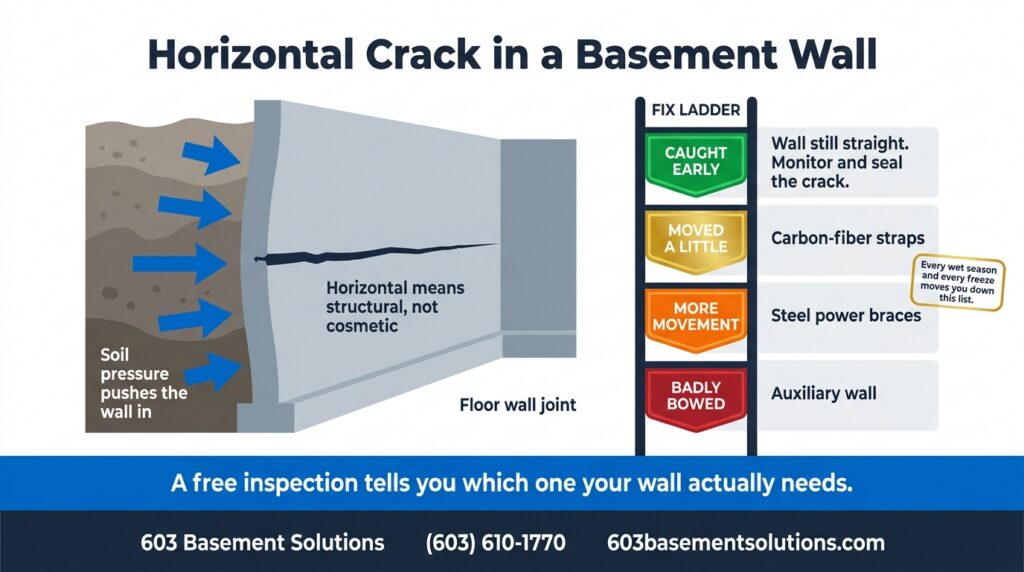
A horizontal crack in a basement wall is the one to worry about. It usually means the soil outside is pushing the wall inward, not just concrete shrinking as it cures. Vertical cracks are often cosmetic. A horizontal crack tells you the wall is starting to bow, and that only gets worse if you leave it. Get it looked at.
Horizontal vs. vertical: why the direction matters
Not every crack is a problem. The direction tells you most of what you need to know.
A vertical crack, or one that runs at a diagonal, usually comes from the concrete or block curing and settling in its first few years. Annoying, sometimes wet, but the wall itself is doing fine. When a full system is out of budget, you seal that kind and move on.
A horizontal crack is a different animal. It runs side to side across the wall, often about a third of the way down from the top, right where the soil pressure peaks. That’s the wall telling you it’s being pushed. The ground outside is leaning on it harder than it was built to take, and the wall is bending under the load. Left alone, a hairline turns into a bow, the bow turns into a lean, and eventually the wall can shear and slide. So when we see a crack running the long way, we stop guessing and take a real look.
What causes horizontal cracks in New Hampshire basements
It’s almost always pressure from the outside. A few things around here stack up to create it.
Saturated soil. After a wet spring or a heavy stretch of rain, the ground around your foundation soaks up water and gets heavy. Wet soil weighs a lot more than dry soil, and all that extra weight leans on the wall.
Hydrostatic pressure. Water that can’t drain away builds up against the wall and pushes. The building-science term is hydrostatic pressure, and it’s the same force that makes a basement leak. Enough of it, over enough time, and a wall that was straight starts to bend.
Disturbed backfill. When your house was built, the crew dug out around the foundation and then shoved that same loosened dirt back in. That disturbed backfill is looser than the packed native soil farther out, so it drains slowly and holds water right against the wall. It’s a big reason the pressure sits where it does.
Freeze and thaw. This is the New Hampshire piece. Our winters push frost deep into the ground. Wet soil freezes, expands, and shoves against the wall, then thaws and settles, and it does that over and over every year. That freeze-thaw cycle works a wall the way you’d work a paperclip back and forth, and cracks are how the wall gives.
Put saturated soil, poor drainage, disturbed backfill, and a hard freeze together and you’ve got the recipe for a horizontal crack. It’s why we see so many of them in older Seacoast and southern NH homes with block foundations.
When a horizontal crack is an emergency
Most horizontal cracks give you some warning before they turn serious. Here’s how to read yours.
Watch for a wall that’s visibly bowing or bulging inward, a crack that’s getting wider or longer month to month, block courses that are shifting or stepping out of line, or a wall that’s leaning in at the top or sliding at the bottom. Any of those means the wall is actively moving, and that’s when you stop watching and call.
A crack that’s leaking water is a problem too, but a leaking wall that’s also bowing is the combination that gets our attention fast. Water is what’s driving the pressure in the first place, so a wet, moving wall is a wall under active load.
If you can slide a coin into the crack, if it’s grown since you first noticed it, or if a door or window frame near that wall has gone out of square, don’t wait on it. That wall won’t fix itself, and every freeze-thaw season adds more load. Our foundation inspection is free, so there’s no reason to sit and wonder. We’ll tell you straight whether you’re looking at a monitor-it situation or a fix-it-now one.
How 603 fixes a horizontal crack
The right fix depends on how far the wall has moved. We don’t sell you the biggest repair on the menu. We match the fix to the wall.
Carbon-fiber straps. For a wall that’s cracked and moved a little but is still mostly straight, carbon-fiber straps are the go-to. They’re bonded floor to ceiling across the wall and they lock it in place so it can’t keep bending inward. Clean install, no digging up the yard.
Steel power braces. When the wall’s moved more than straps can hold, we set steel power braces against it. They brace the wall from the inside, anchored down low and up at the floor joists, and they hold the line against the soil pressure.
Wall anchors. If there’s room to work in the yard outside, wall anchors are another route. They tie the failing wall back to solid, undisturbed ground out past the disturbed backfill and pull it back over time.
An auxiliary (sister) wall. Sometimes a wall is too far gone to save on its own. When that’s the case we build an auxiliary wall, also called a sister wall, right up against the old one to take over the structural job. It’s the heavy-duty answer for a wall that’s badly bowed or already shearing.
Piers, if it’s also settling. A horizontal crack means the wall is being pushed in. But if that same wall is also dropping, sinking downward, then you’ve got two problems, and the sinking half needs helical piers driven down to stable soil to stop it. We self-perform our piering in-house.
Whichever fix the wall calls for, our wall stabilization work carries a 25-year warranty. The warranty transfers if you sell, as long as the work stays untouched by another contractor.
Fix by severity, and what it costs
Every job is different, so treat these as our NH starting ranges, not a quote. The free inspection is where we nail down which one your wall needs.
| Where the wall’s at | What we do | 603 NH price |
|---|---|---|
| Hairline horizontal crack, wall still straight, caught early | Monitor, then seal or inject the crack | Crack repair 1, 000–3,000 |
| Wall cracked and moved a little, still mostly straight | Carbon-fiber straps | $850 each |
| More movement than straps can hold | Steel power braces | $1,300 per brace |
| Room in the yard to excavate and reset the wall | Wall anchors | Priced on-site (varies by wall) |
| Wall too far bowed or shearing to save on its own | Auxiliary (sister) wall | ~$1,350 per linear foot |
| Wall is also settling downward, not just bowing in | Helical piers | $2,700/pier for the first 3, then $2,200/pier |
Straps and braces are priced per piece because a wall might need two or it might need six, depending on how wide the crack and the bow run. On the inspection we count what your wall actually needs and put it in writing. Wall anchors and braces are structural stabilization, and we back that work with a 25-year warranty.
Frequently asked questions
Is a horizontal crack in a basement wall always serious?
Yes, more so than a vertical one. A horizontal crack means the wall is being pushed inward by soil pressure, which is a structural load, where a vertical crack is usually just concrete curing and settling. It doesn’t always mean an emergency today, but it always means you should have it looked at before another freeze-thaw season adds to it.
Can I just fill a horizontal crack myself?
Filling it hides the crack but doesn’t stop what caused it. The soil pressure that opened the crack is still there, so a patch will crack again as the wall keeps moving. Sealing makes sense for a stable vertical crack. A horizontal one needs the wall itself stabilized, then the crack sealed, in that order.
How much does it cost to fix a horizontal crack in NH?
It depends on how far the wall has moved. A simple crack repair runs $1,000 to $3,000. Carbon-fiber straps are $850 each and power braces are $1,300 per brace, and the count depends on your wall. A badly bowed wall that needs an auxiliary wall runs about $1,350 per linear foot. Our inspection gives you the real number for your wall.
Will my homeowners insurance cover a horizontal foundation crack?
Usually not. Most homeowners policies exclude foundation damage from soil pressure, settling, and gradual water, which is exactly what causes horizontal cracks. Coverage tends to apply only to sudden events like a burst pipe. Check your own policy, but plan on this being a repair you own.
How long can I wait to fix it?
Not long, if it’s actively moving. A hairline crack in a still-straight wall can be monitored for a bit. But a wall that’s bowing, widening, or leaning is under active load, and every wet season and every freeze pushes it further. The longer you wait, the more the fix moves up the table above, from straps toward an auxiliary wall. Cheaper to catch it early.
What’s the difference between fixing the wall and fixing a leak?
They’re related but separate. The same water pressure that pushes a wall in is what makes a basement wet, so a bowing wall and a leaking basement often show up together. Stabilizing the wall stops it from moving. Keeping the basement dry is a drainage job. On a wet, bowing wall we’ll talk you through both so the pressure that caused the crack gets handled too.
Don’t guess at a moving wall
If you’ve got a crack running side to side across your basement wall, get eyes on it before the next freeze. We’ll tell you straight whether it needs watching or fixing, and we won’t sell you a bigger repair than the wall calls for. Call us at (603) 610-1770 or book your free inspection and we’ll come take a look.
Want to know what else to watch for? Read up on the signs of foundation failure in NH, how a bowing foundation wall gets braced, our full structural and foundation repair work, and what happens on a free foundation inspection.
By Chris Pagliccia, 603 Basement Solutions