

Quick Answer
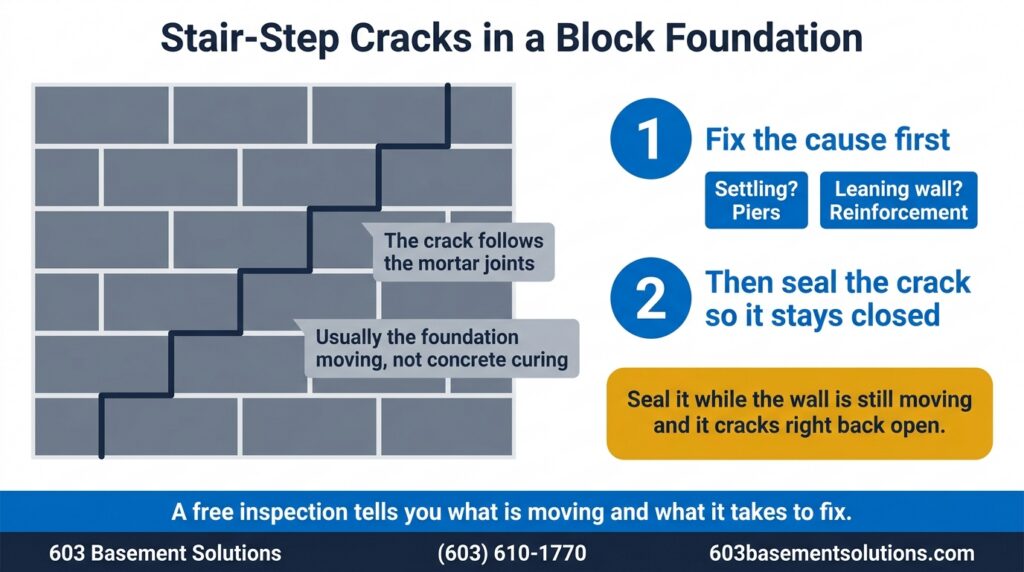
A stair-step crack follows mortar joints up and across a brick or block wall. The pattern can appear when part of the masonry moves, but it does not identify the cause by itself. Settlement, lateral wall movement, a problem around an opening, or deteriorated mortar can produce different versions of the same shape. 603 Basement Solutions checks both sides when accessible, looks for displacement and connected symptoms, and follows the load below the cracked area. Have it inspected when the crack is new, changing, open, or paired with wall or floor movement.
What Stair-Step Cracks in Brick or Block Look Like
The path through the joints is the first clue. Displacement and context tell the rest of the story.
A diagonal stair pattern
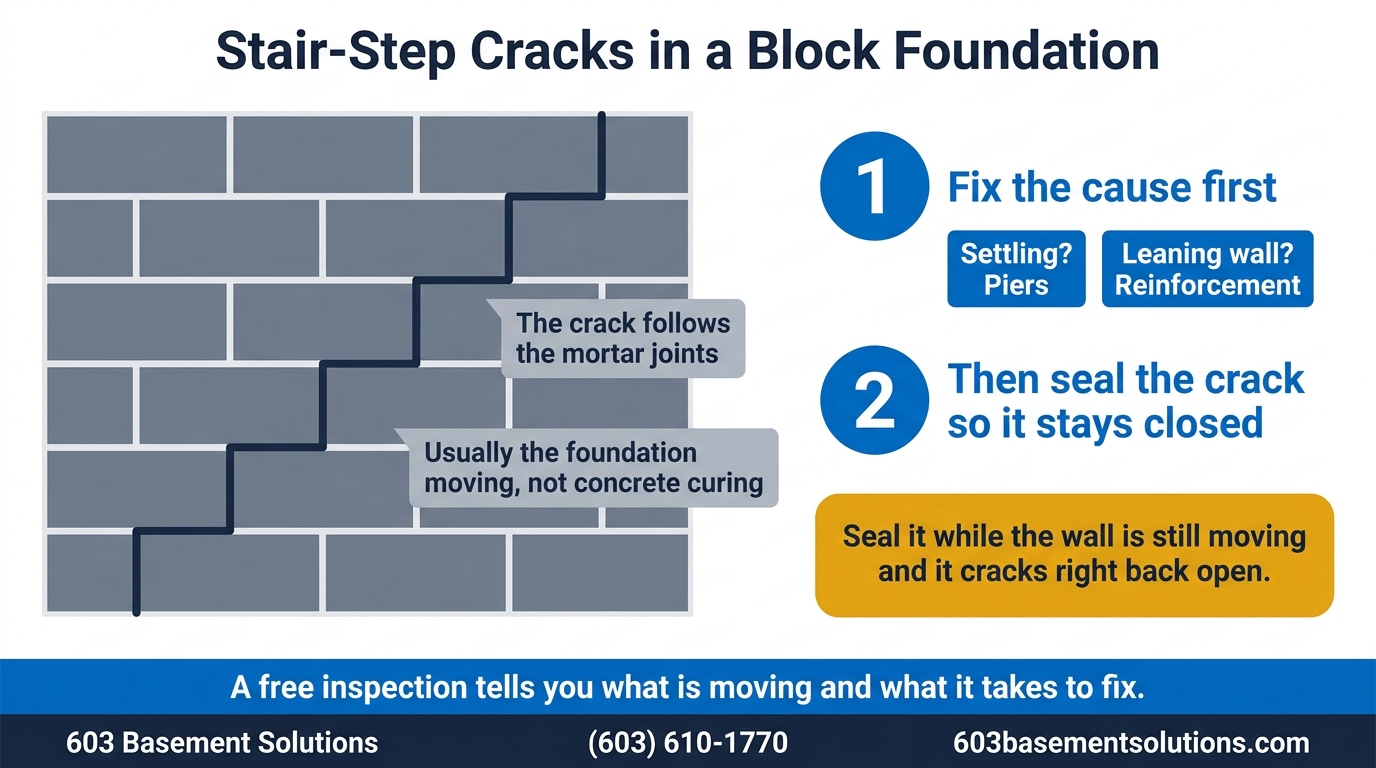
The opening travels through horizontal and vertical mortar joints instead of cutting straight through units.
A wider end
One end may be more open, which helps show how the wall moved.
Offset across the crack
One side sits forward, back, up, or down from the other.
Connected changes
Nearby doors, floors, corners, or wall sections have changed too.
How Serious Is This Problem?
Crack width alone is not enough. We look at direction, displacement, location, material, and change over time.
A fine, unchanged mortar-joint crack with no displacement or connected movement may be photographed and rechecked.
Schedule an inspection when the crack is new, keeps opening, crosses several courses, or returns after a prior patch.
Move promptly when masonry is loose or displaced, the wall is bowing, an opening is visibly changing, or the crack is progressing quickly.
Common Causes
Differential settlement
One part of the support below the wall may move differently from the rest.
Lateral wall movement
Soil and water pressure can move a foundation wall inward and open joints in a diagonal pattern.
Movement around an opening
A window, door, or lintel changes how load travels through nearby masonry.
Mortar deterioration
Weathered or incompatible mortar can fail at the joints without proving that the whole foundation is sinking.
When This May Not Be a Foundation Problem
- Brick veneer can crack around a window or lintel even when the foundation below is stable.
- Old mortar can erode and open at joints without measurable structural movement.
- A prior hard patch can push stress into the masonry beside it and create a new visible line.
How 603 Diagnoses the Problem
We read the wall as a system. Filling the line first would erase part of the evidence.
- Record the crack path, ends, width changes, and any offset across it.
- Identify whether the wall is structural masonry, veneer, or another assembly.
- Inspect corners, openings, adjacent walls, floors, and the foundation below.
- Check for bowing, settlement, moisture, and deteriorated mortar.
- Compare old repairs or photos when they exist.
- Choose monitoring, joint repair, crack repair, or structural work from the full pattern.
What the Pattern Can Point To
| What you see | What it can indicate | What 603 may inspect | Possible next step / repair path |
|---|---|---|---|
| Fine joint crack with no offset | Mortar movement or a stable old change | Material, history, and nearby symptoms | Monitor or masonry repair |
| Diagonal crack widening toward one end | Differential movement | Support below and connected floor or wall changes | Settlement evaluation |
| Stair-step crack in a bowing wall | Lateral wall movement | Wall plane, pressure conditions, and restraint | Wall stabilization evaluation |
| Crack near a window or door | Opening, lintel, veneer, or support movement | The opening and the structure around it | Localized masonry or structural repair |
Possible Repair Options
Repair follows the movement behind the joint pattern. These pages explain the likely routes after that movement is identified.
Foundation crack repair
A stable crack may be repaired after the masonry and moisture conditions are understood.
Structural and foundation repair
Use the broader owner when the pattern connects to settlement, wall movement, or the load path.
Bowing-wall bracing
Bracing may fit when measurements show that the masonry wall is moving inward.
Helical piers
Piers are considered only when the evidence ties the crack to foundation settlement.
What Happens If You Ignore It?
If movement continues, the opening can extend through more joints, disturb nearby finishes, and make the original pattern harder to read after repeated patches. A stable hairline crack is a different decision. Keep a clear photo and inspect the wall before covering it.
Real Experience with 603
Jon's account confirms that 603 has repaired real foundation cracks as part of broader basement work. The crack pattern on your wall still controls the recommendation.
Questions Homeowners Ask
Are stair-step cracks always serious?
No. Some are stable mortar-joint cracks. A changing crack, displacement, or connected wall and floor movement makes professional inspection more important.
Can I fill a stair-step crack with mortar?
A patch can close the visible joint, but it will not correct settlement or a moving wall. Diagnose the movement before hiding the pattern.
Why do stair-step cracks follow the joints?
Mortar joints form a path through brick or block construction. Movement can open that path before it breaks through the masonry units.
Does a crack under a window mean foundation trouble?
Not necessarily. The opening, lintel, veneer, and nearby support all matter. The foundation is one possible source, not the only one.
How can I tell whether the crack is changing?
Use dated photos from the same angle and keep a simple record of nearby changes. An inspection can add measurements and identify what should be monitored.
Let Us Read the Crack Before It Is Patched
We will inspect the masonry, connected openings, wall shape, and support below the crack before naming a fix.