
Quick Answer
A foundation repair visit from 603 Basement Solutions starts with diagnosis in Raymond, New Hampshire for settlement, inward wall movement, uneven floors, failed columns, and damaged sills or beams. Possible scopes include deep foundation support, wall bracing, beam or post correction, sill work, focused crack repair, or no major work yet. The inspection and written repair proposal are provided without charge.
Find the first weak part, not just the loudest symptom
A crack gets attention because you can see it. The first failure may be somewhere else: a footing that moved, a wall that bent, a sill that deteriorated, or a post that stopped carrying its share. We inspect the relationships between those parts before putting a repair name on the job.
Five parts we compare in a Raymond inspection
Footing
Support below the wall or column.
Foundation wall
Movement, cracking, and condition from end to end.
Sill
The wood connection between foundation and framing.
Beam and joists
The path carrying floor loads through the house.
Posts and bases
Alignment, corrosion, connection, and footing support.
Openings
Doors and windows that help show where change is occurring.
Foundation Problems, Inspection Points, and Possible Repairs in Raymond
| What you are seeing | What 603 inspects | Possible repair |
|---|---|---|
| Cracks and openings are changing near one settled area | Follow the settled section from rooms above to its contact with the ground | Monitoring remains an option when current movement is not established |
| A basement wall is moving inward | Check the amount and direction of movement across the entire wall | The measured wall condition determines the stabilization method |
| Joists deflect where they meet a beam, wall, or support | Compare floor elevations with beam bearing, columns, sills, and concrete below | Only the component causing the low area should drive the repair scope |
| An earlier patch opened again while nearby finishes stayed stable | Read the pattern in context with the rest of the foundation and structure | Injection or sealing may apply when the wall remains stable |
These are decision paths, not diagnoses for a Raymond house.
A local address is context, not a diagnosis
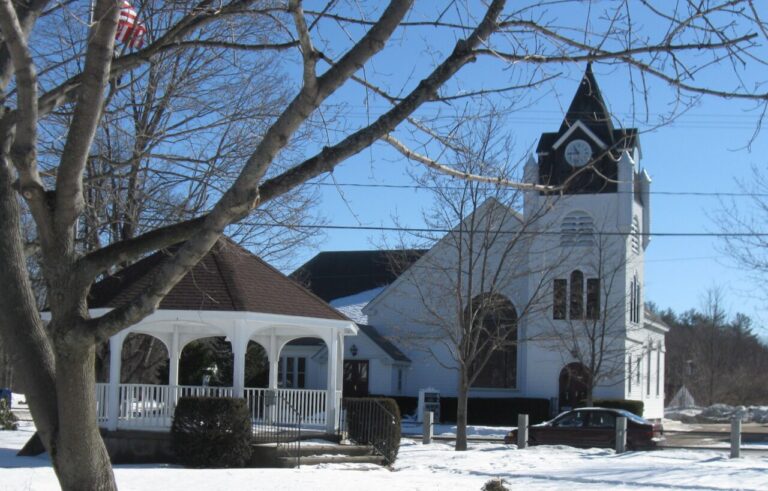
Raymond’s town common is easy to recognize. A residential foundation is not. Two houses on the same road can have different materials, additions, support layouts, and repair histories. We verify what is present instead of turning the town name into a structural assumption.
Why Homeowners Choose 603 for Foundation Repair
The review and project evidence below show how 603 communicates through structural work for homeowners near Raymond.
How we narrow the repair
If the load path fails where the framing bears on the foundation, review the repair sequence on our sill replacement page.
Document the pattern. We compare wide views, crack direction, wall measurements, floor slope, and your timeline.
Check connected components. A low floor near an outside wall sends us toward the sill and wall as well as the interior beam.
Separate active movement from old evidence. Prior patches and repairs matter, but they do not prove what is happening today.
Match the method. The result may be monitoring, crack injection, bracing, a new support footing, wood repair, or engineered underpinning.
Foundation Repair Methods and Pricing in Raymond
Helical piers transfer the structure’s load to competent bearing below. They are not a general answer for every crack or low floor. They make sense when the inspection and design identify settlement that requires deeper support.
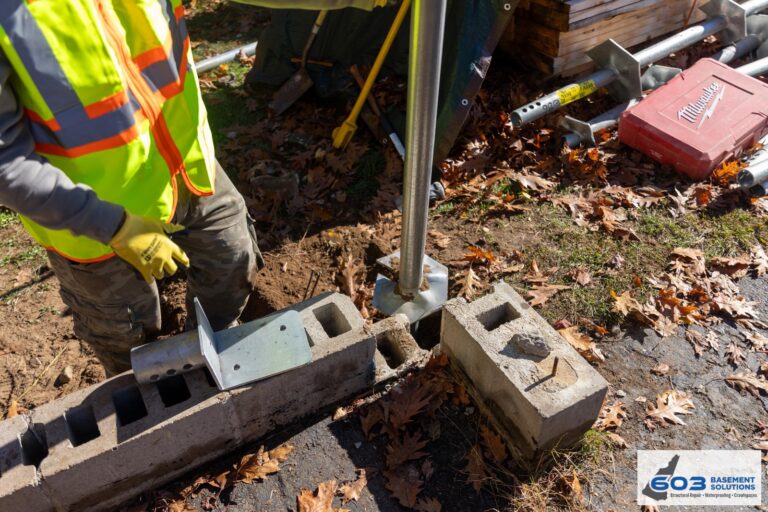
603 self-performs helical-pier installations and structural lifting. Confirmed pricing is $2,700 per pier for the first three and $2,200 for each additional pier. Engineered pier performance carries a 25-year warranty. The proposal must still identify the actual quantity, locations, access, and design.
A foundation that needs deeper support may be a candidate for push piers or helical piers. Push piers depend on the existing structure for reaction during hydraulic installation. Helical piers are turned into the soil, and torque is recorded against the design. The footing, building weight, access, supported section, and intended correction guide the choice. The proposal should explain that choice and keep it separate from a focused crack, sill, beam, or column repair.
If the wall is stable and the crack is the problem
A stable crack may need a much smaller repair. Polyurethane is commonly used to stop water through a nonstructural crack; epoxy restores the bond across a structural crack when the surrounding wall is suitable. See foundation crack repair in Raymond for that inspection path. We will not recommend piers or braces just because a crack exists.
When the slab itself enters the repair path
The slab should not be blamed because a floor feels uneven. We first establish whether it supports the building and compare the concrete with the footing, walls, posts, and framing above. Displaced crack edges, a line that keeps changing, or movement repeated at nearby openings can justify structural slab work. A stable isolated crack may need monitoring or targeted repair instead. Where the building-supporting slab has failed, stabilization or replacement may be appropriate. See the options on our slab foundation repair page.
What you receive from 603
The inspection and estimate are free. We explain what we observed, which parts were checked, why the recommended method fits, and what the warranty covers. A written quote is normally delivered within 24 hours. 603 is licensed and insured and has served more than 5,000 homes.
Old repairs are evidence, even when they failed
Do not remove an old patch, sistered joist, added post, or wall brace before we see it. The material, placement, and cracks around it can show what an earlier owner or contractor was trying to address. Bring invoices or photographs if you have them. A repair that worked for years tells a different story from one that never changed the symptom.
We also look for work that changed the structure without an obvious repair label: a removed partition, a finished opening in a foundation wall, a relocated staircase, or a column moved to create open space. None of those proves the cause, but each can change how loads travel and where we need to measure.
Small scope and large scope should be easy to tell apart
A focused crack repair names the crack, injection material, treated area, and leakage or bond warranty. A column job names the beam, support point, base, and footing. A wall-stabilization job provides the measured wall, system, spacing, and tolerances. A pier plan identifies the supported area, pier locations, and whether stabilization or lifting is intended.
If a proposal mixes several methods, ask how the conditions connect. Sometimes a house genuinely needs a staged structural plan. Other times, two unrelated symptoms need two small repairs. The explanation should be clear enough that you can point from each line item to the part of the house it treats.
Prepare the area without disturbing it
Move stored items far enough away for the wall and floor supports to be seen. Keep utilities on and accessible. Do not chip out masonry, tighten adjustable posts, or jack the floor before the inspection. If a support looks unstable, keep people away from it and tell us when you call. Safe access is useful; changing the evidence is not.
Raymond foundation questions
Should I patch a crack before the inspection?
No. Leave it visible if you can. A patch can hide its direction and make recent change harder to compare.
Does an uneven floor always need lifting?
No. Some conditions should be stabilized without trying to reverse every slope. The right goal depends on the structure and finishes above.
Can 603 replace damaged sill or beam material?
Yes. We inspect the wood, nearby framing, and the foundation connection before defining the repair.
Where can I compare methods and costs?
Start with our foundation repair overview and New Hampshire cost guide.
Get the whole support path checked
We will show you which part needs attention and which parts do not.
Sources: 603 confirmed service, pricing, warranty, and operating information; Wikimedia Commons locality-image record. Work photography shows a 603 repair method.