



A low slab is not always a broken slab, and a crack is not always a structural problem.
Sound surrounding concrete with a limited damaged edge may support a focused repair.
A sound but low slab belongs in a concrete-leveling assessment.
Broken pieces may need a new pour. Movement tied to the building needs a structural check.
Start with what the concrete is doing, not what it looks like. A sound panel that sits low is usually a support question. A crack that runs from a corner, follows a joint, or appears near a step may be a movement question. A surface that flakes, pops, or wears through the top layer is a surface question. None of those automatically means the slab is structural. On a walkthrough, check the first step and landing as one set of fixed heights. Then look separately at the driveway apron. That way, an entry repair is not mixed with roadway access. The decision follows the symptom, not the label.
Concrete that is sound in the field, still tied together, and only low can often stay in place while the support is addressed. A broken edge, a spalled step nose, or a shallow surface defect can sometimes be repaired without removing the whole slab. Removal and re-pour enter the conversation when the slab is cracked through its depth, heaved out of plane, crumbled across a large area, or moving with the building. On a hypothetical Exeter property, the driveway apron and the entry step are separate decisions. One may be a repair, the other a replacement, and the written scope should say which surface it covers.
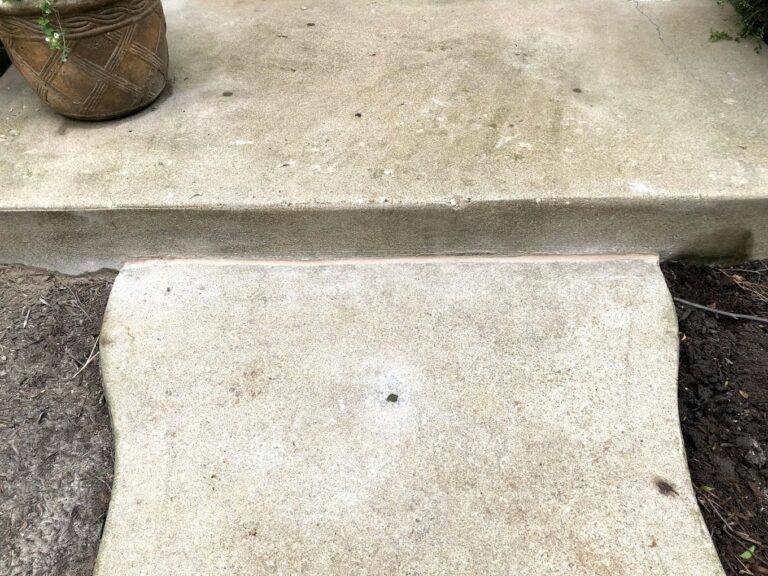
Leveling is for a slab that is intact but out of plane. Patching is for a localized defect in an otherwise serviceable surface. Replacement is for concrete that has lost its section or its support. The method follows the inspection: how much of the slab is sound, how the movement happened, and whether the surface can accept a repair. A quote should name the method and the surface. If it does not, ask which one is being priced.
ACI's horizontal repair guide is general technical guidance, not a specification for this house.
Exeter Public Works publishes a driveway-paving resource for residents. That page is about the town side of paving and access, so it belongs in a conversation about the street edge, not in a quote for a load-bearing slab. If a question is about the apron where a private drive meets the roadway, use the town resource. Keep that separate from a basement, step, or interior slab repair so the estimate does not blur public work with private concrete.
Read the Exeter source. We check the approval path against the proposed scope.

Some conditions sit outside a concrete repair scope. A crack tied to building movement may need an engineer or a foundation contractor before anyone patches it. A slab that has settled because of a failed base may need the base addressed, not only the surface. Work at the street edge, including the apron where a private drive meets the roadway, is not the same as a private slab repair. A repair quote should say plainly when the work is outside its scope. If a condition falls outside what we handle, we will tell you before work begins.
Access, slope, drainage, and what sits on the slab all change the repair plan. A step and landing are fixed heights, so the repair has to respect the existing rise. A driveway apron has to handle vehicle loads and the transition to the roadway. A basement slab has to be judged against the walls and the building above it. None of those conditions can be assumed from a town name. On a hypothetical Exeter property, the inspector should look at the first step and landing as one set, then look separately at the apron. The written scope should name the surface and the constraint that shaped the method.

A useful estimate names the surface, the symptom, the method, and the limit of the work. It should say whether the price covers a step, a landing, a driveway apron, a basement slab, or a patio slab, and it should say what is excluded. If the work is a repair, the estimate should describe the preparation and the material. If the work is a replacement, it should describe the removal and the pour. If the work is leveling, it should describe what is being lifted and what stays in place. ACI RAP-1 discusses structural concrete cracks, but the estimate should still state the assumption in plain language.
Not every call needs a repair. A hairline crack in a slab that is not moving may need monitoring, not patching. A low panel that is still sound may be a leveling question, and leveling is not always cheaper than replacement. A surface defect that is stable may be left alone. The honest answer can be that no work is needed now, or that a smaller repair covers the problem. On a hypothetical Exeter property, the first step and landing might be fine while the apron needs attention, or the reverse. The decision should follow the inspection, and the homeowner should be free to stop there.
Not by itself. A crack can come from shrinkage, a joint, or a local repair issue, and it does not prove the structure is failing. If the crack is wide, moving, or paired with settlement, bring in an engineer before patching. If it is stable and narrow, monitoring or a localized repair may be enough.
Show us the concrete and we will tell you what is worth fixing, what can stay, and what still needs checking.

