



A low slab, a broken edge, and a moving crack are three different problems, and only one may need a repair.
Sound surrounding concrete with a limited damaged edge may support a focused repair.
A sound but low slab belongs in a concrete-leveling assessment.
Broken pieces may need a new pour. Movement tied to the building needs a structural check.
Concrete repair in Hampton Falls begins with a simple diagnosis, not a product choice. A sound but low panel still rings solid underfoot and has no loose pieces. A repairable broken edge or surface has sound concrete behind the damage. A slab that needs removal and re-pour is usually cracked through, rocking, or settled in more than one direction. A crack associated with building movement may run through a foundation wall or across a slab that ties into a structure. Those are different problems. The diagnosis decides the scope.
Not every slab needs to come out. If the concrete is sound but low, and the low edge is not fighting a drainage path, leveling may be the smaller repair. If the damage is a broken edge or a surface spall, a partial-depth repair can sometimes stay within the existing slab. If the slab is cracked through, rocking, or settled unevenly, removal and re-pour is the honest option. If the crack is tied to building movement, a flatwork repair may not address the cause. ACI RAP-11 discusses slabjacking assessment, and NRMCA CIP6 discusses planned slab joints, but those documents do not tell us what this specific slab needs. The decision is made on site, not from a photo.

Method selection follows the diagnosis. A sound but low panel may be a candidate for lifting, but only after the water path is understood. A broken edge or surface defect may call for removal of loose material, preparation, and a patching material. A slab that has settled in multiple directions or cracked through may need removal and re-pour. A crack associated with building movement may need a structural review before any flatwork repair is promised. The repair has to match the damage, and sometimes the right answer is that the damage is outside the scope of a concrete repair.
ACI's horizontal repair guide is general technical guidance, not a specification for this house.
Hampton Falls' driveway form identifies a town right-of-way and places driveway-culvert maintenance on the property owner. That matters here because a low concrete approach near a culvert or ditch is not just a flatwork question. Before promising a new height, the water path has to be understood. A lift must not become a shortcut around a drainage problem the town form already assigns to the owner.
Read the Hampton Falls source. We check the approval path against the proposed scope.
A repair can go wrong when the water path is ignored. If a low approach sits near a culvert or ditch, lifting the slab without addressing drainage may just move the problem. A repair can also go wrong when a surface patch is used on a slab that is moving. A crack tied to building movement is not a cosmetic issue. Some conditions are outside our scope. Active water, unstable subgrade, or structural movement may need an engineer or a different trade. ACI RAP-1 discusses structural concrete cracks, but that does not mean every crack is structural. A concrete repair cannot fix a drainage problem or a foundation movement problem by itself.
The site decides what is practical. In Hampton Falls, the driveway form identifies a town right-of-way and places driveway-culvert maintenance on the property owner. That means a low concrete approach near a ditch or culvert may involve a water path the owner is responsible for. Before promising a new height, locate the low edge relative to the ditch and house. Ask where water goes after a hard rain. Access, slope, and nearby structures also matter. A small entry landing may be simple to lift, while a driveway approach tied to a culvert may need a different conversation. The site visit answers those questions.
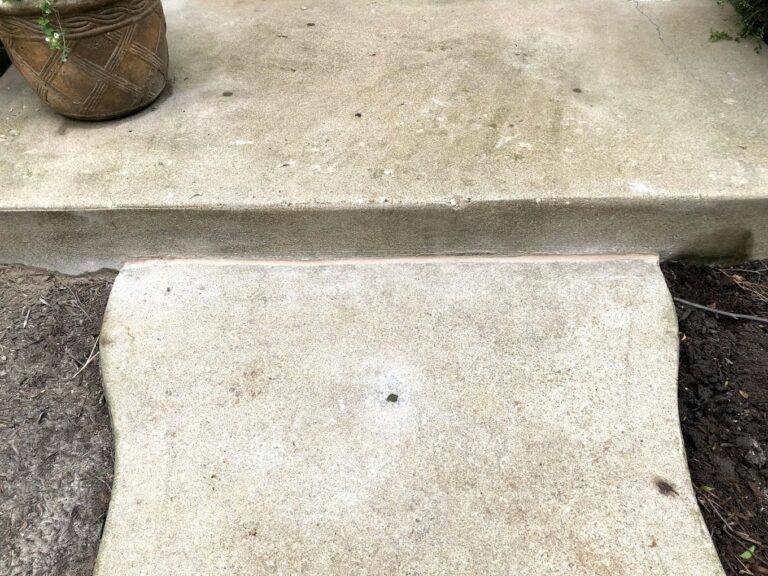
A written estimate should name the repair, the area, and the limits. It should say whether the scope is leveling, partial-depth repair, removal and re-pour, or a recommendation to get a structural review. It should state what is not included, such as drainage work or work beyond the agreed concrete boundary. It should describe how the work will be measured and what access is needed. If the estimate is for lifting, it should say what happens if the slab does not respond. If the estimate is for removal and re-pour, it should say what happens to the existing material. The estimate should be clear about scope.
Sometimes the right answer is no work, or smaller work. A sound but low panel that is not causing a drainage problem may not need to be lifted. A hairline crack in a slab that is not moving may not need repair. A small entry landing with a minor surface defect may be left alone if it is not a trip hazard. If the low edge is beside a ditch or culvert, the water path may need to be addressed before any lift is promised. If the crack is associated with building movement, a concrete repair may not be the answer. 603 is willing to say the homeowner may not need a repair, and that is a useful outcome.
Not necessarily. A sound but low panel may be a leveling candidate, but the water path matters first. If the low edge sits near a ditch or culvert, lifting without addressing drainage may not help. 603 will ask where water goes after a hard rain and whether the low edge is beside the ditch or closer to the house. If the slab is sound and drainage is not a problem, the right answer may be no work. If the slab is cracked through or moving, removal and re-pour may be the honest scope.
Show us the concrete and we will tell you what is worth fixing, what can stay, and what still needs checking.

