



A cellar crack running toward an addition wall does not reveal the wall's support.
A crack that runs across a Groveland cellar floor toward an addition wall calls for a support check, not an automatic slab-foundation repair. The wall may have its own footing. The floor may meet it without carrying it. Or a designed edge may transfer some load. 603 Basement Solutions measures the wall and floor, checks framing and available drawings, and asks what actually bears on what. If only the nonbearing floor has cracked, a structural system may be the wrong purchase.
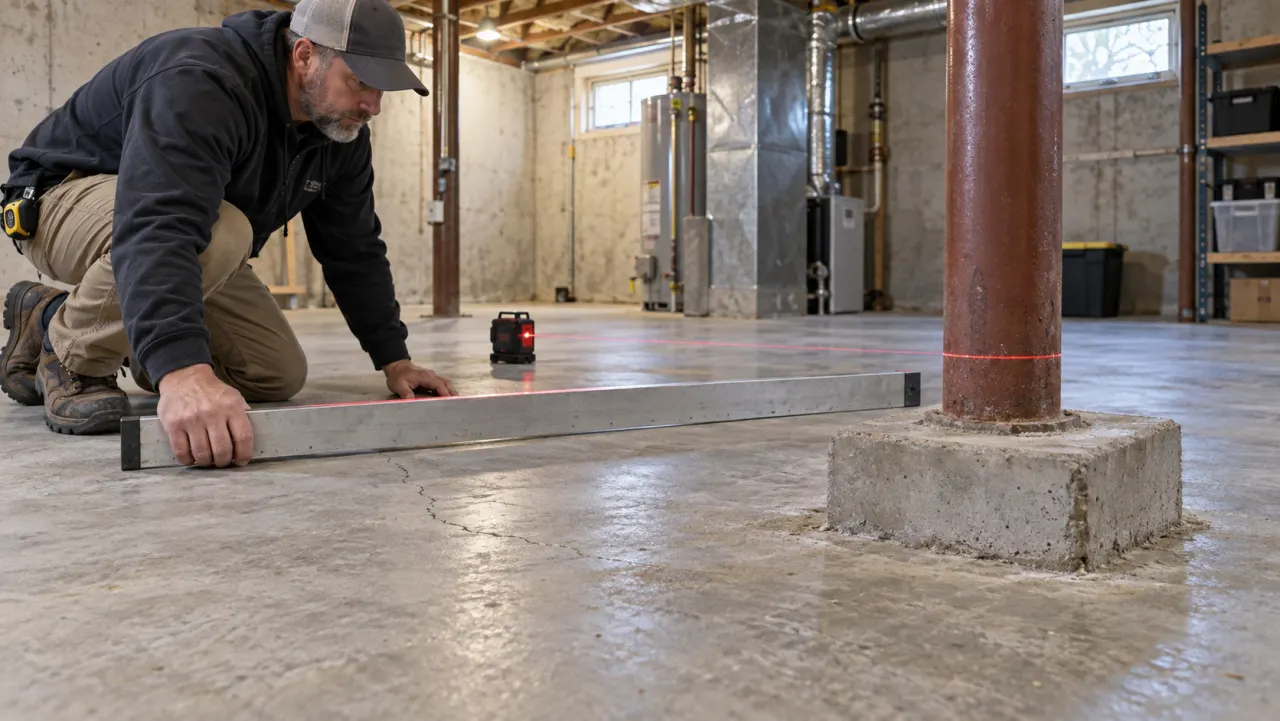
We mark the crack and measure any vertical displacement. Then we look at the wall above and below that line. Is there a beam landing nearby? Does the addition wall meet a foundation wall or a slab edge? Are there visible changes in siding, trim, doors or interior finishes that predate the floor crack? We ask for construction and repair records rather than assigning an age or foundation type to the addition by appearance.
The crack’s direction is a clue, not a verdict. A shrinkage line can run toward a wall. A floor cut made for a service can do the same. A moving footing can change a wall while leaving little floor damage. We record where the line begins, whether its edges are offset and whether it is changing. A repeatable elevation grid across both spaces is more useful than pointing to the widest spot in a single photograph.
An addition can alter framing and load transfer, but this page does not assert that your Groveland house has a specific addition history. The question is what supports each part of the current building. We trace joists, beams, posts, walls and visible footings on both sides of the junction. If the critical detail is concealed, a limited opening or qualified structural review may be needed. The investigation should be designed to answer one support question while keeping utilities and occupied areas safe.
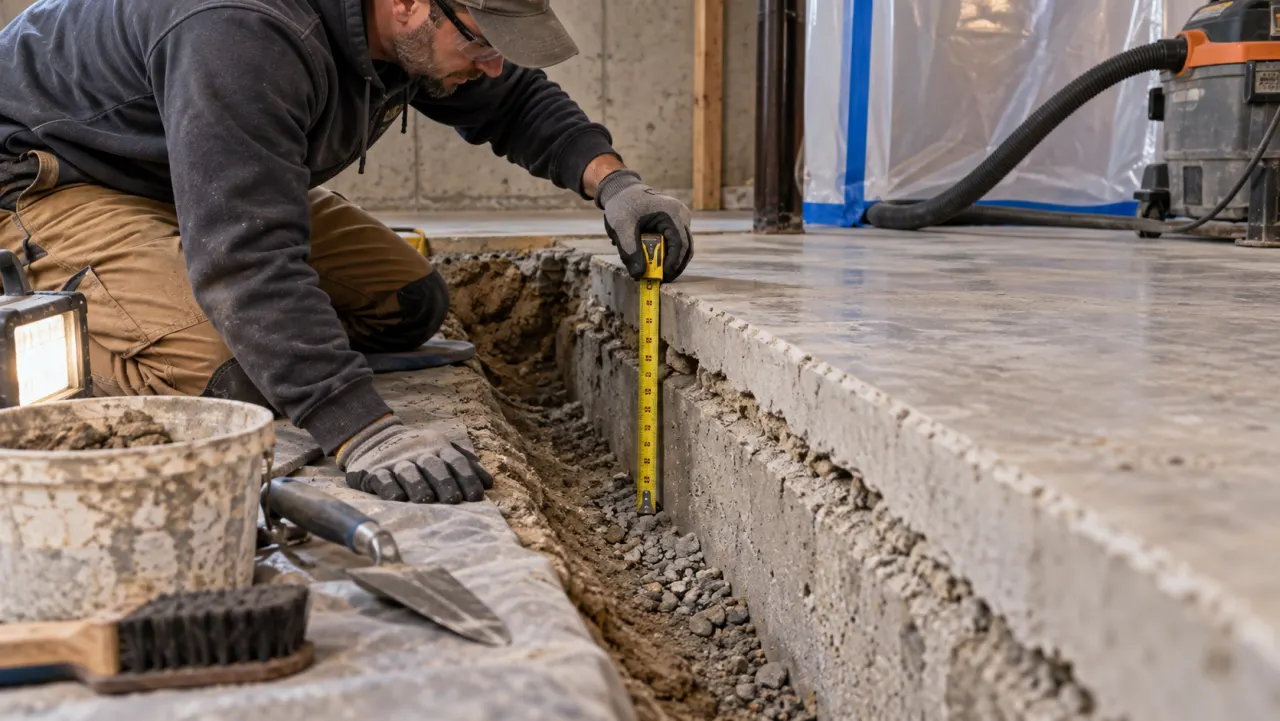
ACI explains that some slabs are soil-supported while others transmit structural loads. Its residential concrete guide addresses slabs, walls and footings in separate chapters. This does not identify the concealed edge in any one house. We use it as a reason to inspect the actual load path before choosing a product. A crack in a cellar walking surface is not enough to prove a footing has failed.
For an isolated stable surface defect, concrete repair may be suitable after the cause is understood. A separate intact low panel can be considered under concrete leveling if lifting will not disturb the wall. A floor that is broadly unsound may need new slab pouring with a base and moisture plan. None of these flatwork treatments corrects a bearing wall that has moved. If the wall or footing is changing, structural and foundation repair is the more relevant owner and engineering input may be needed.
There is no honest universal repair for “crack near addition.” A pier, underpinning, wall treatment, limited patch and monitoring are different decisions. We would state which measured condition supports each one. We would also say what a photo and a first visit cannot settle. That protects you from paying for a neat floor that leaves a loaded wall moving.
Groveland’s PermitLink portal is the town-named online permitting route. We ask the building office about review when the work is defined, especially if a footing, wall or other structural element would change. The portal does not tell us that a particular crack requires a permit or that a particular addition was built under one. We make no such claim.
Before work, the plan should locate the opening, describe temporary protection if loads are affected, and show how the repaired support will be evaluated. If the investigation instead finds a sound wall footing and a stable floor-only crack, the scope should shrink. A good process permits that less expensive answer.
The old and added areas may not share the same floor finish or elevation, so one level reading can mislead. We mark a grid on both sides of the junction, identify which points are on walls, posts or free floor, and note any threshold that was built with a step. The homeowner can then compare later readings at the same spots. We do not infer that a difference was caused by settlement simply because the two spaces meet at a crack. Construction records and dated photos are useful precisely because they show what was already there.
If the wall and its footing are sound but the floor line is stable and unsightly, a bounded repair may be enough. If the wall is changing, a surface fix cannot carry its load. If the floor is low in one area but no structural element moved, a leveling discussion may be reasonable. Those are three distinct findings and three distinct estimates. We will not bundle them into a single “foundation slab” price until the measurements support that description.

Google review · Customer experience
adauri rosario de jesus ★★★★★
“I contracted 603 basement solutions to do helical pier systems to stop my foundation from sinking into the ground any further.
They showed up with a beautiful CAT excavator and did incredible work. By far my favorite experience working with a contractor, they communicated well, they were professional, and they actually cared about every concern I had. I’d recommend them to anyone”
Ask what supports the wall at the crack, which parts of the floor are merely a surface, and what measurement suggests present movement. Ask whether old drawings would change the recommendation. Ask what happens if an opening finds a separate sound footing or a concealed utility. Ask how a finished repair will be checked and which floor finish work comes afterward.
Do not buy structural slab work from a photo of a line running toward a wall. Do not ignore a wall that has measurably changed because the floor crack looks small. Send us wide views of both sides of the junction, the framing and the full floor area, along with any dated photos. We will identify the bearing question first and tell you if structural work is actually warranted.
Show us the affected concrete. We will explain what we measured, what can stay, and which scope fits the house.

