



Lift the private driveway edge only when it preserves the town-side walking transition.
If an Ayer driveway panel has dropped next to an otherwise sound sidewalk crossing, the first question is whether lifting the private concrete can leave a smooth, draining transition at the town-side surface. 603 Basement Solutions measures the fixed sidewalk and driveway joints before proposing polyurethane leveling. Ayer’s street-opening regulation has a specific full-section replacement rule when public concrete sidewalk is excavated or damaged under street-opening work; that is not a claim that an untouched private-panel injection requires sidewalk replacement. We separate those scopes before bidding. A broken slab, an unworkable target grade, or a public-side defect calls for another plan rather than a routine lift.
A driver notices a jolt near the street, but a close-up of the joint does not identify which piece changed. We compare the private driveway panels, sidewalk crossing if one exists, curb or apron, and the adjacent road edge. We also ask what happens when someone walks across the same area. A lift designed only for tire comfort might create a pedestrian lip or redirect runoff into the sidewalk. The useful target is a driveable and walkable connection that leaves a sensible water path.
We check the concrete for through-cracks, unstable corners, spalling, and old patches. A surface blemish can be repaired without moving the panel; an unstable slab may need replacement even when it is low. ACI RAP-11 on slabjacking describes evaluation and lifting of appropriate settled concrete. It does not prove that this Ayer panel is intact or explain the cause of movement at a particular property. For a coherent slab with room to move at both ends, polyurethane can be considered as a support-and-lift method. The drill pattern, target elevation, and stop conditions belong in a measured proposal.

We ask whether a downspout discharges onto the drive, where water stands after rain, and whether lifting one corner could send flow toward a garage or neighboring property. The answer comes from the site, not the town name. The slab need not become perfectly flat to be safe; it may need a controlled slope. Aiming only at the highest adjoining edge can make a new dam. If the two fixed surfaces cannot be joined while preserving a safe water route, a new panel with redesigned base and grade may be better.

Ayer’s Street Opening Permit Regulations are written for the town right-of-way. They say an approved permit precedes excavation, occupancy, or obstruction there. Section 7.10 says a concrete sidewalk section excavated or damaged by street-opening work must be replaced in its entirety. That is a real, specific constraint if a proposed job reaches the public sidewalk. It is not an instruction to tear out an unbroken town sidewalk every time a private driveway panel is leveled nearby.
This is why we mark the work line. If the low piece is private and the proposal does not disturb a public sidewalk, we describe a private slab repair and still confirm the actual boundary. If the public section is itself damaged or the plan requires work there, the town’s process is a separate conversation. The Ayer Streets & Sidewalks page links the town’s current permit materials. We will not infer an individual permit outcome from a photograph or promise that a public-side condition can be included in an ordinary private-panel quote.
During the site visit we record the height difference at the street-facing joint and at the next private panel. We look for utilities, drainage structures, or other buried features before deciding where any injection could occur. We ask whether the slab can move without cracking the next section. In a narrow area, small movement at one end can show up as a larger edge at the other. A homeowner should hear those limits before any drilling, not after a partial lift.
A gap beneath a slab is not a complete diagnosis of why it formed. It may require a base, drainage, or utility discussion that injection alone cannot settle. We can look for evidence and describe uncertainty, but we should not label Ayer soil or weather as the cause of every low driveway. If support cannot be provided within a limited scope or movement is likely to continue without a separate fix, that caveat belongs in the estimate. It may change which service is worth buying.
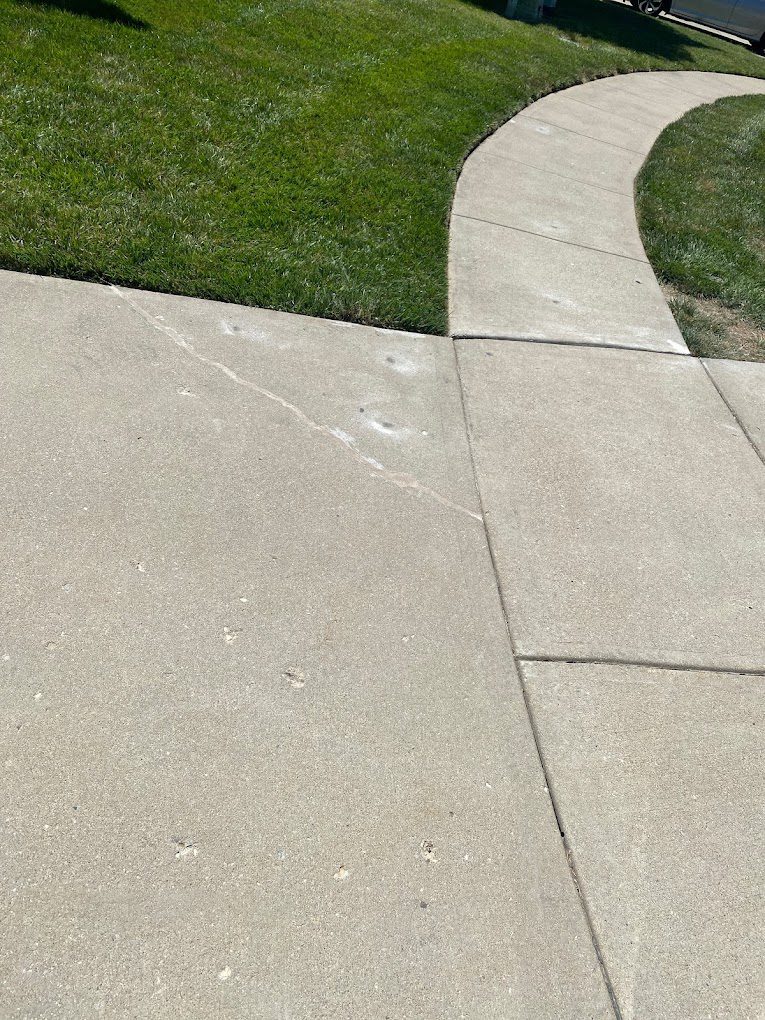
The finished job should be checked by walking and driving the same route used before work. We compare the sidewalk connection only if it is in the observed route; no generic photo of a nice slab proves the transition is correct. We also check the drainage line rather than judging only by a dry surface. A slope that looks smooth can still send water into an unwanted place. The contractor should record what was lifted and what public or adjoining surfaces were untouched.

Google review · Customer experience
Taisha Marte ★★★★★
“This company is the best for foundation issues. They did a whole plan to completely support the house. My house was falling in on itself. Liam took his time to explain different options and did his best to try to get the installation the soonest possible. Angel and the crew did excellent on the installation. They walked me through the whole process and worked efficiently.”
If the panel sits at the right grade but its top has a contained defect, concrete repair is a material question rather than a lifting question. If the panel is fractured, unstable, or geometrically impossible to join to both fixed edges, concrete slab pouring after removal and base preparation can reset its grade and joints. If the driveway problem accompanies a moving garage or house foundation, structural and foundation repair is a separate diagnosis. Lifting pavement does not support a footing or repair a foundation wall.
Those are different scopes, not interchangeable bids. Leveling keeps the sound panel. Surface repair preserves the useful elevation while restoring material. Replacement changes the base and concrete geometry. Structural work addresses building loads. A written recommendation should state why the chosen option matches the observed condition and whether public-side work is included, excluded, or still awaiting town review.
Send one wide photo showing the driveway connection to the street and a second showing its connection to the garage or house. Take close photos of each crack, loose edge, and joint step. If water stands after rain, photograph its actual path and tell us when the image was taken. Tell the estimator whether a public sidewalk crosses the drive and whether anyone has previously removed or repaired that section. None of these facts alone proves which permit applies, but together they help identify the scope for a responsible visit.
Ask to see the proposed panel boundary, fixed elevations, intended water path, and no-go conditions on the estimate. If a contractor proposes to excavate or damage the public sidewalk, the Ayer regulation is no longer background context; it becomes an active coordination item.
Do not inject under a driveway slab that is broken into pieces or cannot be supported as a unit. Do not accept a lift that produces a new sidewalk trip point, tire impact, or water route toward a building. Do not let a private-panel quote obscure required public-side work. Where a sound slab has a feasible target, leveling may be the less disruptive choice; when the geometry or material fails that test, 603 should recommend repair, replacement, or structural evaluation instead.
We will inspect the affected panel, explain what can be kept, and put a useful scope in writing.

