



Confirm whether the driveway is truly shared before changing one panel's grade.
If a sound concrete panel has settled in a Southborough driveway, a controlled lift may preserve it. On a driveway that is actually shared, however, the finished height has to work for more than one user’s route, drainage and maintenance responsibility. 603 Basement Solutions would establish whether the panel is on a one-home private drive or a common drive before proposing a scope. Southborough lists a Common Driveway application, but that listing does not prove a named property’s drive is common or that every one-panel lift needs Planning review. We measure both ends of the panel, vehicle paths and runoff and explain any ownership or town-facing question rather than treating one homeowner’s trip edge as the whole problem.
A homeowner may know a driveway is shared because two homes use it, or may simply have a private drive near a neighbor’s property. Those are not interchangeable. We ask who owns and maintains the surface, who uses the affected panel and whether any recorded arrangement governs changes. We do not infer sharing from the street view. If the panel is private to one home, we can assess its garage and road transitions in the usual way. If other users depend on it, their tire paths and water route are part of a responsible target elevation. Moving one piece to help one entrance might worsen a joint for another.
The panel itself needs a material assessment. An intact slab that has dropped as a unit may be suitable for staged polyurethane leveling. A piece with through-breaks or loose corners may not lift coherently. ACI RAP-11 describes evaluating and raising suitable settled concrete in increments; it does not approve a specific Southborough property, prescribe universal injection points or guarantee that a shared drive will respond uniformly. We inspect accessible edges, measure both joints and explain the stop conditions if a crack opens or adjacent grades become unsafe.
Why the slab moved may remain uncertain after a first look. Water moving along a joint, an earlier repair or inadequate support can present similar surface clues. We ask what changed and where actual puddles occur, but we do not declare a void or soil condition based on the town name. The proposal should say what we can retain, what we can observe during a lift and what hidden condition might force a different repair. That is especially important where maintenance costs or disruptions may be shared. An honest estimate makes its assumptions legible to everyone relying on the route.


Southborough’s Applications, Rules & Regulations page lists a Common Driveway application. That is evidence of a town process for that category, not proof that a particular parcel has a common driveway. Nor does a listed application mean a same-footprint private-panel lift automatically needs Planning review. We would identify the actual arrangement and work area first. If a shared entrance would change, the proposal should address how the users, maintenance obligations and any town-facing review are handled. If the drive is one-home private concrete, we should not invent a common-drive issue merely to sound local.
On a truly shared drive, the lift target must be checked in both travel directions. A panel with a bump for one car can be the smooth approach for another; the neighboring panels may be fixed by different ownership or prior work. We measure the longitudinal route, cross-slope and water path before raising anything. We would not promise a perfect grade for one home if it creates a new problem for the other. The written plan should identify who has authority to approve changes and which affected parts are included. That is an ownership and design question, not a diagnosis from the application list.
Water may cross the same property boundary. A higher panel could shift runoff toward one garage, across a shared walk or into a lower adjoining slab. We ask for observations after rain and measure existing slopes. We will not assert that water crosses a particular boundary without evidence. If a limited lift cannot preserve a usable route for all affected users, a rebuilt profile or drainage plan may be preferable. The ability to inject under one panel does not by itself make that intervention the right shared-drive decision.
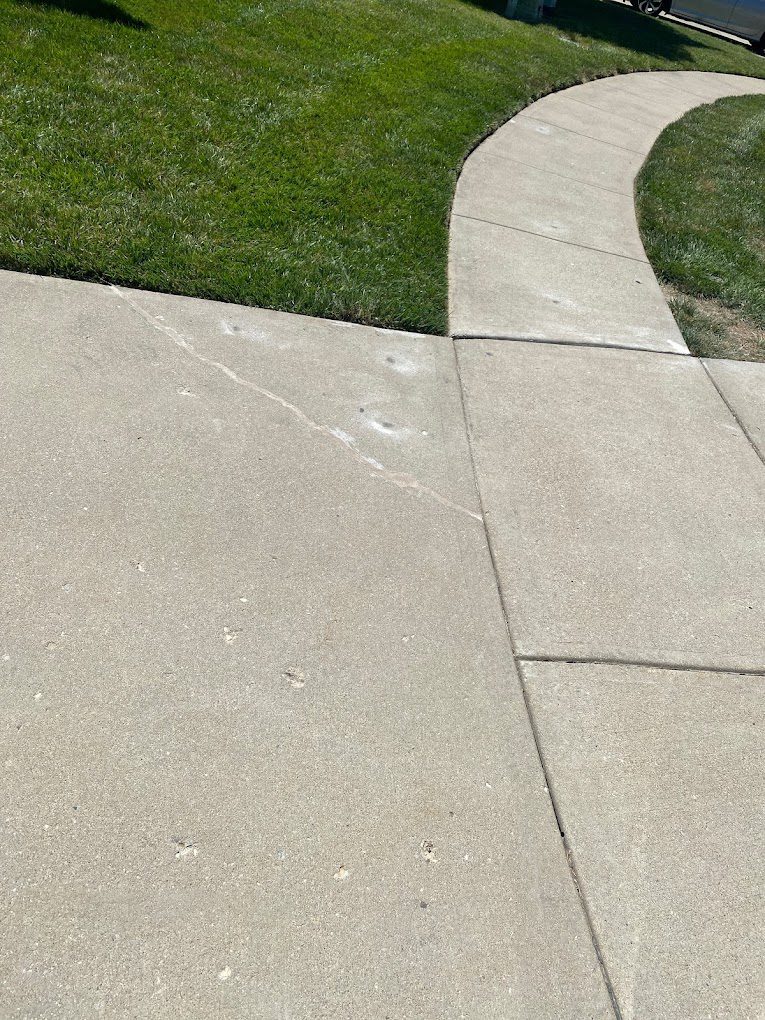
Concrete repair restores chipped or spalled material where elevation is already serviceable. Concrete leveling keeps a coherent settled panel and changes its height. Concrete slab pouring replaces material when the old slab is unsound, the base needs reconstruction or the full route requires a new profile. Those alternatives affect joint lines, access and potentially more than one user’s grade. Compare bids by the exact panel retained or removed, the post-work route, water treatment and what is excluded from price.
An exterior drive is not a bearing foundation simply because it reaches a house. If a wall, post or structural floor moves, structural and foundation repair is a separate diagnosis of the building load path. Foam below a drive will not stabilize the structure. We would describe the evidence for an isolated driveway slab and refer structural clues for a proper assessment. That helps avoid mistaking a better tire route for a house repair.
Send wide photographs of the whole drive from each end, close views of both joints of the low panel, cracks and loose corners, and any actual water marks. Tell us whether another household uses the panel, whether the drive is formally shared if you know, and who usually arranges maintenance. We do not need an invented legal answer before visiting. A ruler at the lip gives scale, but the safe height depends on every fixed edge and route. We will confirm the physical scope, discuss who needs to be involved and put the alternatives in writing.

Google review · Customer experience
Erik Dodge ★★★★★
“Excellent customer service, prompt response to any questions, professional and quality work at a competitive price.”
Do not inject under concrete that has broken into pieces or cannot rise without creating an unsafe joint. On an actual shared driveway, do not raise one user’s approach if it worsens another user’s route or pushes water toward a neighboring entrance. Do not apply Southborough’s Common Driveway application to a one-home private driveway without evidence, and do not assume it approves any particular lift. If ownership, access or town-facing changes are unresolved, resolve them before work. If the house structure is moving, assess the building load path before buying a driveway-only treatment.
We will inspect the affected panel, explain what can be kept, and put a useful scope in writing.

