



Compare lifting a sound driveway panel with repaving, then check both vehicle transitions.
When a Weymouth driveway panel drops but remains coherent, lifting the existing concrete can be worth comparing with repaving or replacement. The comparison is not simply a question of which price is lower. A lift has to leave a usable vehicle approach at the street side, the garage side and every joint between them. 603 Basement Solutions would measure the full drive profile, test whether the panel can be retained and check drainage before recommending polyurethane leveling. Weymouth’s town FAQ says driveway paving needs a DPW permit even if the paved area is not enlarged. That is a clear rule for a paving scope; the FAQ does not explicitly decide how an injection-only lift is classified. We would confirm the actual proposed work with the town rather than claim an exemption or automatically price it as paving.
A driver may feel a jolt at the edge of a settled slab. The tempting fix is to raise that edge until it looks flush. But the opposite edge of the same panel, the garage floor and the road-facing approach are fixed references. We would trace the tire path and measure each joint, including what happens when a vehicle turns across the panel. If the rise needed at one end makes the other end high, a single-panel injection may not solve the route. The estimate should say which transition is the priority and what happens to the remaining ones.
We also inspect the concrete as a material. Is the panel largely intact, or is it divided by a through-crack? Are corners loose? Is there a joint that has crumbled so that raising the slab would leave an unsupported edge? ACI RAP-11 describes evaluation and controlled raising of suitable settled slabs. It is not a guarantee that any slab with a height difference is sound enough to lift. We would explain what the inspection found and where uncertainty remains under the concrete. If the panel begins to crack or adjacent grades become worse during a test lift, work should stop and the plan should be revisited.
Visible conditions can have several causes. Prior utility trenching, drainage, erosion and base compaction could each affect exterior paving, but none should be assigned to a particular Weymouth address without evidence. We would ask when the movement appeared, whether another panel changed at the same time, and where rain or meltwater actually travels. We would look at accessible edges and nearby downspouts. These observations can guide a scope, but a photograph of a low corner cannot prove the full condition of the base.


Weymouth’s town FAQ states that a DPW permit is required for any paving work on a driveway, even if the area is not enlarged, and says the contractor should obtain it before starting that work. This becomes directly relevant when a comparison quote proposes repaving or replacing the driveway surface. A controlled lift that keeps the existing slab is physically different from placing new paving. The FAQ does not expressly classify injection work as permitted or exempt. We would show the town the proposed work if there is a process question, especially if access, staging or apron work approaches the public way.
That distinction should be visible in the estimates. A leveling price should identify the specific sound panels kept, intended rise, injection locations and any joint or surface work excluded. A paving or replacement price should explain removal, base preparation, new material, drainage, joints, cure and DPW process. Comparing only the headline price can mislead an owner if one bid assumes the existing base and the other rebuilds it. Conversely, a more disruptive repaving proposal is not automatically better if the concrete remains serviceable and a measured lift can restore the route.
The street end deserves special attention. A dropped interior panel may make the apron look steep even when the apron itself has not moved. Raising one section can shift the bump toward the road. We would record the transition at the existing apron and not promise to modify it without a separate scope. If a proposed solution requires changing the entrance, the town-facing work and its approval question belong in writing. The objective is a drive that functions from garage to street, not a visually flat center panel with a new scrape at either end.
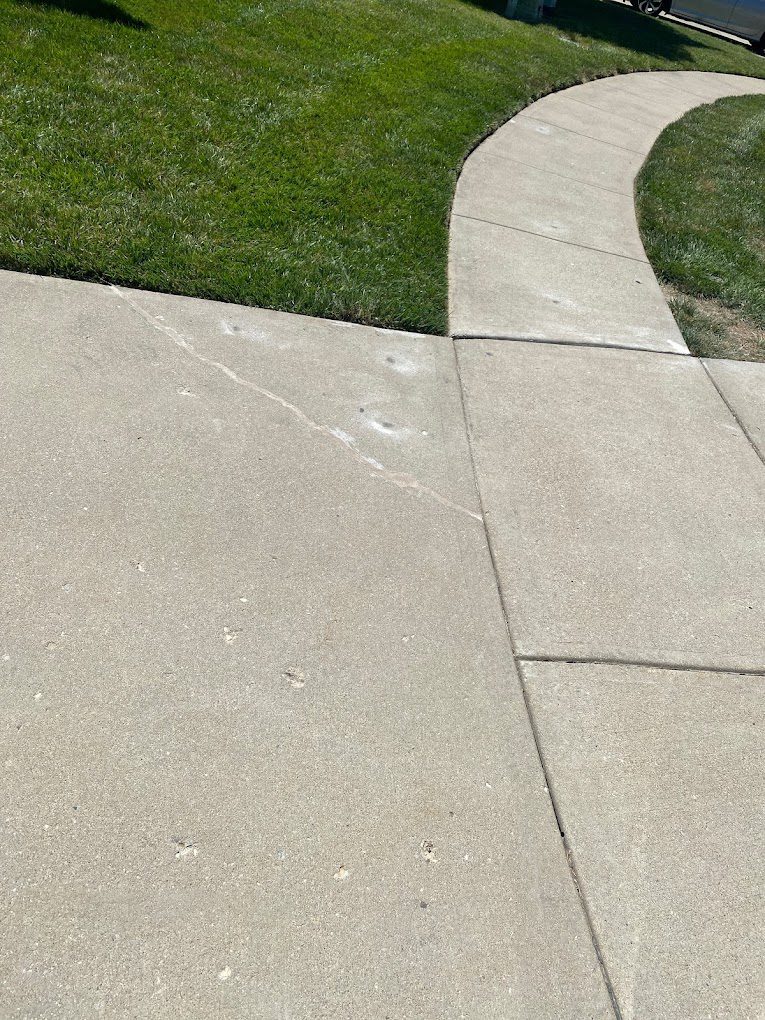
We would check the direction of surface water before specifying a lift. A new grade should not send runoff into a garage, toward the house wall or across a walkway that did not previously collect water. If existing water stains or puddles are visible, we would record them. If not, we should not invent a drainage problem. Polyurethane can change slab height and support a retained piece; it does not fix a blocked drain or redesign a failed site grading system. A responsible estimate explains when separate drainage work or a replacement profile is needed.
The work plan should address household access. Vehicles may need to be moved, and people need a safe walking route during injection. The crew should protect nearby finishes, locate safe holes, raise incrementally and check both ends of the panel as the work proceeds. Afterward, the owner should see the actual resulting joint differences and know whether joint sealing or edge repair remains. Reopening to vehicle traffic depends on the chosen material and conditions. We would not promise a fixed number of hours for every project from a city page.
Good first photos show the whole driveway from garage to street, both ends of the low panel, cracks or loose corners, and any water that stands after rain. A short video of the vehicle approach can help explain a scrape, but it cannot replace a level survey or material inspection. Tell us if the problem appeared after nearby work or if multiple panels have changed. That history can keep the proposal focused on the actual moving parts.

Google review · Customer experience
Riley Lebel ★★★★★
“Very transparent with everything they do, employees are great, personable, and very efficient, and the work comes out fantastic!”
If the surface is at a usable elevation but has a small spall, concrete repair may be enough. If a coherent panel has dropped, concrete leveling can be considered to keep it. If the slab is broadly fractured, a base must be rebuilt or the garage-to-street profile cannot work with the existing panel, concrete slab pouring may be more suitable. If a crack or movement is tied to the house footing or another load-bearing element, structural and foundation repair investigation is a separate priority. We should not sell exterior driveway foam as a foundation treatment.
There is also a legitimate monitoring choice. A small stable difference that does not create a vehicle, walking or drainage issue may be photographed and remeasured later. The owner can decide whether the practical benefit of a lift justifies the work. We would explain what change would make intervention more urgent rather than present every settled seam as an emergency.
Do not inject a slab that has broken into pieces or cannot retain its shape under a controlled rise. Do not remove one scrape by producing another at the apron or garage. Do not ignore an active water source or move runoff toward the building. Do not assume Weymouth’s paving rule proves an injection-only job needs the same permit, or claim that it is exempt. If a comparison changes from leveling to repaving, the DPW process belongs in that new scope. A homeowner should receive a measurable, limited proposal and a clear replacement alternative, not a promise that foam can correct every driveway geometry.
We will inspect the affected panel, explain what can be kept, and put a useful scope in writing.

