



Check the first riser and the water path before moving a settled entry panel.
An Andover entry walk with one low concrete panel may be a candidate for leveling, but a visible trip edge does not tell us whether the slab can be saved. 603 Basement Solutions checks the concrete body, the joints, the first step, and where rainwater will go after any change in height. If the panel is broken or surface repair will not last, we discuss replacement. If movement appears connected to the house, we look at the structure before recommending a walk-only fix. The inspection should give you a clear scope, not a product selected from a photo.
On an entry route, a low panel changes the effective height of the step ahead of it. We measure the transition from the walk to the first riser, and then from the step to the landing or door. Raising the low panel could improve the trip edge at one joint yet make the first riser less comfortable. The right target is a coherent route a person walks, not one isolated reading at the worst-looking crack.
Ask yourself where the problem is felt. Does a shoe catch at the joint? Does a wheeled bin or stroller hit a lip? Does water sit there after rain? Those observations tell us what the homeowner actually needs changed. We also note fixed surfaces: a porch step, retaining edge, wall, or adjoining walk panel may limit how far a sound slab can move. A proposal that never identifies those limits is incomplete.
The panel’s condition determines whether the old concrete is worth keeping. Sound sections that have settled can be evaluated for concrete leveling. A chipped but stable edge may need concrete repair instead. A crumbling or extensively fractured walk may need new residential concrete. A load-bearing slab under the house belongs to slab foundation repair, not an entry-walk lift.
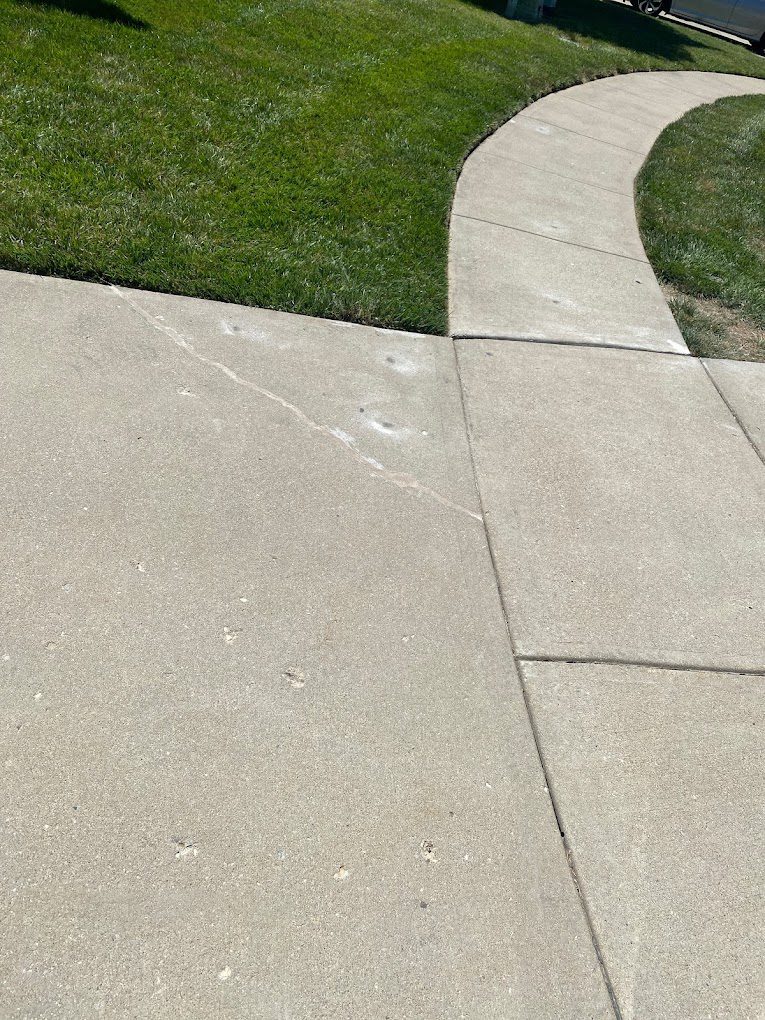
We ask where water comes from and where it leaves the walk. A roof downspout, paved driveway, or adjacent grade can send water across an entry panel. If the low spot fills after rain, changing the height may alter the puddle, but the source and discharge still matter. A lift without a drainage conversation can make the surface look better while water keeps moving material around it.
At the inspection we would observe the slope across the whole route, not only the lip between panels. We would check whether the proposed finished height sends runoff away from the door and whether another fixed surface blocks that path. If the needed change cannot be achieved without creating a new water problem, we would discuss a different scope. We will not promise a precise finished pitch from a photo.
The ACI slabjacking field guide describes slab-on-ground lifting as a repair selected after assessing the existing condition and support. It does not say every uneven walk should be raised. We use that inspection-first principle while the actual method, material, and achievable movement remain project-specific.
The entry walk a homeowner maintains is not automatically the same surface as a town sidewalk. Andover’s Public Works Request page is the official route for submitting a public-works concern. If the low panel appears to be in a public sidewalk, identify that boundary before treating the whole route as private work. If the affected section is entirely within the property, this town reporting tool does not diagnose or authorize the private repair. We do not present a general permit claim for an address we have not seen.
This distinction is practical: the quote should identify the exact panels under 603’s proposed scope. The fact that two surfaces touch does not make them one job or one owner’s responsibility. A homeowner should know which edge the proposal will change and which adjacent surface remains outside it.
A loose corner, a slab that has broken into independently moving pieces, or concrete that has lost its sound surface can turn a leveling discussion into a replacement one. A door that recently binds, a wall crack that is changing, or an interior floor change should prompt a separate structural look. An exterior walk might have settled while the house has not; we do not infer the diagnosis either way from an entry photo.
We also may recommend no immediate concrete work if the panel is stable and the concern is only cosmetic. The purpose of a free inspection is to tell you what work will actually improve use or drainage. We should not create urgency because a page is titled for Andover.

Google review · Customer experience
Madison Cao ★★★★★
“Amazing owners! Dealing with Chris was great! Him and his crew very hard working and respectful! Definitely recommend”
The document should name the affected panels, the desired result at the tripping joint and first riser, the limits created by fixed steps and the doorway, and any drainage work that is separate. It should explain whether existing cracks or color variation will remain visible. If replacement is the comparison, the homeowner should see the additional removal and preparation that option entails. This is how a quote becomes more useful than a one-line “level walk” price.

Possibly, when that panel is sound and can move without creating an unacceptable step or drainage transition. We measure its edges and adjacent surfaces before proposing a target.
A patch may address suitable local surface damage. It does not restore lost support under a settled slab. We need to see whether the problem is at the surface or below the panel.
Photograph the whole entry route, then the height difference with a ruler or straightedge. A photo after rain helps if water pools. Tell us if the change is recent and whether the first step feels different; we will verify on site.
We will inspect the affected panel, explain what can be kept, and put a useful scope in writing.

