



A private driveway-panel lift is different from a change to the curb opening or public-way apron.
The first Framingham driveway question is which piece dropped. A sound private panel between the garage and the street may be a leveling candidate. The curb opening and public-way apron are a different scope. 603 Basement Solutions can measure the panel, the garage clearance, the adjoining walk, and the water route before recommending a controlled lift. We will not quote a private slab lift as though it authorizes a curb-cut change.
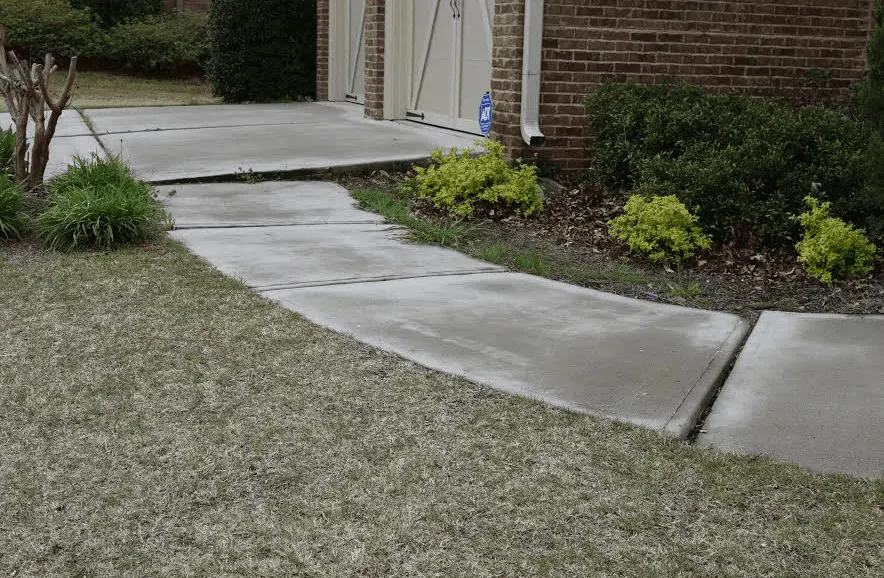
A close-up of a raised joint hides the geometry of the whole approach. We mark each panel and seam, identify the lowest piece, and measure what must remain fixed. At the garage, the door seal and entry slope matter. At a side walk, the crossing must not acquire a new step. At the street, the apron and curb opening have their own boundary. Raising one section can improve a trip at one joint while worsening a different transition. We make that tradeoff visible in the proposal.
Framingham’s official driveway-permit guide distinguishes a new or modified curb cut from work that replaces an existing driveway without changing its original opening. It also describes different processes for state-owned and private roads. That distinction matters before anyone calls an interior private-panel lift a curb-cut project. The city page does not give a blanket permit outcome for polyurethane injection on your property. We identify the actual limits first, then confirm any city-side work with the city. If the desired repair involves widening or relocating the entrance, we do not hide that as a leveling add-on.

ACI’s RAP-11 slabjacking guide covers lifting a settled slab-on-ground and restoring support beneath it. Its method does not tell us whether a particular Framingham driveway is sound. We inspect corners, cracks, previous patches, movement at joints, and any hollow or rocking section. A clean step between two otherwise coherent panels is different from a driveway that has fractured through multiple pieces. The latter may not survive a lift or may fail again because the underlying condition remains.
We also ask what made the section drop. Surface drainage can move base material or keep a joint wet. A buried utility cut or previous excavation can create a separate settlement history. These are possibilities to investigate, not diagnoses we can make from a city page. We check for utilities before any hole layout is agreed. The proposed lift height is set by the garage, walk, neighboring panel, and runoff, not by a wish to make every surface level in isolation.
If the cause is still active, we explain what leveling can and cannot do. Injection can support and reposition appropriate concrete; it does not replace a damaged drain, repair a failed base outside the slab, or strengthen a moving footing. A homeowner should hear that before the crew arrives, not after a puddle reappears.
Some driveway photographs include an apron or sidewalk segment without showing the property line. Framingham’s Public Way Access Permit guidance addresses new or modified access to city-owned roads. The city’s driveway guide also discusses public-right-of-way work. Neither means the private panel two joints back from the street can be treated as a public-way project. Conversely, a private-panel quote should not imply we are authorized to alter the apron. We mark what is inside and outside our repair on a photograph or simple plan.
That boundary protects the result. If the public-side apron is the part creating the trip, lifting the private panel may leave the bad crossing in place. If the private panel is low but the apron is sound, the useful lift must finish at the fixed apron edge. The difference affects access, scope, approvals, and cost. We do not promise to settle a boundary question by choosing the cheaper piece of concrete to move.

Google review · Customer experience
Ken Burke ★★★★★
“Generally great experience. The guy I met with that did the estimate was great. The guy that installed it was awesome. Professional experience through and through”
A driveway whose elevation is right but whose surface has an isolated spall belongs in the concrete-repair conversation. A panel that has cracked into unstable pieces, lost an edge, or has no credible finish grade may need replacement pouring. If the garage floor or house foundation is moving along with the exterior slab, begin with structural and foundation repair. Exterior leveling is not a footing repair. A drain or basement leak needs its own water-entry assessment.
These are not interchangeable bids. Ask each contractor to name the specific section being treated, the elevations at both ends, the method, the effect on drainage, and what is excluded. We can document a leveling proposal with joint measurements before work and the same points after work. If the slab cannot be lifted to the requested height without a garage conflict or a new trip, we should state the limit instead of selling a lift on the assumption that higher is always better.
Give us a wide driveway photograph from the garage to the road, then show where a vehicle bottoms out, where someone trips, and where water ponds after rain. Include the curb opening and any walk that crosses the drive, even if those are not part of your planned work. If you know whether the road is city-owned, state-owned, or private, that helps us frame the scope; we will not assume it from a map view. Tell us about any previous utility excavation, patching, or lifting. Old work can explain a joint, but it does not prove the current cause.
During inspection we measure the panel and adjoining fixed edges. If the concrete remains sound, we outline injection access, target elevations, and the water route. If the curb opening itself must change, we separate that question and follow the city’s published process for the correct road type. The closeout should show which private panel moved, what was not touched, and whether the garage and pedestrian crossings work at the agreed finish height. That is the test of a useful repair, not a before-and-after photo cropped to one joint.
Do not buy a lift for a crumbling panel that cannot hold together. Do not pay to lift an interior section if the defect is in the public-way apron. Do not accept a finished height that traps water at the garage or creates a new sidewalk step. If your real goal is a wider curb opening, leveling is not a substitute for the separate access decision. If the sound private panel can be raised to a workable grade, we will define that limited job plainly.
We will inspect the affected panel, explain what can be kept, and put a useful scope in writing.

