



Check the garage, private panel and apron before treating a low driveway as one repaving job.
A low panel in a Randolph driveway does not automatically call for a new pour. If the concrete remains sound, 603 Basement Solutions can inspect whether a controlled lift would restore the garage transition without pushing rainwater toward the door or creating a new step at the apron. The first decision is where the movement occurred: an interior private panel, the apron, or the curb opening. A lift of one sound panel is a different scope from repaving or widening a driveway, and the town’s published permit guidance treats driveway paving as its own project.
The scrape at the garage door may come from a single dropped panel, a low apron, or both. We measure the threshold, each concrete joint, and the curb-side end so a proposed lift has a target at both ends. The garage entrance must remain usable after the work. We also check whether water has been collecting at the door, crossing the driveway toward the house, or draining across the street-side edge. An improvement at one joint is not enough if the car still bottoms out or water begins entering the garage.
Look closely at the panel itself. A broad, mostly intact piece that settled as a unit may be a leveling candidate. A driveway full of through-cracks, separated corners, crumbling edge concrete, or old failed patches is another case. ACI’s slabjacking procedure explains how an appropriate settled slab can be raised and supported; it cautions against skipping condition assessment. It cannot confirm a Randolph homeowner’s cause of movement from a photograph. We inspect the support and joints before discussing injection locations or a target rise.

The work plan should specify which panel moves and which surfaces stay fixed. Raising the interior panel may leave a manageable garage transition but a sharper apron joint. Raising an apron may involve a different owner or approval path. A simple sketch with measured elevations makes that tradeoff visible before anyone quotes the job.
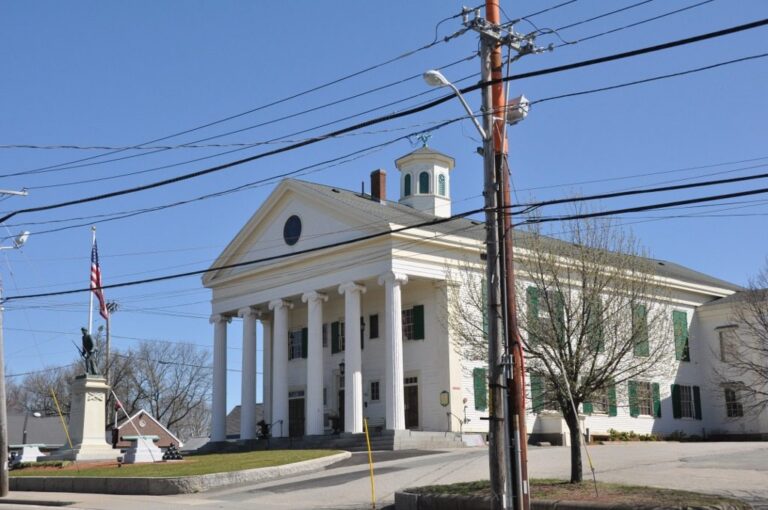
Randolph’s Building Department FAQ says repaving an existing driveway, expanding it, or installing a new one requires a town permit and a bonded contractor before work. The town’s Permitting Center also notes that multiple departments may review paving, access, construction or stormwater work. This is useful when comparing options, but it does not state that every private-panel lift has the same permit path as repaving. We would confirm the actual proposed scope rather than claim an exemption or an automatic approval.
If the owner wants to widen the drive or change the curb opening while fixing the low panel, that is not “just leveling.” It adds a new footprint and access question. The town also encourages attention to impervious area and runoff. We would not tell a homeowner that ordinary concrete is prohibited; the proper point is to define what is changing so any required review can be handled before work starts.
We check the pavement slope from the garage through the apron and toward the yard. Runoff crossing a control joint can exploit a weak base or leave the edge unsupported. A downspout or surface grade may contribute to recurring settlement, but we cannot know that from the municipal FAQ. Where water concentrates, the proposal should address the route. Raising a sound slab while leaving water to flow beneath it may solve the lip but not the reason the support was lost.

A polyurethane lift can preserve sound concrete and avoid a full demolition, but it cannot remake a soft, broken panel. The method also cannot establish an entirely new driveway grade if fixed neighboring elevations leave no room. We tell the homeowner the achievable target, not the tallest corner a pump might force upward. The completed driveway should work for walking, driving, and drainage.

Google review · Customer experience
Taisha Marte ★★★★★
“This company is the best for foundation issues. They did a whole plan to completely support the house. My house was falling in on itself. Liam took his time to explain different options and did his best to try to get the installation the soonest possible. Angel and the crew did excellent on the installation. They walked me through the whole process and worked efficiently.”
An isolated surface spall on a panel that has not moved belongs first in a concrete repair discussion. A fractured or poorly supported driveway that cannot be lifted to a usable line may need a replacement slab with a prepared base. If garage-wall cracks, door racking, or a house footing shows movement, start with structural and foundation repair rather than assume the driveway caused the building symptom. Slab foundation repair is a separate structural question; an exterior drive panel is not a building foundation.
Written alternatives should explain what material can be saved, what must be removed, and whether the proposed work changes the paved footprint or town-side opening. A low-price lift that leaves a sharp curb-side step may be worse than a correctly scoped replacement. A full new pour for a single sound dropped panel may be unnecessary. The useful comparison is the finished route, water path, disruption and approvals, not the service label alone.
Photograph the garage threshold, each driveway joint, the apron and the curb from both directions. Mark where a car scrapes or a person trips. Photos after rain help locate ponding. Tell us whether the driveway was previously repaved, expanded, or trenched for utilities, without assuming that history proves the cause. If a proposed change to the driveway footprint is part of the goal, say that upfront so the town-review question is not hidden inside a leveling estimate.
We will measure what is fixed, test how sound the panel is, and separate private concrete from any public-side work. The proposal should state the lift target at the garage and apron, work exclusions, water-route observations, and the alternative if the panel cannot be retained. The after-check repeats those same critical measurements.
Do not buy a lift for a shattered slab, a moving house footing, or a driveway whose geometry will still be unusable afterward. Do not let a single-panel lift be used as a shortcut around a separate driveway paving or access review. If a sound private panel can be raised to a working line at both ends and the drainage plan holds up, we can describe that limited scope. If it cannot, we should say what repair would solve the actual problem.
We will inspect the affected panel, explain what can be kept, and put a useful scope in writing.

