



Keep the private driveway panel only if its garage, walk, and street-side transitions will still work.
A sound Rowley driveway or walk panel that has dropped may be worth lifting. First we need to find the low panel, measure its fixed edges, and see where rainwater would go after the lift. 603 Basement Solutions can inspect a separate slab for polyurethane leveling. We will not call a cracked-up driveway a leveling job, and we will not treat a moving house foundation by raising concrete outside it.
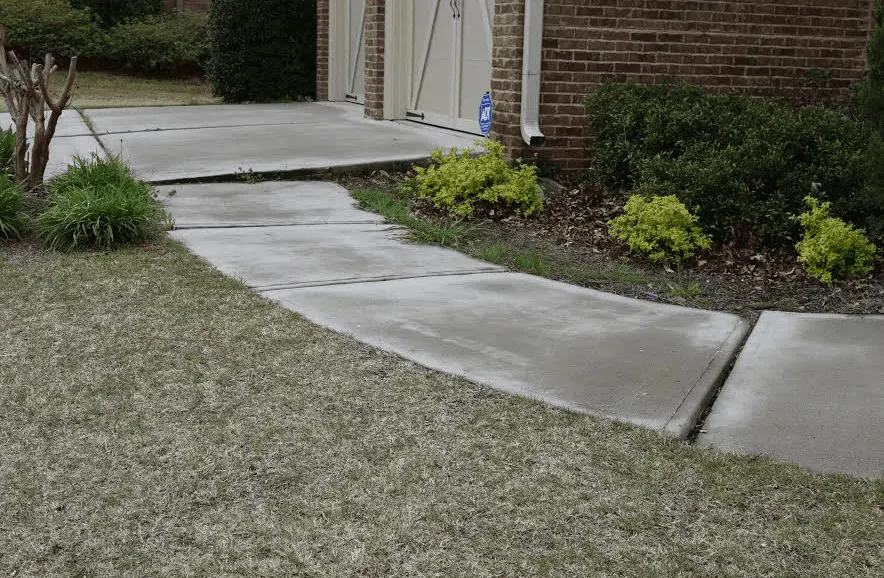
Show us a wide view from the house to the road. A close photograph of one step hides the panel layout. We mark each joint, note which section is low, and measure the change at both ends. If a garage door closes over the slab, its clearance becomes a fixed point. If the panel meets a walkway, that crossing matters too. The highest possible lift is not automatically the useful lift.
Rowley has a Highway Department, and its Planning Board handles common-driveway and subdivision matters. Neither fact tells us who owns the concrete at your address. We identify the private work area before a quote includes a roadside approach or a shared entrance. One town-hosted MassDOT permit covers a particular Route 1A/Main Street approach. It is an example of why a street-edge change can need a separate review, not a rule for every Rowley driveway. A fully private panel is a different question.


ACI’s slabjacking guide describes lifting a settled slab-on-ground and restoring support beneath it. It does not prove the cause of the drop at your house. We check whether the concrete remains coherent, whether corners have broken away, whether the joints are open, and whether water has a route that keeps washing material from beneath the edge. A panel that rocks or breaks at multiple points may not be a good lift candidate.
An injection plan needs access, hole locations, nearby utilities, and a target elevation that respects the garage, walk, and roadway connection. We lift in controlled steps and recheck the transition as it moves. A written proposal should name the exact panel. It should also say which adjacent slabs stay put. If the low part is actually the public-side apron, do not buy a private-side lift just to chase the wrong edge.
A high corner can hide a puddle behind it. We trace water from the building, over each joint, and toward an allowed outlet. Raising a panel beside the house while leaving a low spot by the road might only move the puddle. Raising the road edge might send water back toward the foundation. We will not promise drainage from one measurement at one corner.
If the problem is a failed drain, grade outside the concrete, or a downspout discharging at the joint, leveling alone may not hold. We explain that before asking you to pay for an injection. Basement seepage needs its own water-entry diagnosis. A drier driveway does not prove a basement leak has been fixed.

Google review · Customer experience
Steven Hancock ★★★★★
“Even though they were scheduled for 2 days they finished in 1 day in 6 hours.The clean-up was great.”
A slab that is still level but has a sound-area spall belongs in the concrete repair discussion. A section that has cracked into pieces, lost much of its edge, or no longer has a reliable base may be better replaced through concrete slab pouring. If wall cracks, doors, or floors inside the house are moving, begin with foundation assessment. Exterior leveling cannot carry a house load.
Ask us to mark the panel on a photograph and write down what will move. We should show the measured step, the proposed finish height at each adjoining edge, the water route, and the reason the concrete is sound enough to keep. That makes a leveling quote comparable with a replacement quote. It also gives you a way to check the result after the crew is gone.
A sketch of the driveway from the garage to the street is more useful than ten close-ups of the same crack. Mark where a car scrapes, where someone trips, and where water stands after rain. If you know the property line, show us the plan or survey. If the entrance is shared, tell us which neighbor uses it and where the separate panels begin. We can then keep the proposed repair inside the section the owner can actually authorize.
Past work matters. A patch may cover a broken corner. An invoice for an earlier lift may show which area moved and whether the new problem is in that same panel. We inspect rather than assume either explanation. Bring utility information too, especially if the injection area is near buried lines. The proposal should identify unknowns that could change hole placement instead of silently treating the underside as clear.
The closeout should answer the same questions as the estimate. Photograph the joints at matching points, note the final transitions, and check drainage after the work. If one part of the approach was excluded because its ownership was uncertain, the closeout should say that. You should not have to guess why a low spot remains.
If the shared entrance or road edge is the source of the trip, keep that separate from a private panel that merely looks low in a photograph. Paying to lift the wrong piece does not fix the crossing.
Do not lift just because a crack has a lip. A shattered slab will still be shattered at a higher elevation. Do not buy a private repair to alter a shared or public approach without first resolving the work boundary. Do not accept a target height that creates a new trip or sends water at the house. If the slab is sound and the geometry works, keeping it may be the less disruptive choice. We will tell you when it isn’t.
We will inspect the affected panel, explain what can be kept, and put a useful scope in writing.

