



A low driveway panel, a broken garage floor edge, and a moving crack are three different repair decisions.
Sound surrounding concrete with a limited damaged edge may support a focused repair.
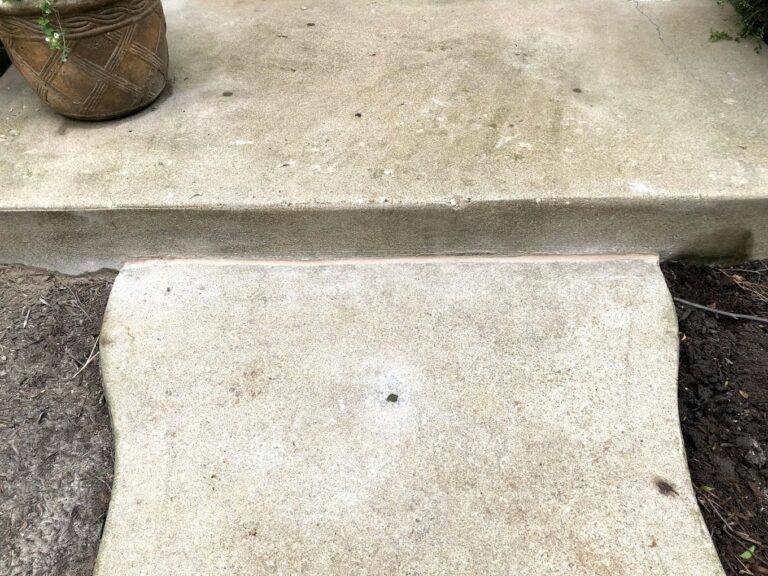
A sound but low slab belongs in a concrete-leveling assessment.
Broken pieces may need a new pour. Movement tied to the building needs a structural check.
Diagnosis comes before method. A sound but low panel usually still rings solid under a hammer and has tight joints. A repairable broken edge or surface spall is chipped at the lip or scaled on top but the slab body is intact. A slab that needs removal and re-pouring is cracked through, crumbled, or moving as pieces. A crack that tracks with building movement is a different conversation. ACI RAP-1 discusses structural concrete cracks, and ACI RAP-7 discusses horizontal repair preparation. In Dover, compare the driveway approach with the road and garage door, because the two fixed edges can limit how far a panel should move.
Not every slab needs full replacement. If the panel is sound but low, it can often stay and be lifted. If the damage is a broken edge or a scaled surface, a partial-depth repair may keep the slab in place. If the slab is cracked into loose pieces, has failed subgrade, or the garage floor has settled unevenly against the wall, removal and re-pouring may be the honest scope. ACI RAP-11 discusses slabjacking assessment, which is a reference for evaluating lift options. That does not mean every low panel should be lifted. The decision turns on whether the slab is still one piece, whether the edges are stable, and whether the grade at the road end can move.

Method selection follows the diagnosis. For a sound but low panel, slabjacking or grout lifting may raise the slab without replacing it. For a broken edge or surface spall, a horizontal repair with proper preparation may restore the wearing surface. For a slab that is cracked through or has lost support, removal and re-pouring is the durable route. A planned joint is not the same defect as a crack cutting across an unsupported panel. Lifting also changes elevation, so the finished height must work at both ends of the driveway.
ACI's horizontal repair guide is general technical guidance, not a specification for this house.
Dover's construction guide says a driveway modification that affects grade or elevation can require a driveway permit when it connects to a city-controlled right-of-way. That makes the proposed lift height important at the road end. We can measure and price private concrete, but will flag a city-side grade change for Community Services before work starts.
Read the Dover source. We check the approval path against the proposed scope.
Concrete repair has edges that surprise homeowners. A crack that looks like a surface flaw may be tied to building movement, and patching it will not stop the movement. A low panel may be low because the soil under it moved, and lifting it without addressing the cause can lead to a repeat. A garage floor may be tied to a foundation wall, so lifting one section can stress the connection. If the crack is active or the slab is separating, the right next step may be an engineer, not a concrete crew.
Two fixed edges control most driveway and garage floor decisions. At the road end, the driveway approach meets a fixed boundary. That makes the proposed lift height important there. We measure the panel at both ends; the road connection and garage door are fixed points that a repair cannot ignore. At the garage end, the door and apron set a fixed elevation. If the panel must rise to meet the door, the lift is limited by that threshold. Compare the driveway approach with the road and garage door, because the two fixed edges can limit how far a panel should move.
A written estimate should state the diagnosis in plain terms: sound but low, broken edge, surface spall, cracked through, or movement-related. It should list the repair method considered, the measured elevations at the road and garage edges, and the limits of the scope. It should not promise a specific product, warranty, or lifespan. The estimate should also say what is excluded, such as structural foundation work, soil correction, or any work beyond private concrete. That keeps you from assuming a patch solves a movement problem.
Sometimes the honest answer is no work. A hairline crack in a garage floor that has not changed in years may only need monitoring. A sound but low driveway panel that does not pond water or trip anyone may stay as is. A broken edge that is stable and not worsening may be left alone. If the crack tracks with building movement, the right step is a structural review, not a concrete patch. 603 Basement Solutions can measure and price private concrete. We will say when the scope is smaller than a full repair or when the decision belongs to an engineer.
You cannot tell from the surface alone. A crack that is tight, stable, and not offset may be a surface or joint crack. A crack that is widening, has vertical offset, or tracks with a wall or foundation movement points to a structural review. In Dover, compare the driveway approach with the road and garage door, because those fixed edges limit how far a panel should move. The next step is an inspection and a written scope.
Show us the concrete and we will tell you what is worth fixing, what can stay, and what still needs checking.

