



Before you replace that cracked walk or low slab, figure out what actually needs fixing.
Sound surrounding concrete with a limited damaged edge may support a focused repair.
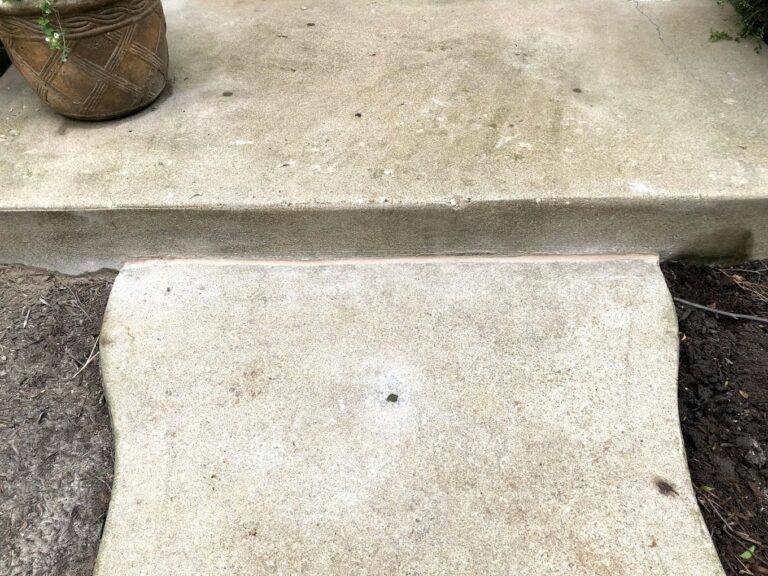
A sound but low slab belongs in a concrete-leveling assessment.
Broken pieces may need a new pour. Movement tied to the building needs a structural check.
Start with what the concrete is doing, not what it looks like. A sound-but-low panel still sits in one piece and moves as a unit. A broken edge or spalled surface is a local repair candidate. A crack that has opened, offset, or runs with a wall or step is a movement question, and movement questions get inspected before they get patched. Not every crack is structural, and a hairline crack in a walk is not the same as a crack in a load-bearing slab. Put a level on the private walk and mark the curb separately. That simple check tells you whether you are dealing with elevation, edge damage, surface wear, or something that needs a closer look.
Plenty of concrete does not need to come out. A walkway panel that is intact but low can often stay, with the repair focused on the trip edge or the joint that has opened. A driveway curb edge with a broken nose can sometimes be rebuilt without tearing out the whole approach. Surface scaling or a shallow spall on a patio slab is a repair, not a replacement, when the base under it is still doing its job. The decision point is whether the slab is sound enough to keep. If the panel is cracked through, rocking, or hollow underfoot, keeping it is usually a patch on a problem. If it is solid and only low or worn at an edge, the smaller scope is the honest one.

Repair selection follows the diagnosis. A low but sound slab points toward a leveling assessment, which is its own evaluation and not automatically the cheap answer. A broken edge or spalled surface points toward a horizontal repair that prepares the area and rebuilds the section. A slab that is cracked through, settled unevenly, or no longer draining correctly may point toward removal and re-pour. A crack associated with building movement gets looked at as a movement issue first, because patching a moving crack without understanding it tends to reopen. The method has to match the failure mode. If someone quotes a repair without saying which failure they are treating, you do not have a scope yet.
ACI's horizontal repair guide is general technical guidance, not a specification for this house.
Merrimack lists driveway alteration and curb or sidewalk work in the public right-of-way among projects that need a right-of-way permit. That matters when a repair reaches past the private walk toward the road-side curb or walkway. A private walk leading to your front door can be scoped on its own. Once a proposed repair touches that public edge, we pause and confirm the town process before anyone starts cutting or pouring.
Read the Merrimack source. We check the approval path against the proposed scope.

The common failure is treating every crack as structural or every low slab as a leveling job. Both directions waste money. A second risk is scope creep at the edges: a private walk repair is one thing, and work that reaches the road-side curb or walkway is another. That boundary is a real pause point, not a formality. Other limits are practical. A repair cannot fix a drainage problem that keeps washing out the base. A patch cannot make a rocking slab stable. And a surface repair on a slab that is failing underneath will not last. We look at what is actually failing before we price any fix.
Access, slope, and drainage drive the scope more than the crack photo does. A front walkway that slopes toward the house is a different repair than one that slopes away. A driveway curb edge that collects water needs the water question answered before the edge is rebuilt. Tight access can rule out equipment and push a job toward hand work or removal. Freeze-thaw exposure matters in New Hampshire, but you cannot assume a specific soil, water table, or local house type from a town name. Those are site findings, not town facts. The inspection should record slope, drainage path, access width, and whether the low spot is isolated or part of a longer settled run. That record is what makes the estimate honest.
A useful estimate separates the private walk from anything near the curb and names the failure being repaired. It should state what stays, what is removed, what is rebuilt, and what is only being evaluated. If leveling is on the table, the estimate should say it is an assessment with its own limits, not a guaranteed fix. If removal and re-pour is on the table, it should say why the slab cannot stay. Measurements should be taken, not guessed from a photo. If a quote is one line and one number, ask what failure it treats and what happens if the slab is worse once it is opened.
Sometimes the honest answer is that you do not need a repair yet. A hairline crack in a walk that is not offset and not widening is a monitor item. A low panel with no trip edge and no water problem can wait. A surface blemish on a patio that is not spalling deeper is cosmetic. The smaller-work decision is real: repair the broken edge only, leave the sound panels alone, and keep the curb edge out of the quote until the town process is confirmed. That is not a sales pitch in reverse. It is the same decision sequence applied honestly. If the concrete is sound and the problem is cosmetic or isolated, spending less now is the better call.
Usually no. A broken curb edge can often be repaired as a local section while the sound panels stay. The inspection decides it: if the slab is intact and only the edge is damaged, the scope can stay small. If the panel is cracked through or rocking, replacement may be the better call. Work that reaches the road-side curb or walkway is a separate question and gets confirmed with the town before scheduling.
Show us the concrete and we will tell you what is worth fixing, what can stay, and what still needs checking.

