



Your Rye concrete may not need a repair. Here is how to tell before you call.
Sound surrounding concrete with a limited damaged edge may support a focused repair.
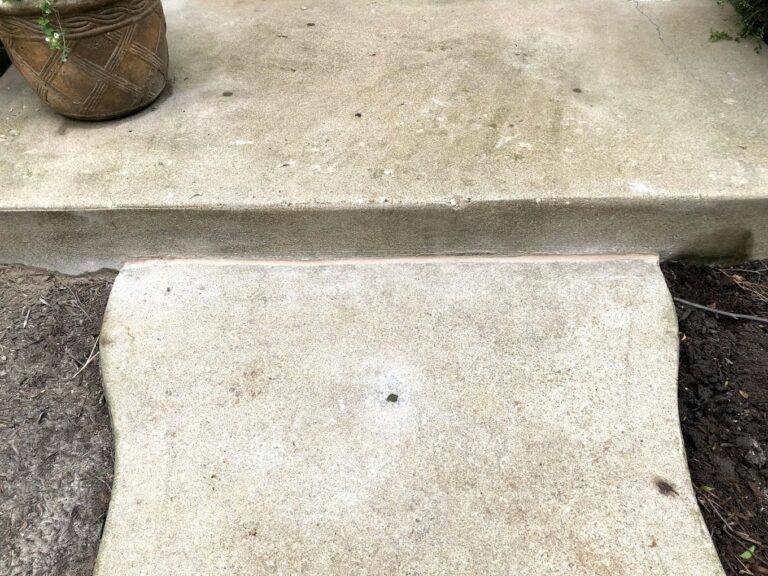
A sound but low slab belongs in a concrete-leveling assessment.
Broken pieces may need a new pour. Movement tied to the building needs a structural check.
Concrete repair starts with a diagnosis, not a method. A sound but low panel is a leveling candidate. A broken edge or surface spall may be a repair candidate. A slab that has cracked into separate pieces, settled unevenly, or lost its base support may be a removal and re-pour candidate. A crack associated with building movement is its own category and does not automatically mean the slab is structural. ACI RAP-7 discusses horizontal concrete repair preparation, ACI RAP-11 discusses slabjacking assessment, and ACI RAP-1 discusses structural concrete cracks. The diagnosis decides the scope.
Not every slab needs to come out. If the concrete is sound and the issue is a low spot, the slab may stay in place. If the damage is a broken edge or a surface defect, a repair may be enough. A private walk or a private patio can often stay a private slab question. The inspection should trace runoff from the walk and identify any slab edge tied into the road entrance. The proposal should say which edges move and which do not. If the slab is sound and the base is stable, removal is usually the wrong first move. If the slab has lost support, keeping it may not be honest.

Method selection follows the diagnosis. A sound but low panel points toward leveling. A broken edge or surface spall points toward a horizontal repair. A slab that has failed as a slab points toward removal and re-pouring. ACI RAP-11 discusses slabjacking assessment and ACI RAP-7 discusses horizontal concrete repair preparation. The estimate should name the method and the reason. If the base is unstable, leveling may not hold. If the slab is sound, removal may be unnecessary. The right method is the one that matches the actual failure, not the one that is fastest to sell.
ACI's horizontal repair guide is general technical guidance, not a specification for this house.
Rye's land-development code defines driveway construction to include changes to an existing access's alignment, grade, width, drainage, or dimensions within the town right-of-way. A specific permit decision still needs town confirmation. For concrete repair, that matters most when work touches the road entrance. A private patio lift can stay a private slab question. Work at the road edge needs a different review, especially if the proposed height changes drainage. Keep those two scopes separate in the estimate.
Read the Rye source. We check the approval path against the proposed scope.
Concrete repair has limits. A crack from building movement may not be a slab repair at all. A drainage problem that keeps sending water under a slab may return after any repair. Keep exterior flatwork out of a structural quote. If the scope crosses those lines, the estimate should say so. We separate what we can fix from what needs another trade or a different scope. You get a clear answer before work begins, so the repair matches the actual problem.
Site constraints decide what is practical. Trace runoff from the walk and identify any slab edge tied into the road entrance. Access matters too. A slab that cannot be reached with the right equipment may change the method. At a patio, check the door threshold, steps, and downspout before choosing a finished height. The repair must still let water leave the house. If planting beds or a narrow gate block access, the estimate should explain the workable route and any area that needs protection. None of that is a reason to skip the work. It is a reason to write the scope before the work starts.
A written estimate should be specific enough to compare. It should name the slab, the failure, the proposed method, and the limits. It should say which edges move and which do not. It should separate private flatwork from work at the road edge. It should not promise a price or a lifespan that has not been verified. Measurement matters because a low panel and a failed slab are different scopes. You should be able to read the estimate and know what is included, what is excluded, and what happens next.
Sometimes the right answer is no work or smaller work. If the slab is sound and the low spot is not causing a problem, leveling may not be necessary. If the crack is stable and not tied to movement, monitoring may be enough. If the damage is a broken edge, a repair may be smaller than a full replacement. If the slab has failed as a slab, removal and re-pouring may be the honest scope. The homeowner should ask what happens if nothing is done. A good concrete repair page should be willing to say that the homeowner may not need a repair. That is not a sales failure. It is a diagnosis.
You do not know from the crack alone. A crack associated with building movement is a different question than a crack in a driveway or patio slab. The useful next step is a walkthrough that traces runoff, checks the slab edge, and identifies whether the crack is moving with the building or sitting in flatwork. That diagnosis decides whether you need a structural conversation or a concrete repair.
Show us the concrete and we will tell you what is worth fixing, what can stay, and what still needs checking.

