



A dropped patio slab and a cracked driveway edge are different problems, so start by deciding which one you actually have.
Sound surrounding concrete with a limited damaged edge may support a focused repair.
A sound but low slab belongs in a concrete-leveling assessment.
Broken pieces may need a new pour. Movement tied to the building needs a structural check.
Concrete repair in Salem starts with a simple sort. A sound but low panel is a leveling question. A repairable broken edge or surface is a patching or reconstruction question. A slab that is cracked through, heaved, or badly settled may be a removal and re-pour question. A crack associated with building movement is its own conversation and does not automatically mean the slab is structural. Use the patio edge at the house as your first inspection point, then look at the driveway entrance separately. The goal is to name the problem before anyone names a method. If the symptom is unclear, the honest next step is more inspection, not a bigger quote.
Some concrete can stay in place. A sound panel that is low but intact may be a candidate for leveling assessment rather than replacement. A chipped edge or a spalled surface may be repairable if the surrounding slab is stable and the repair is not carrying a load it was never designed to carry. What usually cannot stay is a slab that has lost its support, is broken into moving pieces, or is tied to a crack that keeps opening. Planned slab joints are there for a reason, and a crack that follows a joint is different from a crack that cuts across a panel. The decision is about support and movement, not about appearance alone.
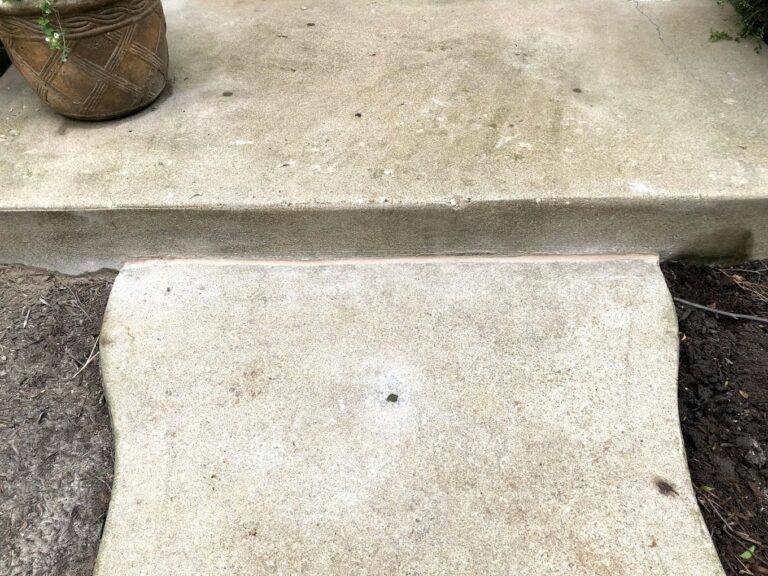
Method selection follows the diagnosis. A low but sound panel may be assessed for leveling. A broken edge may be cut back and rebuilt. A slab that has lost its base may need removal and re-pouring. The right method depends on access, thickness, reinforcement, and how the slab is supported. Ask what the repair is meant to do and what it is not meant to do. We match the method to the condition we find, so you are not paying for work your slab does not need. You should know what the repair will and will not fix before you decide.
ACI's horizontal repair guide is general technical guidance, not a specification for this house.
Salem's permitting page lists driveway and street excavation among the work categories for contractors operating in rights-of-way. That matters when the affected concrete sits at a street entrance, because the scope and approval question change. A homeowner with a dropped backyard slab should not be sold a road-access project. Keep the two conversations separate.
Read the Salem source. We check the approval path against the proposed scope.
Some conditions are outside a normal concrete repair scope. If a crack is associated with building movement, the slab may be a symptom rather than the problem, and repairing the concrete alone may not address the cause. If the subbase is failing, patching the surface can be temporary. If the work is at a street entrance, drainage, access, and approval questions change the project. Salem's permitting page lists driveway and street excavation among the work categories for contractors operating in rights-of-way, which is a reason to keep exterior flatwork out of a structural quote. That page does not say anything about a load-bearing slab. Do not let one scope absorb the other.
Access, slope, drainage, and nearby structures all change what is practical. A backyard patio may be reachable with small equipment, while a driveway entrance may involve the street edge and a different set of constraints. A slab that slopes toward the house raises a drainage question. A slab that is boxed in by steps, walls, or plantings may limit how much can be repaired in place. If the affected concrete is at a street entrance instead of the backyard, the scope and approval question change. Start with the patio edge at the house, then separate any street-entrance concern so drainage, access, and scope do not get mixed together. That separation is the point of the inspection.

A useful written estimate names the affected area, the observed condition, and the proposed work in plain language. It should say whether the slab is expected to stay, be leveled, be partially rebuilt, or be removed and re-poured. It should list what is included, such as preparation, material, and cleanup, and what is excluded, such as landscaping or work outside the slab area. Measurements should be tied to the actual area, not a guess. If the estimate mentions a method, ask what condition that method is meant to address. If it mentions a crack, ask whether the crack is being treated as a surface repair or as a sign of movement. Those questions keep the scope honest.
Sometimes the right call is to do nothing, or to do less. A sound but low panel that is not causing a drainage or trip problem may not need work today. A small surface crack that is stable and not widening may be a monitoring item. If the concrete is at a street entrance instead, the scope and approval question change, and that may push the work outside a simple repair. Ask whether the condition is getting worse, whether it affects drainage or safety, and whether a smaller repair would solve the actual problem. A no-work answer is a valid outcome.
You do not diagnose that from a photo. A crack that follows a planned joint, stays closed, and shows no offset is often a surface or joint issue. A crack that is widening, has a vertical offset, or appears with movement elsewhere in the building deserves a closer look. Start with the patio edge at the house, then separate any street-entrance concern, and ask for a written scope that states what the repair is meant to address.
Show us the concrete and we will tell you what is worth fixing, what can stay, and what still needs checking.

