
Quick Answer
603 Basement Solutions provides broad foundation repair in Bolton, Massachusetts for movement below the footing, pressure on basement walls, floor sag, failing posts, and timber decay. The result may be a pier layout, wall bracing, corrected support line, sill or beam replacement, crack-specific work, or a recommendation to watch the condition. The inspection and written repair proposal are provided without charge.
Choose safe access for a settling foundation
A settling corner can need piers, but the pier count is not the first decision. We first confirm which foundation section has moved.
Then we walk the outside route. Gates, steps, utilities, paving, and planted areas can change how the crew safely reaches that section.
What the Bolton housing number can and cannot tell us
The 2023 ACS lists 1986 as the median year built for housing across Bolton. That is a citywide midpoint, not the age or condition of your foundation.
Bolton's housing stock includes foundations and additions from different periods. A townwide midpoint does not tell us why one corner looks low.
The useful clues come from elevations inside, wall and footing observations, and the exterior section tied to those readings.

Foundation Problems, Inspection Points, and Possible Repairs in Bolton
| What you are seeing | What 603 inspects | Possible repair |
|---|---|---|
| One outside corner appears lower than the rest | Test whether the visible changes align with a loss of support at the footing | Deep pier support may fit if the measurements confirm bearing failure |
| A stair-step pattern appears with wall displacement | Inspect how the wall is built and what is acting on it from outside | A wall-specific design is needed before any system is selected |
| The floor changes elevation across one basement span | Compare floor elevations with beam bearing, columns, sills, and concrete below | Supplemental support may fit when the existing beam line is inadequate |
| An earlier patch opened again while nearby finishes stayed stable | Separate water entry from movement by checking the wall and connected loads | A reopened patch may require monitoring or a broader repair rather than another cover |
A symptom at one Bolton home can have a different cause at another.
Four useful checks for this Bolton concern
Confirm the settling section before counting piers
A diagonal crack or sticky window can point toward a corner, but measurements must show where the movement starts and stops.
Walk the equipment route from the street to the wall
The crew needs room to move equipment and work beside each proposed bracket. A tight turn or narrow gate can rule out an easy route.
Stabilizing and lifting are different promises
Piers can be designed to stop further settlement. An attempted lift adds another question because walls, windows, utilities, and finishes may react.
Know what happens to the yard after excavation
Pier work may disturb soil, lawn, paving, steps, or planting near the bracket locations. Those surfaces do not all return the same way.
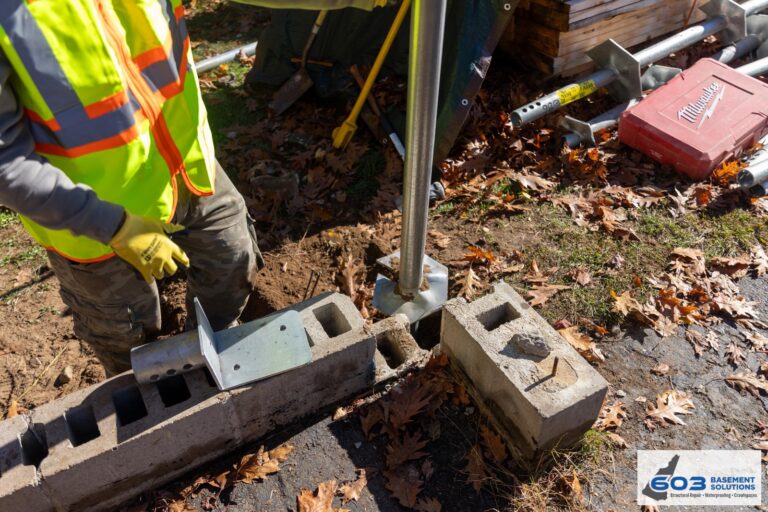
How pier selection fits this finding. Safe Bolton access is part of a pier plan only after the footing section is shown to be settling. Push piers use the existing building for installation resistance, while helical piers rotate into the ground with helical plates. Building weight, footing condition, equipment clearance, utilities, and design select the system. The easiest route cannot move a bracket away from the measured concern or turn an access limitation into a structural finding.
Locate the Bolton slab before choosing the safest route
The work path and the concrete boundary are not the same drawing. A Bolton basement floor may be only a surface, while another slab carries a wall or portion of the building. Displacement, recurring movement, or a changing crack aligned with that load helps define the structural area. Once identified, access and protection can be planned around it. Monitoring, focused crack repair, stabilization, and replacement remain possible outcomes until the inspection connects the evidence. When the load-supporting slab is confirmed, slab foundation repair may fit. The route remains a delivery constraint, not the reason for repair.
How confirmed 603 prices may apply in Bolton
If the measured wall in Bolton needs stabilization, a power brace costs $1,300 and a carbon-fiber strap costs $850. Work completed to the written design carries a 25-year warranty.
When the weak point is under a beam, a lally column costs $1,300 to $2,500. The support work carries a 10-year settlement warranty.
If settlement calls for helical piers, the first three cost $2,700 each. Additional piers cost $2,200 each, and engineered work carries 25-year coverage.
Those figures do not choose the repair. The right method and count depend on the wall, beam, post, footing, or settling section found at your Bolton home.
Confirm the settling section before counting piers
We carry floor readings into stable parts of the house and compare openings along the same wall. Outside, we follow the matching foundation line.
That keeps a local repair local. A pier system should support the measured section, not every wall near the symptom.
Walk the equipment route from the street to the wall
Show us septic covers, irrigation, buried wires, steps, fences, and areas you want protected. Required utility marking still comes before excavation.
We would rather spot a route problem during the inspection than discover it after a hole is open beside the house.
Stabilizing and lifting are different promises
We take starting readings and explain the goal in plain language. If the safe result is stabilization only, the estimate should say that.
No one should promise that an older corner will return to its original position before the structure responds under controlled pressure.
Know what happens to the yard after excavation
Before work, ask which areas 603 will backfill and which finish repairs are separate. Starting photos help everyone remember the existing condition.
The structural warranty covers the stated foundation work. Landscaping or masonry should only be included when the estimate names it.
Why the equipment route matters
Helical pier work needs room beside the foundation and a safe way for equipment to reach it. A narrow gate, sharp turn, steep grade, or low branch may change the route. We look at those limits after identifying the settling section.
Access should never decide where a pier belongs. If the easiest route misses the structural target, another approach is needed. The homeowner should understand the likely path and what will be protected before choosing the repair.
Protecting the yard starts with a walk-through
Paving, steps, drainage features, siding, and valued plantings can sit close to the work area. Point them out during the inspection. Existing cracks or wear are worth photographing so there is no confusion about the starting condition.
Some disturbance is unavoidable when excavation is required. The useful question is what the crew will protect, what it will backfill, and which finished surfaces may need separate repair. Those answers should be plain before work starts.
Stabilization is not a promise to lift
A pier can support a settled foundation in its present position. A controlled lift attempt is a different goal and may affect masonry, trim, plumbing, or doors. We discuss the condition of those nearby materials before any movement is considered.
Older settlement may be safer to stabilize than to reverse. If an adjustment is attempted, small measured steps and clear stop signs matter. No contractor can responsibly promise that every finish will return to its original place.
What to check after the exterior closes
Before soil covers the repair, photos should show the pier connection and its position on the wall. After backfill, the nearby grade should still direct water away from the house. Drain outlets and window wells should remain clear.
Walk the route again after equipment leaves. Look at steps, paving, lawn, and the access point. Structural work and final landscaping may be separate, but you should know which part remains before the crew is finished.
Questions to ask before approving exterior work
Ask where each pier or repair point sits, how equipment reaches it, and which surfaces may be disturbed. The answers should connect the yard route to the measured foundation section.
Also ask whether the goal is stabilization or an attempted lift. Those outcomes affect both the structure and the finishes above it.
Finally, clarify backfill, grading, and surface repair. You should know what the yard is expected to look like when the structural crew leaves.
How to read a Bolton foundation estimate
A Bolton pier estimate should show the treated foundation section and the number of brackets. It should also explain access, excavation, and the intended result.
Look for a clear difference between stabilization and any lift attempt. Surface restoration should be listed instead of left to a conversation later.
What happens during the free foundation inspection
We connect the indoor readings to the outdoor wall before recommending piers. Access affects the method, but it does not prove the need for repair.
If the corner is stable and the symptoms are not changing, another set of measurements may be the better next step.
603 Basement Solutions is licensed and insured and has worked in more than 5,000 homes. The same team handles helical piers and structural lifting.
If work is recommended, 603 normally sends a written quote within 24 hours. The price and warranty should match the exact area being treated.
Why Homeowners Choose 603 for Foundation Repair
For a Bolton homeowner comparing contractors, the review and field evidence below show how 603 handles the work.
Get the Bolton foundation checked
We will measure the settling section and walk the route needed to reach it before pricing a pier layout.
Sources: U.S. Census Bureau 2023 ACS 5-year table B25035. The city image caption gives its photographer and Wikimedia Commons license. 603 supplied the service, price, warranty, and crew details. The work photo shows a 603 repair method. See Structural and Foundation Repair or Foundation Crack Repair.