
Quick Answer
603 Basement Solutions inspects and repairs structural foundation problems in Burlington, Massachusetts for settled foundations, bowed masonry, changed floor elevations, poor supports, and damaged beams. The measured condition may lead to pier support, wall stabilization, column or framing work, sill replacement, a crack-specific repair, or monitoring. The on-site inspection and written estimate are free.
Find out whether the wall or the floor owns the symptom
A crack near a low floor can point toward more than one load path. We inspect the wall, beam, posts, and footing before naming the repair.
The goal is a written boundary. It should show which component moves, which component carries it, and which evidence supports the recommendation.
Burlington housing context without the guesswork
The 2023 American Community Survey places Burlington’s median housing year at 1971. That citywide midpoint does not identify one home’s structure or condition.
Use the age of your address, addition history, and prior repairs instead. Bring records that show changes near the same wall, beam, or corner.

Foundation Problems, Inspection Points, and Possible Repairs in Burlington
| What you are seeing | What 603 inspects | Possible repair |
|---|---|---|
| Cracks and openings are changing near one settled area | Measure the change and inspect the footing, framing, grade, and history | Deep pier support may fit if the measurements confirm bearing failure |
| Blocks or poured concrete no longer remain in plane | Check the amount and direction of movement across the entire wall | Repair may focus on restraint, drainage, rebuilding, or a combination |
| A floor sags near a beam or interior post | Compare floor elevations with beam bearing, columns, sills, and concrete below | Only the component causing the low area should drive the repair scope |
| A slab has changed elevation near another structural element | Inspect stone alignment, mortar loss, bearing, and water paths | The crack should be routed to its own repair only after diagnosis |
Only the measurements at the Burlington inspection can set the scope.
Put the visible clue in the right lane
A crack follows the floor line
Measure the wall and floor together before choosing a crack-only repair.
A room dips near an opening
Trace joists into the beam and inspect every support below it.
One wall bows inward
Map the entire curve, not only the widest visible line.
An outside corner drops
Connect interior symptoms to the footing and exterior access.
Start with two separate sketches
Draw the foundation perimeter on one sheet and the floor framing on another. Number walls, beams, posts, openings, and exterior corners.
Join the sketches only where the structure joins them. That keeps a nearby crack from becoming proof of an unrelated floor problem.
Ask which measurement changes the decision
For a wall, record shape and displacement. For a floor, record elevations, joist direction, beam condition, and support locations.
A proposal should name those readings. Product names alone do not show why the selected component belongs in that location.
Keep repair outcomes distinct
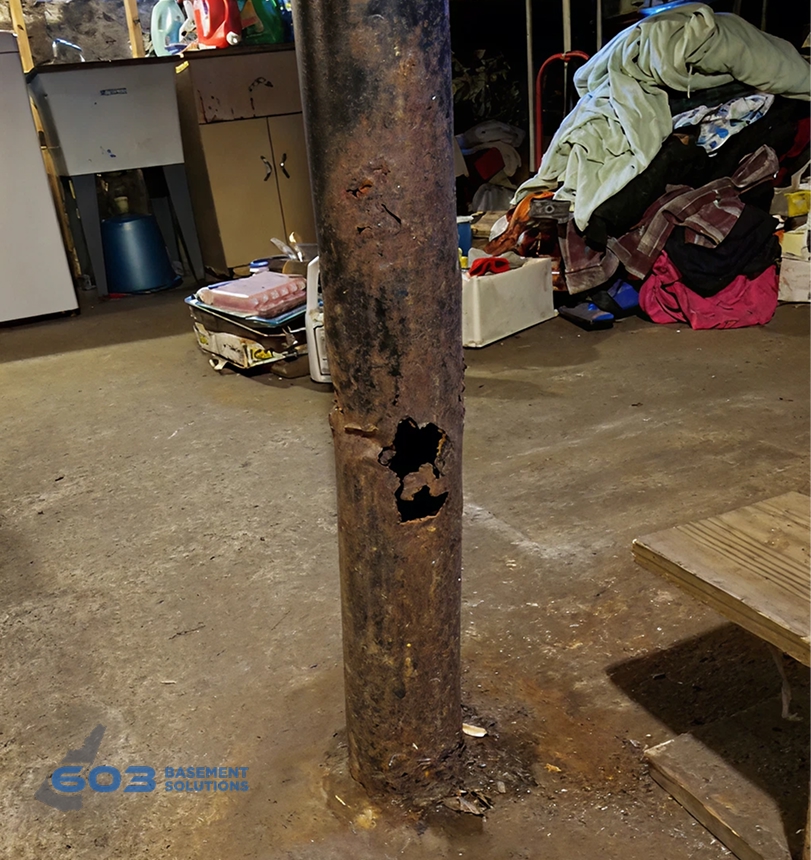
Sealing controls a stable opening. Bracing resists wall movement. A column carries floor load. A pier transfers a settling foundation section.
Ask the contractor to write sealing, support, stabilization, adjustment, or attempted lift beside every major line item.
Use a two-color decision map
Mark wall evidence in one color and floor evidence in another. Add a third mark only where measurements connect the systems.
Write the proposed repair beside the component it changes. A column should sit under a named beam. A brace should sit on a measured wall. A pier should align with a supported foundation section.
Review the map from the living space down to bearing. If a symptom has no connection, keep it as a separate observation instead of forcing one explanation.
Close each lane with its own proof
Wall work needs full-height photographs and connection evidence. Floor work needs the beam, posts, bases, footings, and final elevations.
Pier work needs bracket locations and the supported section. Crack work needs the treated opening and confirmation that the wall remained in the crack-only lane.
Keep these records separate even when the same crew completes the work. One successful item should not hide an unrelated open concern.
Use one final scope sentence
Write a sentence that names the component, location, measured condition, repair, quantity, and intended outcome.
Read it against the drawing and price. If any major item cannot be connected to the sentence, ask whether the scope contains another condition.
Use that sentence again at closeout. The final evidence should show the homeowner exactly what was treated.
When floor support is the measured lane
Follow Burlington floor symptoms through joists, beams, posts, bases, and footings. Name any damaged section or weak connection before choosing a column.
603’s confirmed lally-column range is $1,300 to $2,500 each. The quote should separate footings, temporary support, beam work, access, and adjustment. Treated support work has a 10-year settlement warranty.
When wall stabilization is the measured lane
Map the inward curve from corner to corner. Record wall height, displacement, openings, top restraint, utilities, and any finish that affects brace or strap placement.
603 lists steel power braces at $1,300 each and carbon-fiber straps at $850 each. A treated wall carries a 25-year warranty against further inward movement within written tolerances.
Foundation Repair Methods and Pricing in Burlington
A helical-pier plan should show the exact settling section, bracket locations, quantity, access, and whether the target is stabilization or attempted lift.
603 prices the first three helical piers at $2,700 each and additional piers at $2,200. Engineered pier work carries a 25-year warranty. Confirm engineering, utilities, excavation, and restoration.
Test the boundary with a room-by-room walk
Begin above the concern and note doors, floors, trim, cabinets, tile, and openings. Use observations as clues, not proof of one cause.
Return below and follow framing in the same direction. Mark where joists change, beams end, posts shift, or the foundation steps.
Walk outside last. Pair corners and openings with the interior labels. Keep drainage observations separate unless evidence connects water to the structural condition.
Write the smaller-repair option
Ask what scope would be appropriate if measurements show the wall, floor, or footing remains stable. A crack treatment or monitoring plan may be enough.
Then ask what new evidence would justify the larger repair. This keeps urgency tied to measurements rather than the number of products in a proposal.
Save both answers with the inspection record. The homeowner can see why one path was selected and when the other should be reconsidered.
Give each concern a disposition
At the end of the inspection, mark every item as repair, monitor, cosmetic, water-related, or outside the current scope. Do not leave a photographed concern without a next step.
Place the disposition beside the same location label used on the drawing. Add the responsible person and date when another trade or future check is required.
This short list prevents the main structural proposal from swallowing smaller concerns. It also shows which observations did not become part of the repair.
Burlington inspection worksheet
- Map the Burlington symptom. Label its room, elevation, direction, moisture, and nearest structural connection.
- Trace the complete load path. Follow the floor or wall through every connection until the load reaches bearing.
- Compare the proposed boundary. Match each brace, column, or pier to the measured area it treats.
- Define closeout evidence. Choose the photographs and readings that will prove the installed scope.
Burlington foundation questions
Can a wall crack cause a low floor?
It can share a larger condition, but proximity alone does not prove one cause.
Should every crack be sealed first?
No. Preserve the clue until wall shape and movement are checked.
Can one proposal include two repairs?
Yes, when each repair has its own measured condition and outcome.
Where is the crack-only service?
Use the Foundation Crack Repair service when the wall is stable and the opening is the primary problem.
What 603 brings to the inspection
603 is licensed and insured, has worked in more than 5,000 homes, and self-performs helical-pier installation and structural lifting. The inspection and estimate are free. We normally send the written quote within 24 hours.
We will tell you when the house needs a smaller repair or a period of monitoring. If work is proposed, the scope should name the treated area, quantities, outcome, exclusions, and warranty.
Why Homeowners Choose 603 for Foundation Repair
For a Burlington homeowner comparing contractors, the review and field evidence below show how 603 handles the work.
Get the Burlington load path checked
We will measure the structure, explain the repair boundary, and give you a written scope you can compare.
Sources: U.S. Census Bureau, 2023 ACS 5-year table B25035. The city image caption links its Wikimedia Commons source and license. 603 supplied the confirmed service, pricing, warranty, and operating information. Work imagery shows a 603 repair method. See Structural and Foundation Repair or the Foundation Crack Repair service.