
Quick Answer
603 Basement Solutions handles foundation movement and support problems in Concord, New Hampshire for foundation movement, wall displacement, framing deflection, column concerns, and failed sill material. The measured condition may lead to pier support, wall stabilization, column or framing work, sill replacement, a crack-specific repair, or monitoring. The on-site inspection and written estimate are free.
A support plan starts under the load
A deteriorated or undersupported post needs a defined base and beam connection; our lally column replacement page shows that scope.
When a Concord floor slopes or bounces, the nearest steel post is not automatically the cause. The beam could be damaged. The post may be out of plumb. The footing may be too small or deteriorated. The sill near the outside wall may have lost material. Sometimes more than one part needs attention.
603 follows the load from the floor framing down to the supporting soil. That keeps a post replacement from becoming a guess. If the wall is stable and the only issue is a crack, the narrower service is foundation crack repair in Concord. If the support system, wall, or footing is moving, we build the scope around that finding.

What we measure before recommending a column
| Part | What we check | Why it changes the scope |
|---|---|---|
| Floor and beam | Level change, deflection, damage, and where the load lands | A new post cannot repair a compromised beam by itself. |
| Existing columns | Corrosion, plumb, connections, spacing, and whether a temporary post remains | The visible post may be a symptom or an incomplete prior repair. |
| Footings | Size, condition, and placement under the intended support point | A strong column on an unsuitable base does not complete the load path. |
| Sill and joist ends | Material loss and bearing near the perimeter | A center support does not fix a damaged outside connection. |
Foundation Problems, Inspection Points, and Possible Repairs in Concord
| What you are seeing | What 603 inspects | Possible repair |
|---|---|---|
| Cracks and openings are changing near one settled area | Review level readings, footing condition, structural loads, and site access | Support on deeper bearing can be proposed when shallow support has failed |
| The wall leans toward the basement | Compare the wall face, top, corners, and exterior sources of pressure | Wall reinforcement can be selected for the material and displacement found |
| A floor sags near a beam or interior post | Trace joists through beams, posts, connections, and supporting footings | Only the component causing the low area should drive the repair scope |
| A fieldstone joint is losing mortar or admitting water | Inspect stone alignment, mortar loss, bearing, and water paths | A reopened patch may require monitoring or a broader repair rather than another cover |
This table helps route the concern; it is not a repair plan for the Concord address.
A slab needs its own load-path check
A support post standing on concrete does not prove that the visible floor is an adequate structural footing. We check what the slab carries, whether cracks show displacement, and whether movement repeats at the beam, wall, or openings above. That separates an isolated surface condition from a problem in a building-supporting slab. The recommendation may be monitoring, crack repair, stabilization, or replacement of the failed concrete. Our slab foundation repair page explains the options; the site inspection confirms the actual load path at the house.
Prices that can be stated, and work that cannot
Lally-column replacement generally runs $1,300–$2,500 and carries a 10-year warranty against further settlement in treated areas. A sill replacement, beam repair, or new footing can change the job, so those items must be described in the written proposal instead of hidden inside a generic column price.
If the footing below the foundation is settling, 603 may recommend helical piers. They are $2,700 each for the first three and $2,200 for each additional pier, with a 25-year engineered-performance warranty. If the foundation wall is moving inward, carbon-fiber straps are $850 each and power braces are $1,300 each under the current confirmed framework. Wall stabilization carries a 25-year warranty within the design tolerances.
An underpinning recommendation should also identify the pier type. Push piers are hydraulically advanced using an existing structure’s weight as reaction. Helical piers are screwed into the ground, and torque readings help verify the installation against the design. The footing, wall material, supported load, access, and repair objective determine which method belongs. We keep that decision separate from interior column work, sill repair, and wall stabilization because each follows a different load path.
No online table can set the final total. Access, repair quantity, material condition, engineering, and the parts above and below the visible symptom all affect the scope. The free inspection is where those variables become a house-specific quote.
What a complete proposal should say
The proposal should identify the failed or moving part, the repair method, the number of supports or braces, any beam, sill, or footing work, and the warranty that applies. If engineering or another review is needed, that should be clear before installation begins. 603 is licensed and insured and self-performs structural lifting and helical-pier installation.
The inspection and estimate are free. The normal process is a written quote within 24 hours, with the repair explained without pressure. For broader comparisons, use the Structural and Foundation Repair hub and the foundation repair cost guide.
Useful information to send ahead
Photograph the full beam or wall, not only the tightest close-up. Include the nearby supports and the floor above if accessible. Tell us if a post was added, moved, or adjusted; if a renovation changed the load; and whether the condition is changing. That history helps us prepare, but the recommendation still comes from the on-site inspection.
Why Concord needs a material-first inspection
The 2023 American Community Survey reports that 33.6% of Concord’s housing units were built in 1939 or earlier, and the citywide median year built is 1970. Housing age does not establish foundation material or condition, but it makes one point clear: a citywide repair assumption is not good enough. The inspector must verify the wall, sill, beam, posts, footings, additions, and any previous structural work at the property.
For a sloping floor, the lowest point is only the start. The measurement should be compared with the beam line, the perimeter sill, existing post locations, and the footings below them. If the problem sits at the exterior edge, a new center post may not change it. If the beam is damaged, transferring more load into it can make the scope worse rather than better.
What column and beam proof looks like
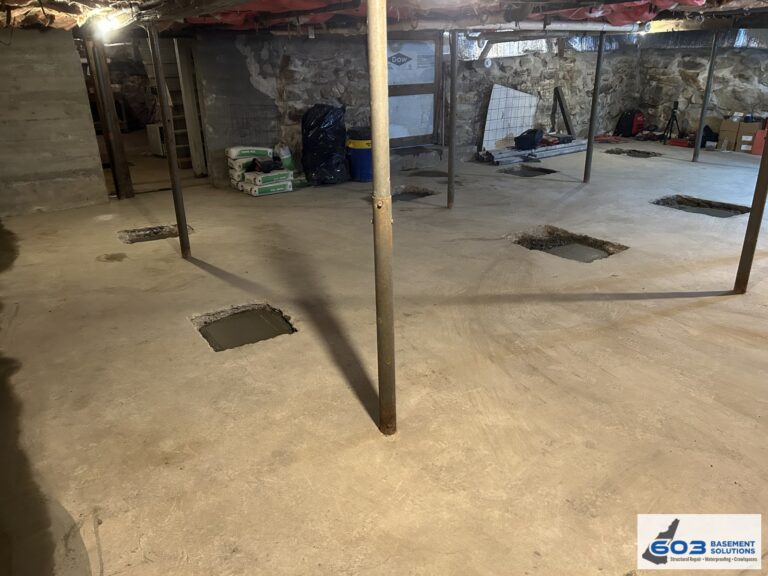
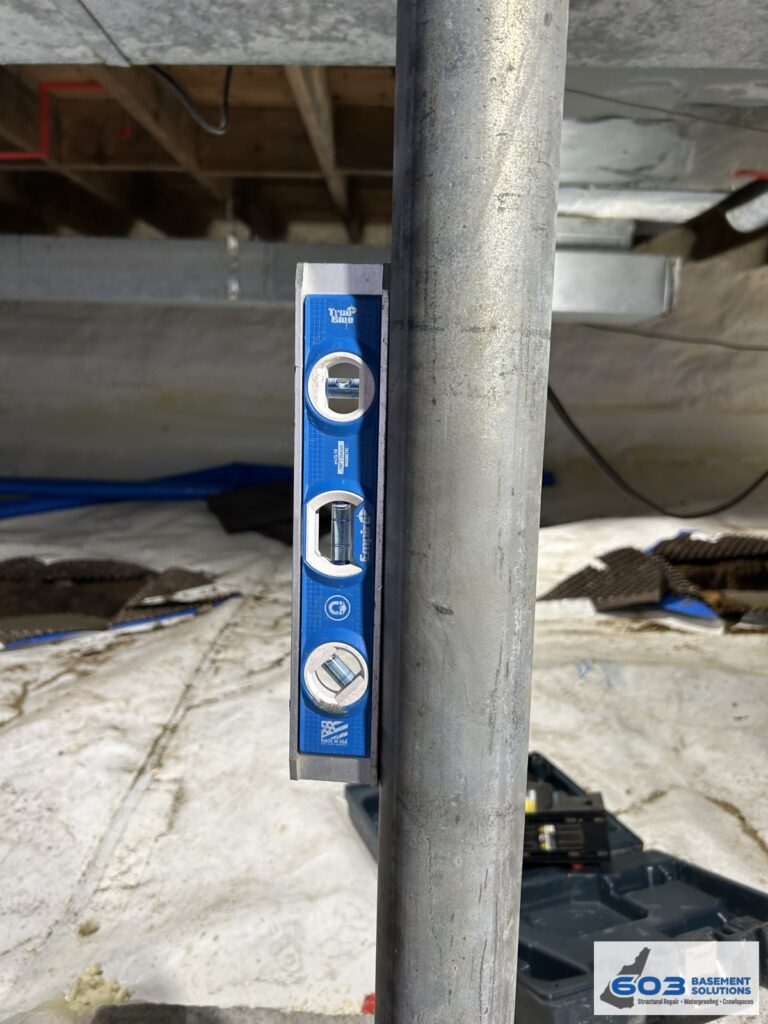
603 has real portfolio photographs of deteriorated columns, new adjustable columns, purpose-built footings, sill replacement, and beam work. The images on this page show those methods. The company is licensed and insured and has served 5,000+ homeowners across New England.
A customer who needed failing support columns and rotted beams repaired wrote that the crew made them “brand new” and left the family feeling safer. Another customer described 603 explaining a lally-column process step by step before completing the work in under a week. The schedule is one customer’s report, not a promise for every house.
Compare the written load path, not only the column count
- Does the plan name the beam or sill the new support will carry?
- Does it show the new footing rather than assuming the slab can take the load?
- Are post locations tied to measured low points and the framing above?
- Does the scope include damaged connections or material found next to the proposed support?
- Is the 10-year treated-area warranty stated in writing?
603’s confirmed lally-column range is $1,300–$2,500 per replacement. Sill replacement is $7,000–$40,000 because damaged length, temporary support, access, and adjoining material can vary substantially. Beam and wall-replacement work remains quote-based. The inspection and estimate are free, and the written proposal normally follows within 24 hours.
When the problem is not the floor support
If wall measurements show inward movement, the decision moves to wall stabilization. If exterior and interior evidence confirms footing settlement, it moves to an engineered pier plan. If the wall and support system are stable and the issue is one isolated opening, a narrow crack repair may be enough. The value of the inspection is ruling those paths apart before money is committed.
Concord questions that prevent a vague support job
Can an adjustable post sit directly on the slab?
The load must reach a suitable footing. A basement slab and a designed footing do different jobs. The proposal should state what supports the new column and how that base is built, not only the post model.
What if the existing posts are still upright?
Plumb appearance alone does not establish capacity or condition. The inspector checks corrosion, the base, top connection, beam condition, spacing, and whether the post actually sits under the load that is dropping.
Will a new column lift the floor?
Not automatically. Floor support work is first designed to carry and stabilize the load. Any adjustment or recovery must be safe for the framing and stated in the proposal. Existing finishes may limit what can move without damage.
When does a floor problem become a foundation problem?
When the evidence leads below the interior framing to movement at a footing or foundation component. The inspection follows that evidence rather than using “foundation” as a catch-all label for every sloping floor.
Before the appointment, note which rooms feel low and whether the change crosses the center beam or stays near one wall. Include photographs of every existing post from floor to beam, not only the most damaged one. That gives the inspector a map of the support line without assuming that the closest visible post is the cause.
Do not turn an adjustable post to see whether the floor moves. Changing one point can transfer load elsewhere and remove a useful reference. Leave adjustments to the written repair plan after the structure and footing have been checked.
Why Homeowners Choose 603 for Foundation Repair
For a Concord homeowner comparing contractors, the review and field evidence below show how 603 handles the work.
Get the whole load path checked
Free inspection, a clear scope, and a written estimate for your Concord home.
Sources: U.S. Census ACS 2023 5-year tables B25035 and B25034; 603 confirmed service, pricing, warranty, and credential information. Work photos show 603 repair methods.