



Quick Answer
603 Basement Solutions inspects and repairs structural foundation problems in Dover, New Hampshire for foundation movement, wall displacement, framing deflection, column concerns, and failed sill material. The appropriate plan can involve piers, a wall system, support-column work, beam or sill replacement, narrow crack treatment, or documented monitoring. The next step is a free inspection followed by a written estimate.
A water line and a moving wall are not the same problem
Staining can show where moisture has been. It does not tell us whether a foundation wall is stable. For Dover foundation repair, we compare the wall at several heights, look at the crack pattern, check the top and bottom connections, and inspect the nearby floor system. The repair depends on measured movement, not on how dramatic the paint or staining looks.
A stable wall with one leaking crack may only need foundation crack repair in Dover. A wall that is moving inward needs a stabilization plan. A floor or footing problem belongs in a different branch of the inspection.
Stable crack or structural movement?
Evidence for a narrow crack scope
The wall remains in position, the crack pattern is stable, and there are no related changes in the floor, openings, or support system. Injection may address the crack after inspection.
Evidence for a wider repair scope
The wall measures farther inward at one level, the pattern continues through joints or blocks, or related floor and opening changes suggest movement beyond the crack itself.
No single symptom proves the answer. We measure first, then explain whether the goal is sealing, stabilization, support, or a different structural repair.
Foundation Problems, Inspection Points, and Possible Repairs in Dover
| What you are seeing | What 603 inspects | Possible repair |
|---|---|---|
| Floors and trim changed above the same footing section | Map connected symptoms before checking bearing below the affected zone | Helical or push piers may be designed where competent bearing is needed |
| A horizontal opening accompanies a bowed wall | Map the wall movement and inspect cracks, construction type, and outside conditions | Repair may focus on restraint, drainage, rebuilding, or a combination |
| A beam end or sill has lost sound material | Check the whole support line instead of judging one shiny or temporary post | A new footing or column may be paired with beam and sill repair where needed |
| A slab has changed elevation near another structural element | Inspect stone alignment, mortar loss, bearing, and water paths | Focused crack repair may fit after structural movement is ruled out |
Possible does not mean required; the site findings control the recommendation.
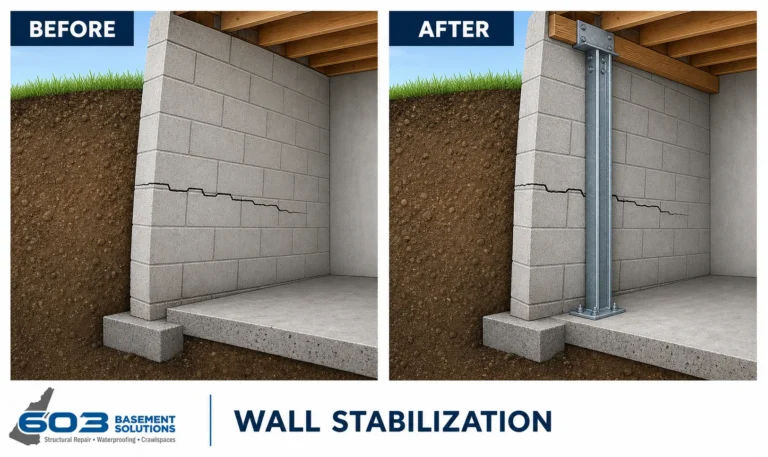
How wall stabilization works
For a wall that is moving inward but remains suitable for stabilization, review the bowing foundation wall brace service path.
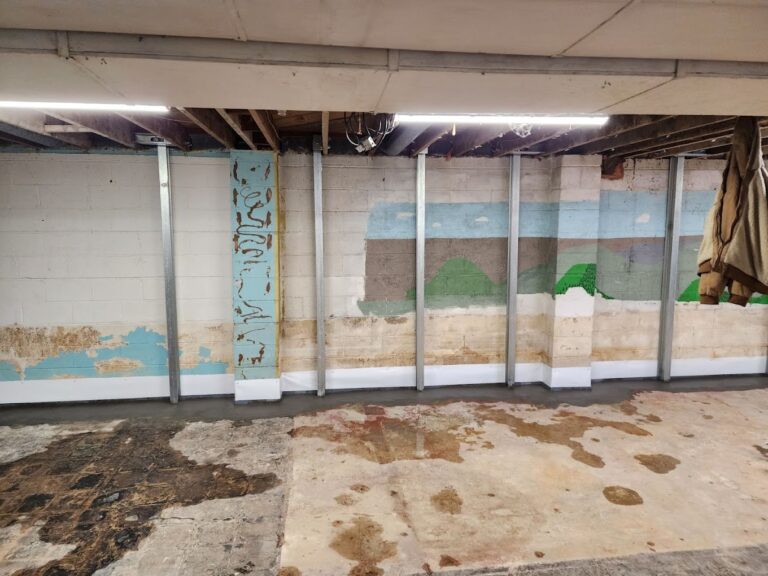
The immediate goal is to resist further inward movement. Depending on the wall, access, and design, 603 may use carbon-fiber straps or steel power braces. Carbon-fiber straps are $850 each and power braces are $1,300 each under the current confirmed pricing framework. Treated wall stabilization carries a 25-year warranty against further inward movement within the system’s design tolerances.
Why Homeowners Choose 603 for Foundation Repair
The review and repair imagery below provide practical proof for a Dover homeowner deciding who should inspect the structure.
Foundation Repair Methods and Pricing in Dover
When the footing is settling, a wall brace does not support the dropping corner. 603 self-performs helical-pier installation when the inspection confirms that need. Piers are $2,700 each for the first three and $2,200 for each additional pier, with a 25-year engineered-performance warranty.
When a dropping area traces to footing settlement, the repair may use push piers or helical piers. Push piers are hydraulically advanced against the weight of an existing building. Helical piers are rotated into the ground and checked through installation torque. The wall and footing condition, structure, access, and repair design decide the method. A pier does not replace a brace for lateral wall movement, and a brace does not carry a settled footing.
When a floor sags, we inspect the beam, sill, posts, connections, and footings. Lally-column replacement generally runs $1,300–$2,500 and carries a 10-year warranty against further settlement in treated areas. Sill, beam, masonry, or wall-replacement scopes remain quote-based because access and damaged material vary.
When wall movement may include the slab
A crack crossing the floor can be separate from a moving wall, or it can be part of a larger pattern. We check whether the floor is only a surface, whether the slab supports the structure, whether the crack edges have shifted, and whether the condition is changing. Those observations decide whether monitoring or focused crack repair is enough, or whether stabilization or replacement belongs in the scope. The slab foundation repair page covers that structural concrete path without turning every floor crack into a foundation diagnosis.
From inspection to written scope
Document the condition. Wide photographs and a simple timeline help, especially if the crack, wall, floor, door, or window has changed.
Measure the related parts. We inspect the load path instead of treating the most visible mark as the whole problem.
Match the method to the finding. The proposal should identify the repair, quantity, price, and warranty, not just say “foundation work.”
Plan any required review. If the scope needs engineering or another step before installation, it belongs in the plan.
603 is licensed and insured. The inspection and estimate are free, and the normal process is a written quote within 24 hours. Review the broader methods on the Structural and Foundation Repair page or use the foundation repair cost guide before the appointment.
Dover context does not replace wall measurements
The 2023 American Community Survey reports a median housing year of 1975 in Dover, with 26.9% of housing units built in 1939 or earlier. Those figures show the breadth of the city’s housing stock. They do not reveal whether an individual wall is fieldstone, block, or poured concrete, and they do not prove that a crack is moving. 603 verifies the material, wall geometry, support conditions, and prior repairs at the house.
If you are monitoring a wall, use repeatable reference points. Photograph the whole wall from the same place, include the floor and top of the wall, and note the date. A close-up of a crack is useful, but it can hide the curve or lean that changes the repair decision. Do not tighten, remove, or add supports before the inspection.
What a wall-stabilization proposal should tell you
The finding. Where is the wall out of plane, and what evidence shows that movement is structural rather than a surface defect?
The system. Is the plan using carbon-fiber straps, power braces, or another method, and why does it fit the wall?
The quantity. How many units are included, how are they spaced, and what portion of the wall is treated?
The limit. Is the goal to stop further movement, and is any straightening or recovery actually included?
The warranty. Does the proposal state the 25-year coverage against further inward movement within design tolerances?
603’s confirmed prices are $850 per carbon-fiber strap and $1,300 per power brace. An auxiliary wall is approximately $1,350 per linear foot. Wall replacement, anchors, and steel-beam work remain quote-based because access and the required structural scope vary. The free inspection establishes which price framework belongs to the house.
Real work images, used honestly
The brace diagram and completed installation photograph on this page explain the method. 603 also has genuine portfolio images of piers, columns, footings, sills, and beams. 603 is licensed and insured, self-performs helical-pier installation, and has served 5,000+ homeowners in New England.
One customer praised 603 for diagnosing the basement problem, communicating clearly, and treating the condition professionally. That supports the inspection experience. The wall measurements, method, quantity, and warranty in the written scope remain the evidence for the house being inspected.
If the wall is not the only finding
Wall movement can appear beside a separate floor-support or settlement problem. The proposal should not fold every symptom into one vague line item. If the footing is settling, the pier plan needs its own quantity and warranty. If the sill or beam is damaged, temporary support and replacement work need their own scope. If one stable crack is the only issue, the narrower Dover crack-repair service may be enough.
Dover wall questions to answer before installation
Is every horizontal crack a bowing-wall repair?
No. Crack direction is one signal. The inspector still measures the wall, checks the material and surrounding conditions, and looks for movement. The repair follows the structural finding rather than the crack label alone.
Can a brace be hidden behind a finished wall?
Ask what access and service clearance the selected system requires. Do not cover structural hardware until the work is documented and the installer confirms the finish plan will not interfere with inspection, adjustment, or warranty conditions.
What if the wall is leaking but not moving?
That points to a water-management or narrow crack-repair decision, not automatically to stabilization. The scope should separate water control from structural work so you know what each line item is intended to solve.
Does a 25-year warranty mean the wall will straighten?
No. The confirmed wall-stabilization coverage is against further inward movement within design tolerances. Straightening or recovery, when feasible, must be described separately in the proposal. Do not rely on an unstated expectation.
What if the wall is too damaged for braces?
A crumbling, displaced, or otherwise unsuitable wall may require an auxiliary wall, replacement, or another engineered scope. Those methods are not interchangeable with straps or braces and should be priced from the measured condition.
Bring any earlier engineer note, home-inspection report, crack injection invoice, or wall-system warranty to the visit. A prior document can provide a useful reference measurement and show what area was treated. It does not replace current measurements, especially if the wall or a nearby opening has changed since that work.
If storage or finishes block the wall, explain that when booking. Do not remove structural hardware or unsafe material for access. The inspection can identify what must be exposed and put that requirement into the scope before installation is scheduled.
Find out whether the wall is actually moving
Free inspection, clear measurements, and a repair plan built around the finding.
Sources: U.S. Census ACS 2023 5-year tables B25035 and B25034; 603 confirmed service, pricing, warranty, and credential information. Work images explain a repair method.

.jpg)