
Quick Answer
603 Basement Solutions handles foundation movement and support problems in Dunstable, Massachusetts for foundation movement, wall displacement, framing deflection, column concerns, and failed sill material. The result may be a pier layout, wall bracing, corrected support line, sill or beam replacement, crack-specific work, or a recommendation to watch the condition. The on-site inspection and written estimate are free.
Sometimes the right first step is to watch, not repair
A crack or slight floor change can look urgent without showing whether it is moving. One careful baseline is more useful than a row of unlabeled phone photos.
We set fixed points and a reason to check them again. If the condition stays stable, we will not invent a larger job.
Dunstable housing context without pretending it diagnoses a house
The 2023 American Community Survey places Dunstable’s median housing year at 1986.
That townwide midpoint can guide questions about repair records and later alterations. It cannot identify the materials, movement, or load path at one address.

Foundation Problems, Inspection Points, and Possible Repairs in Dunstable
| What you are seeing | What 603 inspects | Possible repair |
|---|---|---|
| Cracks and openings are changing near one settled area | Measure the change and inspect the footing, framing, grade, and history | Helical or push piers may be designed where competent bearing is needed |
| A basement wall is moving inward | Document deflection while reviewing masonry condition and water management | The measured wall condition determines the stabilization method |
| A beam end or sill has lost sound material | Compare floor elevations with beam bearing, columns, sills, and concrete below | Unsound structural wood can be replaced in a planned support sequence |
| A crack is visible without obvious movement elsewhere | Separate water entry from movement by checking the wall and connected loads | Injection or sealing may apply when the wall remains stable |
Only the measurements at the Dunstable inspection can set the scope.
Put the visible clue in the right lane
A crack has no earlier photograph
Create a labeled wide view and fixed endpoints now.
A floor feels different by season
Record elevations with the same method and surface.
A post has not moved visibly
Document its top, base, beam, and bearing before deciding.
A wall patch remains closed
Measure the full wall instead of treating the patch as proof.
Choose one question for monitoring
Decide whether you are watching crack width, wall shape, floor elevation, or support contact. Each condition needs a repeatable way to check it.
A vague plan to keep an eye on things rarely leads anywhere. The next reading should help decide repair, continued observation, or no current work.
Mark points you can find again
Use fixed edges, corners, or labeled locations that paint and stored items will not hide. Take a wide photo before the close measurement.
Record the tool, units, direction, and date. A later number means little if it came from a different surface or angle.
Keep stable readings
No change is still useful information. It can support a smaller repair, a crack-only treatment, or a decision to leave the area alone.
Do not save only the photograph that looks dramatic. The quiet dates are what show whether the condition is changing.
Know what ends the waiting period
Set a measured change or functional warning that brings us back sooner. A new opening, wall movement, lost support contact, or sudden floor change deserves prompt review.
Monitoring is not a delay tactic for a clearly unsafe condition. We explain when temporary support or immediate work should come first.
Avoid changing the evidence
Do not tighten a post, fill the crack, add shims, or repaint the marked area during the check period. Those changes can erase the baseline.
If something must change, photograph it and begin a new set of readings. Two honest baselines are better than one misleading trend.
Turn the result into a small decision
When readings change, the repair should connect to the measured area. When they stay stable, continued watching may be enough.
We separate wall movement, floor support, footing concerns, and water. A stable crack does not need to inherit every foundation service.
Keep the Dunstable notes with the house
Save the full series, not only a summary. Another inspector should be able to find the same points and understand why work started or stopped.
If a repair happens later, those earlier readings become the before picture. That can make the later repair clearer and more focused.
Use more than one photograph
A close crack image shows detail but loses the wall around it. A wide view shows location but may hide a small change.
Take both from repeatable positions and keep a simple label in view. The pair is far more useful at the next reading.
Do not use a sticking door as a ruler
Doors and windows can change with hardware, humidity, paint, or ordinary wear. Their operation helps tell the story but is not a structural measurement.
We place that clue beside wall or floor readings. Repair depends on the combined evidence, not one stubborn latch.
What to do if the mark suddenly changes
Take a wide photograph, note the date, and avoid filling or adjusting the area. If support looks loose or movement seems rapid, keep people away and call.
A sudden change deserves a new inspection even if earlier readings were quiet. Monitoring is useful only while the condition remains suitable for monitoring.
When a focused crack repair fits
If the wall is stable and the opening is mainly allowing water, crack-specific sealing may be the smaller answer. It does not need to become a full structural project.
We keep that decision separate from bowed walls, weak beams, and footing movement. Similar-looking cracks can belong to different repair lanes.
Let the monitoring plan stay simple
You do not need an elaborate report to watch one condition well. A few labeled points, repeatable pictures, and the same measuring method can be enough.
Write down the next check date and the change that would bring the visit forward. Keep the note where another household member can find it.
If the question becomes harder to repeat, call before improvising a new method. Consistency matters more than collecting a large pile of numbers.
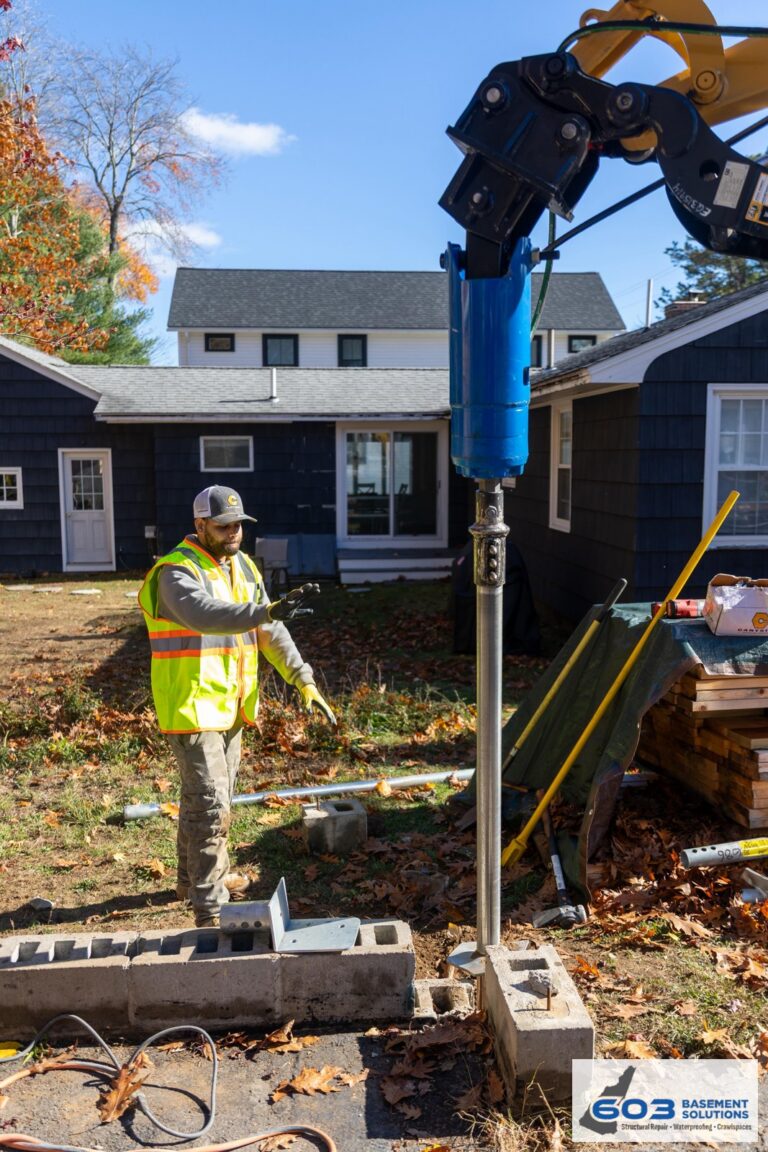
How pier selection fits this finding. A Dunstable monitoring series needs to show actual settlement before pier selection begins. Push piers use the existing structure’s weight as reaction during installation; helical piers advance by rotating helical plates. House weight, footing condition, access, and a documented repair design then decide which fits. A single old crack or one invalid reading should lead to a better baseline, not directly to either pier system.
Monitor a Dunstable slab with a decision already in mind
The monitoring question should identify whether the concrete is only a floor surface or a slab that supports part of the house. In Dunstable, fixed endpoints can track displacement, a changing crack, and movement corresponding with a wall or other loaded component. Every date uses the same method, and disturbed points begin a new series instead of being blended into the old one. Stable evidence can support closure or continued observation. Confirmed change can lead to focused crack repair, stabilization, or replacement. The slab foundation repair path begins only when those readings connect the load-supporting slab to the concern.
Dunstable foundation repair prices and limits
Wall stabilization
Steel power braces are $1,300 each. Carbon-fiber straps are $850 each. Treated wall stabilization carries a 25-year warranty within written tolerances.
Floor support
Lally columns range from $1,300 to $2,500 each. Treated support work carries a 10-year settlement warranty. Footings and timber repair are priced separately.
Helical piers
The first three piers are $2,700 each. Later units are $2,200 each. Engineered pier work carries a 25-year warranty on the treated footing section.
What those numbers do not decide
Price does not choose the method. Wall shape, floor framing, bearing, footing evidence, access, and the intended result still need an inspection.
Dunstable inspection worksheet
- Choose the question. Name the change the monitoring plan is testing.
- Mark fixed points. Save method, tool, units, date, and photographs.
- Set the threshold. Write what triggers repair or another inspection.
- Close the series. Record repair, continued monitoring, or no action.
Dunstable foundation questions
How long should a crack be monitored?
The condition should set a specific interval and decision threshold.
What if readings do not change?
Stable evidence may support continued monitoring or closure.
Can I fill the crack during monitoring?
Leave it visible unless the inspection plan says otherwise.
Does monitoring replace urgent repair?
No. Conditions that require prompt support should not be delayed for a trend.
What 603 documents during a Dunstable structural inspection
The decision begins with this page’s central issue: Sometimes the right first step is to watch, not repair. The crew maps that observation to the connected wall, footing, beam, post, or floor before a repair enters the proposal.
603 is licensed and insured and has worked in more than 5,000 homes. Its own crews install helical piers and perform structural lifting. The inspection and estimate cost nothing; the written quote normally follows within 24 hours and identifies the treated area, quantities, intended result, exclusions, and warranty.
Why Homeowners Choose 603 for Foundation Repair
The proof below gives Dunstable homeowners a direct view of 603’s service, explanations, and completed structural work.
Get the Dunstable load path checked
Your Dunstable visit will connect the measurements to a defined repair boundary and a written scope that can be checked against the house.
Sources: U.S. Census Bureau, 2023 ACS 5-year table B25035. The city image caption links its Wikimedia Commons source and license. 603 supplied service, pricing, warranty, and operating information. Work imagery shows a 603 repair method. See Structural and Foundation Repair or the Foundation Crack Repair service.