
Quick Answer
603 Basement Solutions helps homeowners separate structural movement from limited damage in Fitchburg, Massachusetts for foundation movement, wall displacement, framing deflection, column concerns, and failed sill material. The appropriate plan can involve piers, a wall system, support-column work, beam or sill replacement, narrow crack treatment, or documented monitoring. 603 documents the recommendation in a free written estimate.
Understand old patches and added supports before repairing
An older-looking patch is not automatically the problem, and a newer post is not automatically the cure. We read the whole support line first.
That means checking what each post touches, where the beam carries weight, and whether the wall or floor is changing now.
What the Fitchburg housing number can and cannot tell us
The 2023 ACS lists 1950 as the median year built for housing across Fitchburg. That is a citywide midpoint, not the age or condition of your foundation.
Fitchburg basements may contain repairs from several different years. A citywide housing midpoint cannot identify which change happened at your address.
We do not guess their age from paint color or surface wear. Connections, bearing, current measurements, and any dated photos tell us more.

Foundation Problems, Inspection Points, and Possible Repairs in Fitchburg
| What you are seeing | What 603 inspects | Possible repair |
|---|---|---|
| A section of the foundation seems to have dropped | Test whether the visible changes align with a loss of support at the footing | Helical or push piers may be designed where competent bearing is needed |
| A stair-step pattern appears with wall displacement | Measure displacement and assess material, drainage, soil pressure, and loads | Wall reinforcement can be selected for the material and displacement found |
| A floor sags near a beam or interior post | Trace joists through beams, posts, connections, and supporting footings | A new footing or column may be paired with beam and sill repair where needed |
| A slab has changed elevation near another structural element | Record direction, width, displacement, moisture, and changes around it | Slab repair depends on whether the changed concrete is structural |
The possible-repair column does not prescribe work for a Fitchburg property.
Four useful checks for this Fitchburg concern
Read the original framing before judging the repairs
Paint and coatings can make unrelated patches look like one system. Edges, fasteners, beam joints, and post connections reveal more.
A post needs a sound top and a sound bottom
A steel column touching a beam is not enough. Its top connection, base, and bearing below all have to do their jobs.
Keep wall movement and floor movement separate
A coated wall can hide an old crack while a low floor comes from the beam. Similar timing does not make them one problem.
Leave old parts in place until they have been photographed
A removed shim or beam piece can show how the support changed. Once it is gone, that clue cannot be checked again.
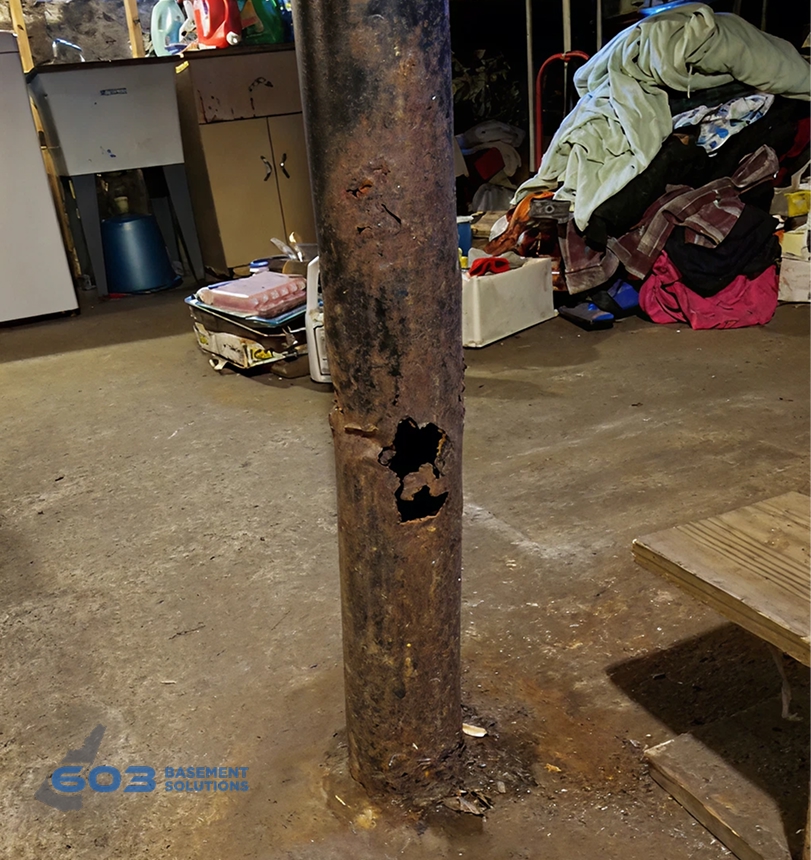
How pier selection fits this finding. Added supports and old Fitchburg patches remain evidence until the current footing condition is measured. When settlement supports pier work, push piers use the existing structure for installation reaction and helical piers advance through helical plates. Building weight, footing condition, access, and a new repair design decide between them. No legacy post or patch should silently select the system or extend the scope beyond its measured section.
Separate the Fitchburg slab from earlier patches and supports
A patched floor and an added post can sit close together without proving that a structural slab has failed. The Fitchburg inspection records the floor surface, individual footings, and any slab carrying the building as separate components. Displacement, new change, and movement corresponding with a loaded support can establish a connection. The evidence may instead support monitoring or a focused crack repair; when the slab is involved, stabilization or replacement can be scoped to it. The slab foundation repair service explains that structural lane. Earlier work stays on the drawing with its own boundary rather than being rewritten as the current diagnosis.
How confirmed 603 prices may apply in Fitchburg
If the measured wall in Fitchburg needs stabilization, a power brace costs $1,300 and a carbon-fiber strap costs $850. Work completed to the written design carries a 25-year warranty.
When the weak point is under a beam, a lally column costs $1,300 to $2,500. The support work carries a 10-year settlement warranty.
If settlement calls for helical piers, the first three cost $2,700 each. Additional piers cost $2,200 each, and engineered work carries 25-year coverage.
Those figures do not choose the repair. The right method and count depend on the wall, beam, post, footing, or settling section found at your Fitchburg home.
Read the original framing before judging the repairs
We start with the joists and follow the load through the beam. Then we look at each added post, shim, patch, or sistered board.
The newest-looking item may be harmless. The weak point may sit at an older beam end or below a post that still looks straight.
A post needs a sound top and a sound bottom
We check whether the post is plumb and whether shims are tight. We also look for beam crushing, splits, rust, or movement at the base.
If the footing below is unknown, stronger steel above does not settle the question. The support needs a dependable place to land.
Keep wall movement and floor movement separate
We measure wall shape and crack displacement on their own. Floor elevations, beam condition, and post bearing get a separate check.
Only the framing can connect those findings. This keeps you from buying wall work for a floor problem, or the other way around.
Leave old parts in place until they have been photographed
Photograph the part in place before disposal. A wide view should show which post, beam end, or wall section it came from.
You do not need a thick history file. A few clear photos and current readings are enough to make the next repair understandable.
Read old repairs from oldest to newest
A basement may contain painted cracks, added posts, fresh shims, patched mortar, and newer coatings. We first look for the original wall, beam, and bearing. Then we ask what each later change was trying to address.
The newest patch is often the easiest thing to see, but it may only cover an older symptom. Following the layers in order helps separate a past water repair from a current support concern.
Leave posts and shims untouched before the visit
An improvised support can still reveal how the floor was behaving when someone added it. Moving that support erases a useful clue and may shift load without knowing what sits below.
We check contact at the top, the beam condition, and the base. If a post is loose or unsafe, keep people away and call. Do not tighten it as a test.
A patch can be sound without solving everything
Sealed cracks and repaired mortar may be doing their job. We check whether moisture or movement continues around them. A dry, stable patch does not need removal simply because another foundation issue is nearby.
If the wall shape or floor readings point elsewhere, the new recommendation should follow that finding. Keeping good prior work in place avoids unnecessary demolition and cost.
Photograph clues before replacing old material
Before damaged wood, a corroded post, or loose masonry is removed, wide and close photos can show how the pieces met. That view may explain load transfer better than the loose parts after removal.
The final photos should show the repaired connection and a nearby landmark. You then have a simple before-and-after reference without turning the home into an archive.
When an old repair only needs watching
A patched crack, added post, or sistered joist can remain useful when it is dry, tight, and carrying the intended load. New-looking work is not required for every older basement.
We check the surrounding wall, beam, and floor for current change. If the readings are steady, leave the repair visible and take a dated photo.
Call again if the patch opens, the support loses contact, or nearby finishes change quickly. Otherwise, preserving sound older work can be the safest and least disruptive choice.
That focused approach also makes later changes easier to recognize.
How to read a Fitchburg foundation estimate
A Fitchburg estimate should name which older parts stay and which parts need repair. Each new column or beam section needs a clear location.
Ask whether the price includes footing work, adjustment, or removal of older supports. Those are different jobs and should not hide inside one line.
What happens during the free foundation inspection
We do not condemn a repair because it looks old. We test whether it still carries load and whether the surrounding structure is stable.
Some parts may stay. Others may need support, replacement, or a period of watching before the right answer is clear.
603 Basement Solutions is licensed and insured and has worked in more than 5,000 homes. The same team handles helical piers and structural lifting.
If work is recommended, 603 normally sends a written quote within 24 hours. The price and warranty should match the exact area being treated.
Why Homeowners Choose 603 for Foundation Repair
The following customer and job evidence helps a Fitchburg owner judge 603 on documented work rather than promises alone.
Get the Fitchburg foundation checked
We will sort the old patches and added supports by what they are doing now, not by how they look.
Sources: U.S. Census Bureau 2023 ACS 5-year table B25035. The city image caption gives its photographer and Wikimedia Commons license. 603 supplied the service, price, warranty, and crew details. The work photo shows a 603 repair method. See Structural and Foundation Repair or Foundation Crack Repair.