
Quick Answer
603 Basement Solutions helps homeowners separate structural movement from limited damage in Hamilton, Massachusetts for settled foundations, bowed masonry, changed floor elevations, poor supports, and damaged beams. The result may be a pier layout, wall bracing, corrected support line, sill or beam replacement, crack-specific work, or a recommendation to watch the condition. The inspection and written repair proposal are provided without charge.
Old patches are clues, not proof
A patched crack, added post, or old wall brace tells us someone noticed a problem. It does not tell us whether the structure is stable today.
We inspect beyond the earlier repair and measure the parts around it. Sometimes the old work can stay. Sometimes it points to a different problem nearby.
Hamilton housing context without pretending it diagnoses a house
The 2023 American Community Survey places Hamilton’s median housing year at 1958.
That townwide midpoint can guide questions about repair records and later alterations. It cannot identify the materials, movement, or load path at one address.

Foundation Problems, Inspection Points, and Possible Repairs in Hamilton
| What you are seeing | What 603 inspects | Possible repair |
|---|---|---|
| One wall line no longer matches earlier elevations | Review level readings, footing condition, structural loads, and site access | Deep pier support may fit if the measurements confirm bearing failure |
| Blocks or poured concrete no longer remain in plane | Document deflection while reviewing masonry condition and water management | A wall-specific design is needed before any system is selected |
| The floor changes elevation across one basement span | Check the whole support line instead of judging one shiny or temporary post | Supplemental support may fit when the existing beam line is inadequate |
| A crack is visible without obvious movement elsewhere | Compare the repaired area with measurements from adjacent walls and floors | Slab repair depends on whether the changed concrete is structural |
A symptom at one Hamilton home can have a different cause at another.
Put the visible clue in the right lane
Mortar or sealant covers a crack
Photograph its full length and check the wall around it.
A post lacks paperwork
Inspect the beam above and bearing below before relying on it.
Wall hardware covers only one section
Measure the untreated ends and every connection.
A floor changed after renovation
Place the alteration on the load-path drawing without assigning cause.
Show us every earlier repair
Walk us through patches, posts, steel, sistered joists, replaced wood, and areas that were opened before. Old invoices or photographs are helpful when you have them.
No paperwork is common and does not force a guess. We can start with what is visible now and create a dependable baseline from today forward.
Look past both ends of a patch
Sealant can cover the face of a crack while the wall above, below, or beside it continues to change. A short brace can leave movement at either end.
We measure the full wall section, not only the treated spot. The same idea applies to a post under one point of a longer beam.
Check what the old work is carrying
An added post may now carry real weight, even if nobody knows who installed it. Removing or loosening it without temporary support can create a new problem.
We trace the beam above and the bearing below before recommending a change. Safe repairs respect the load already sitting on the house.
Why Homeowners Choose 603 for Foundation Repair
For a Hamilton homeowner comparing contractors, the review and field evidence below show how 603 handles the work.
Separate a cosmetic patch from structural work
Paint, mortar, or injection can make an opening look better. Those treatments do not brace a moving wall, strengthen a damaged beam, or support a footing.
If measurements show the structure is stable, a focused crack repair may be enough. We will say that instead of turning every patch into a large project.
Keep useful parts when they still work
Not every old component needs removal. A sound column, brace, or timber repair may remain as part of a new plan when its connections and bearing check out.
The estimate should tell you what stays, what changes, and where new work begins. That keeps you from paying twice for the same support.
What to ask before approving the work
Ask which current measurement shows a problem and which component the proposed repair changes. Ask how earlier work affects access, temporary support, and warranty coverage.
You should also know what remains under observation. A narrow repair can be the right repair when the evidence supports a narrow boundary.
Leave the next owner a clear history
We take final photographs and repeat the important readings without erasing the starting condition. The before and after should remain easy to compare.
Keep those records with older information about the house. Future repairs become easier when the next person can see what changed and what stayed untouched.
When monitoring the old repair makes sense
If current readings are stable and the earlier component remains sound, a dated baseline may be more responsible than immediate replacement. We choose points you can check again.
The plan should say what change triggers another visit. Watching without a question delays the same uncertainty.
When earlier work must come out
A component may be damaged, poorly connected, badly placed, or blocking the repair the structure now needs. Removal begins only after its present load is understood.
Temporary support protects the house during that change. We explain the order so an old post is not treated like loose basement clutter.
Do not hide an old crack before inspection
Fresh paint or mortar can erase the edges that help us read an opening. Leave the area visible and bring older pictures if the surface has already changed.
We look for direction, width, displacement, wall shape, and moisture. That is more useful than judging a patch by whether it still looks neat.
What the Hamilton proposal should not claim
No contractor can confirm hidden materials, footings, or connections from an exterior glance. The estimate should name what remains unseen and how it will be checked.
It should also avoid promising that structural work removes every stain or finish crack. Those results need their own explanation.
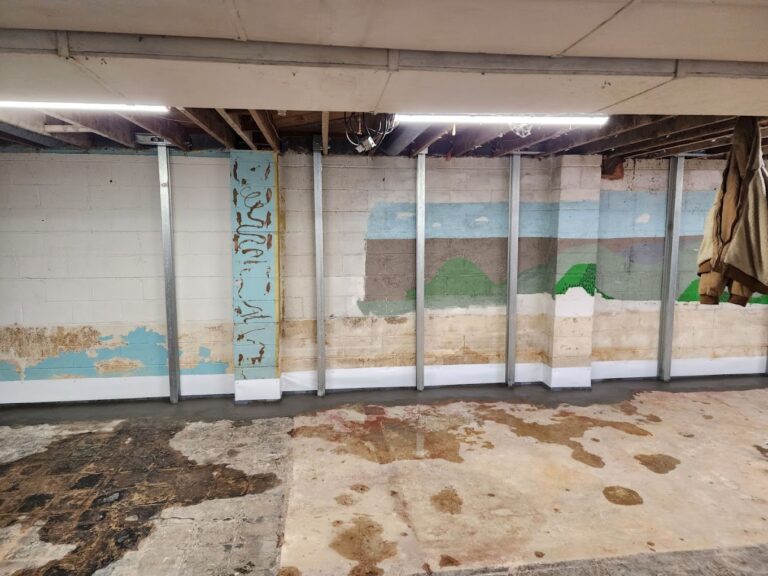
How pier selection fits this finding. An old Hamilton patch can hide the edge of movement, so pier work starts with fresh measurements rather than the earlier repair story. When settlement is confirmed, push piers use the structure’s weight as installation resistance, whereas helical piers advance through the soil with helical plates. The remaining footing, building weight, access, and engineered layout decide between them. Neither system should be selected from the appearance of mortar, sealant, or a historic support alone.
Read a Hamilton slab through the layers already present
A patched basement floor may be only a surface record of earlier work; it is not proof that a building-supporting slab has moved. In Hamilton, we preserve the patch edges and look for displacement, renewed change, and movement that corresponds with a wall, column, or other loaded component. The inspection also identifies which concrete is merely the floor surface and which section participates in the structure. That evidence can support monitoring, focused crack repair, stabilization, or replacement without folding every old mark into one diagnosis. Our slab foundation repair page describes the service when the slab itself is carrying and losing support.
Hamilton foundation repair prices and limits
Wall stabilization
Steel power braces are $1,300 each. Carbon-fiber straps are $850 each. Treated wall stabilization carries a 25-year warranty within written tolerances.
Floor support
Lally columns range from $1,300 to $2,500 each. Treated support work carries a 10-year settlement warranty. Footings and timber repair are priced separately.
Helical piers
The first three piers are $2,700 each. Later units are $2,200 each. Engineered pier work carries a 25-year warranty on the treated footing section.
What those numbers do not decide
Price does not choose the method. Wall shape, floor framing, bearing, footing evidence, access, and the intended result still need an inspection.
Hamilton inspection worksheet
- Number earlier work. Put every patch and support on one plan.
- Measure beyond its edge. Include untreated wall, beam, and floor sections.
- Plan the load transfer. Show temporary support before removal.
- Keep the timeline. Add final evidence without deleting older records.
Hamilton foundation questions
Does an old patch mean the crack was repaired?
It shows earlier work. Current wall measurements decide what it means now.
Should an old post be removed?
Only after its load and replacement sequence are understood.
Can earlier braces stay in place?
They may, when inspection and the repair plan account for them.
What if no records exist?
603 can create a current baseline without inventing the missing history.
What 603 documents during a Hamilton structural inspection
The decision begins with this page’s central issue: Old patches are clues, not proof. The crew maps that observation to the connected wall, footing, beam, post, or floor before a repair enters the proposal.
603 is licensed and insured and has worked in more than 5,000 homes. Its own crews install helical piers and perform structural lifting. The inspection and estimate cost nothing; the written quote normally follows within 24 hours and identifies the treated area, quantities, intended result, exclusions, and warranty.
Get the Hamilton load path checked
Your Hamilton visit will connect the measurements to a defined repair boundary and a written scope that can be checked against the house.
Sources: U.S. Census Bureau, 2023 ACS 5-year table B25035. The city image caption links its Wikimedia Commons source and license. 603 supplied service, pricing, warranty, and operating information. Work imagery shows a 603 repair method. See Structural and Foundation Repair or the Foundation Crack Repair service.