
Quick Answer
603 Basement Solutions provides broad foundation repair in Lancaster, Massachusetts for sinking sections, bowing walls, sagging framing, weakened supports, and deteriorated structural wood. The measured condition may lead to pier support, wall stabilization, column or framing work, sill replacement, a crack-specific repair, or monitoring. Homeowners receive a no-charge inspection and written scope.
Inspect an older support line without losing clues
An older support line often makes sense only when you follow it from the floor joists to solid bearing below. Posts, beam ends, sill pockets, and old carpentry may each tell a different part of the story.
We look at those connections before moving a shim or replacing wood. A weathered surface can still carry its load, while a clean-looking cover can hide a weak joint.
What the Lancaster housing number can and cannot tell us
The 2023 ACS lists 1967 as the median year built for housing across Lancaster. That is a citywide midpoint, not the age or condition of your foundation.
The Census median is useful background for Lancaster as a whole. It cannot date a beam, an addition, or a repair in your basement.
What matters at the house is the framing we can see and the places where loads change direction. Photos or reports can also show earlier work.

Foundation Problems, Inspection Points, and Possible Repairs in Lancaster
| What you are seeing | What 603 inspects | Possible repair |
|---|---|---|
| Cracks and openings are changing near one settled area | Review level readings, footing condition, structural loads, and site access | A pier plan is considered only after settlement is verified |
| One foundation wall has changed shape under outside pressure | Map the wall movement and inspect cracks, construction type, and outside conditions | Repair may focus on restraint, drainage, rebuilding, or a combination |
| Doors bind above a low support line | Check the whole support line instead of judging one shiny or temporary post | A new footing or column may be paired with beam and sill repair where needed |
| An earlier patch opened again while nearby finishes stayed stable | Determine whether the slab carries load and how its edges are supported | A reopened patch may require monitoring or a broader repair rather than another cover |
Possible does not mean required; the site findings control the recommendation.
Four useful checks for this Lancaster concern
Read every connection before touching the support
A post is only one link between the floor and the ground. Its top, base, beam contact, and bearing all matter.
Use a small opening to answer one clear question
Sometimes a beam end or sill disappears behind a finished wall. We first use the unfinished views around it.
Do not replace more wood than the evidence supports
Dark wood is not always rotten, and a dry-looking face can hide damage at the end. The repair limit belongs in sound material.
Keep useful older work when it is still doing its job
A previous post, sistered joist, or repaired beam does not need removal just because it looks different from new construction.
How pier selection fits this finding. An older Lancaster support line needs to be understood before a settling footing is assigned a pier system. Push piers use the existing structure’s weight for installation resistance, whereas helical piers advance with helical plates. House weight, footing condition, access, and design govern the choice. Posts, shims, and patches remain documented until their role is known; none can stand in for current footing measurements.
Keep the Lancaster slab distinct from individual post bases
An old post may bear on its own footing, on an ordinary basement floor, or on a slab carrying a broader load. The Lancaster inspection labels those possibilities instead of assuming one continuous system. Displacement, a crack that changes, or related movement along the support line can show whether the slab itself is involved. The decision can then remain monitoring or focused crack repair, or move to stabilization or replacement for a defined area. Our slab foundation repair page covers that structural service. Retained posts and earlier concrete work keep separate dates and boundaries in the final record.
How confirmed 603 prices may apply in Lancaster
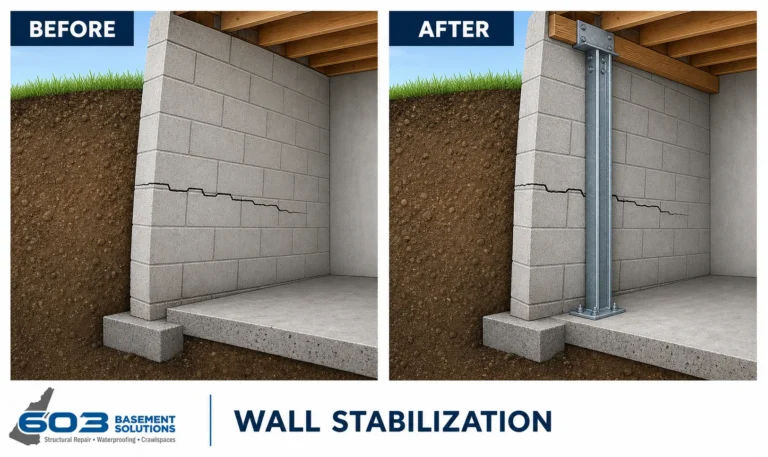
If the measured wall in Lancaster needs stabilization, a power brace costs $1,300 and a carbon-fiber strap costs $850. Work completed to the written design carries a 25-year warranty.
When the weak point is under a beam, a lally column costs $1,300 to $2,500. The support work carries a 10-year settlement warranty.
If settlement calls for helical piers, the first three cost $2,700 each. Additional piers cost $2,200 each, and engineered work carries 25-year coverage.
Those figures do not choose the repair. The right method and count depend on the wall, beam, post, footing, or settling section found at your Lancaster home.
Read every connection before touching the support
We start at the joists and trace their load into the beam. Then we check each post and the surface below it.
If a connection is hidden, we say so. Age, rust, stains, or an unusual shim do not prove that the whole line has failed.
Use a small opening to answer one clear question
If those views do not settle the question, a focused opening may show whether wood is sound and properly supported. The opening should have a clear purpose.
We do not recommend removing a long section of finish just to look around. A few inches in the right place can be more useful than broad demolition.
Do not replace more wood than the evidence supports
We check the visible condition and the bearing at both ends before sizing a sill or beam repair. Hidden decay can change the final length once exposed.
You should see why the end point moved if more damaged material appears. A change in scope should follow the wood condition, not a round number.
Keep useful older work when it is still doing its job
We check whether it carries the intended load and whether its connections remain tight. Sound work can stay while a nearby weak point is corrected.
That approach keeps the repair focused. It also leaves more of the house undisturbed when the older support is stable.
What a beam end can reveal
Beam ends carry large loads into a wall or pocket, yet much of the wood may be hidden. We look for crushing, separation, moisture, and changes in the support below. The nearby joists help show how much floor depends on that point.
A stain alone does not prove the end has lost strength. If the bearing remains firm and dry, monitoring may be reasonable. Soft wood, movement, or lost contact calls for a closer repair discussion.
Why old shims should stay in place
A shim can show that someone tried to close a gap or transfer load. Pulling it out before inspection may let the beam move and removes evidence of the earlier condition.
We check whether the shim is sound, fully seated, and supported below. A temporary-looking piece may need replacement, but the new connection still has to match the beam and bearing.
Moisture and structure need separate answers
Water near a sill or beam can create decay, but discoloration does not establish the depth of damage. We look for the moisture source and assess the wood connection as two related questions.
Stopping the water may protect sound framing. Damaged bearing may still need repair after the area dries. The estimate should not treat waterproofing and structural replacement as interchangeable.
A careful repair can preserve sound framing
Older homes often contain strong original material beside one local weak point. Replacing everything around it may add cost without improving the load path. We find sound wood and dependable bearing before setting the repair length.
The goal is a solid connection, not a uniformly new-looking basement. Keeping sound sections in place reduces disturbance and makes the reason for the repair easier to explain.
Call sooner when a support changes quickly
A post that leans, a beam that loses contact, fresh crushing at a connection, or falling masonry deserves prompt attention. Keep people and stored items away from the immediate area.
Do not wedge the gap or add a temporary post unless a qualified professional directs it. Moving load without knowing the bearing below can make the condition less predictable.
For slower changes, photos and repeated floor readings can help. The response should match the pace and severity of the evidence, not simply the age of the house.
How to read a Lancaster foundation estimate
A Lancaster estimate should identify the exact beam, sill section, post, or footing being repaired. It should show where replacement starts and stops.
Ask what happens if concealed wood is worse than the visible section. You should understand that possibility before anything is opened.
What happens during the free foundation inspection
We trace the support line from joists to bearing and explain which connection is weak. A small opening is considered only when it answers a remaining question.
If the old line is stable and the concern has not changed, monitoring may be enough. An older-looking basement does not automatically need new steel.
603 Basement Solutions is licensed and insured and has worked in more than 5,000 homes. The same team handles helical piers and structural lifting.
If work is recommended, 603 normally sends a written quote within 24 hours. The price and warranty should match the exact area being treated.
Why Homeowners Choose 603 for Foundation Repair
Before choosing a repair company in Lancaster, use the real customer and work evidence below alongside the diagnosis and price.
Get the Lancaster foundation checked
We will help you separate useful older supports from the exact connection that may need attention.
Sources: U.S. Census Bureau 2023 ACS 5-year table B25035. The city image caption gives its photographer and Wikimedia Commons license. 603 supplied the service, price, warranty, and crew details. The work photo shows a 603 repair method. See Structural and Foundation Repair or Foundation Crack Repair.