



Quick Answer
Broad foundation repair from 603 Basement Solutions covers more than crack sealing in Lynn, Massachusetts for settled foundations, bowed masonry, changed floor elevations, poor supports, and damaged beams. The result may be a pier layout, wall bracing, corrected support line, sill or beam replacement, crack-specific work, or a recommendation to watch the condition. 603 documents the recommendation in a free written estimate.
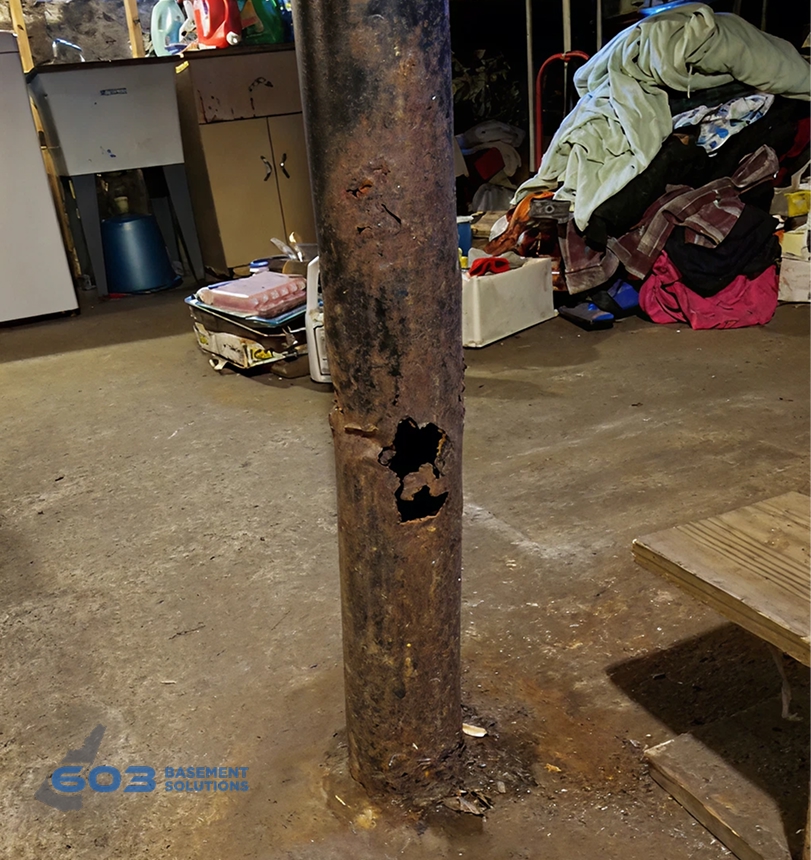
Inspect earlier support work before adding another column
An older post, sistered beam, patched crack, or plated connection is evidence. Photograph it before removing or working around it.
We identify what the earlier component carries and what carries it below. New support should solve a measured gap, not hide an old question.
Lynn housing context without the guesswork
The 2023 American Community Survey places Lynn’s median housing year at 1945. That citywide midpoint cannot date one beam, post, footing, or alteration.
Property records and current framing matter more. Preserve labels, tool marks, fasteners, patches, and repair photographs that help explain later work.

Foundation Problems, Inspection Points, and Possible Repairs in Lynn
| What you are seeing | What 603 inspects | Possible repair |
|---|---|---|
| Floors and trim changed above the same footing section | Compare elevations and trace loads into the footing below | Stabilization below the footing may apply to the measured section |
| The wall leans toward the basement | Inspect how the wall is built and what is acting on it from outside | Repair may focus on restraint, drainage, rebuilding, or a combination |
| Joists deflect where they meet a beam, wall, or support | Inspect structural wood, post condition, connections, and the base carrying each support | Column, beam, sill, or footing work may restore the support path |
| A slab has changed elevation near another structural element | Read the pattern in context with the rest of the foundation and structure | The crack should be routed to its own repair only after diagnosis |
603 confirms the failed component before pricing work at a Lynn property.
Put the visible clue in the right lane
A post was added off the beam line
Check what it contacts above and what bears below.
A beam has several repair layers
Document each layer before defining the sound repair length.
A floor still slopes
Compare elevations without assuming the earlier work failed.
A wall crack was patched
Measure the full wall and keep the patch as timeline evidence.
Read the old support as a system
Inspect the beam, top connection, post, base, slab, and footing. Record gaps, corrosion, crushing, or movement.
A component can look solid while missing the load above or bearing below. Photograph the whole line before close details.
Plan a safe transfer
Show where temporary support lands and which load it carries before an old component changes.
Verify the new connection and bearing before removing temporary work. Repeat measurements at planned steps.
Keep replacement evidence
Photograph the old component while loaded, after unloading, and after removal. Record why replacement was selected.
Closeout should show the new column location, beam connection, base, footing, and final floor readings.
Why Homeowners Choose 603 for Foundation Repair
603’s customer feedback and field documentation below give Lynn owners concrete evidence to weigh with the written scope.
Inspect around every older support component
Look beyond the visible steel or wood. Follow the beam in both directions and inspect the surface below each base.
Record fasteners, gaps, shims, corrosion, splits, crushing, and altered framing. Keep neutral labels until measurements explain the condition.
Do not remove an old component for a clearer view. Temporary support and a written sequence must come first.
Price replacement without losing the transition work
Include temporary support, opening, old-component removal, beam repair, new connections, footing work, adjustment, debris, and restoration.
Show which existing components remain. The price should not imply that every earlier support disappears.
Tie any field quantity to a label and approval rule. Keep the revised count with the drawing.
Keep before, transition, and final evidence together
Pair each old-component photograph with the temporary-support stage and new installation. Use one location label throughout.
Record final quantities, connections, bearing, elevations, and items that remain. Add the reason for every removed component.
A future owner should understand the sequence without reopening the area.
Read the old Lynn support before replacing it
Inspect the beam, top connection, post, base, slab, and footing. Record what remains and how temporary support transfers load.
603’s lally columns cost about $1,300 to $2,500 each. Treated support has a 10-year settlement warranty. Include beam repair, footing work, and adjustment.
Keep earlier wall repairs in the measurement record
Map patches, plates, braces, cracks, full-height shape, restraint, and untreated sections before selecting new wall components.
603 confirms $1,300 for a power brace and $850 for a carbon-fiber strap. The 25-year warranty must identify the new stabilized Lynn wall boundary.
Use piers only where the footing record supports them
Pair interior symptoms with the exact exterior section, bracket layout, access route, and stabilization or attempted-lift target.
The first three 603 helical piers are $2,700 each, then $2,200 for every additional pier. Engineered work carries a 25-year warranty. Preserve old-work evidence.
Use a controlled unload and reload record
Measure the floor and photograph finishes before temporary support takes load. Record each support location and bearing.
Document the old component as load transfers away. Inspect the beam and surrounding framing without forcing movement.
Install the new support, verify connections, then transfer load according to the plan. Repeat readings at each stage.
Keep earlier work legible
Label components that remain and explain their relationship to the new repair. Do not paint over useful marks before closeout.
Save removed-component photographs with the reason for removal. Note any condition that could not be verified.
The finished record should explain old support, new support, and the boundary between them.
Give remaining conditions a status
Mark every original post, patch, slope, crack, and beam item as repaired, retained, monitored, cosmetic, or outside scope.
Use the same labels as the starting photographs. Assign a next date when monitoring remains.
This prevents the new support from becoming an answer for every older condition in the basement.
Do not let new paint erase the history
Finish documentation before coating posts, beams, patches, or repaired wood. Preserve labels and concealed-work images first.
Record which old marks remain visible and which surfaces were restored. Future movement checks need known starting conditions.
Store the unedited photographs with the final drawing and warranty.
Keep one orientation photograph that shows the entire support line. Connection details should link back to that view.
Label retained older components separately from new work. A future inspector should not confuse their installation dates.
Record remaining corrosion, staining, cracks, or slope without assigning them to the completed scope.
Protect access around bases and beam connections. Storage should not block inspection points named in the warranty record.
Lynn inspection worksheet
- Inventory the Lynn support line. Number posts, plates, beam repairs, shims, bases, footings, and nearby cracks.
- Identify every load. Write what each support carries above and what carries it below.
- Plan temporary support. Show sequence, bearing, readings, and the stop rule.
- Preserve the handoff. Keep before, transition, installed, and final photographs in one record.
Lynn foundation questions
Does an old post prove the floor is supported?
No. Its position, connections, base, and footing still need inspection.
Can new columns work beside old ones?
Sometimes, after the complete support line is measured.
Will replacement level the floor?
Not automatically. Support and controlled adjustment are different outcomes.
How are lally columns priced?
603’s confirmed range is $1,300 to $2,500 per column.
What 603 brings to the inspection
603 is licensed and insured, has worked in more than 5,000 homes, and self-performs helical-pier installation and structural lifting. The inspection and estimate are free. We normally send the written quote within 24 hours.
We will tell you when the house needs a smaller repair or a period of monitoring. If work is proposed, the scope should name the treated area, quantities, outcome, exclusions, and warranty.
Get the Lynn load path checked
We will measure the structure, explain the repair boundary, and give you a written scope you can compare.
Sources: U.S. Census Bureau, 2023 ACS 5-year table B25035. The city image caption links its Wikimedia Commons source and license. 603 supplied the confirmed service, pricing, warranty, and operating information. Work imagery shows a 603 repair method. See Structural and Foundation Repair or the Foundation Crack Repair service.

.jpg)