
Quick Answer
Foundation repair by 603 Basement Solutions begins with measured conditions in Nashua, New Hampshire for footing movement, leaning walls, low floors, column failure, and sill or beam damage. The measured condition may lead to pier support, wall stabilization, column or framing work, sill replacement, a crack-specific repair, or monitoring. Homeowners receive a no-charge inspection and written scope.
Quick Foundation Checks Before Your Nashua Inspection
- Look across the basement wall from one end. Does the middle sit farther inward?
- Check whether a floor slope appears near one beam or continues toward an outside corner.
- Open and close doors above the area. Note any recent change.
- Mark the ends of a crack in pencil and add the date.
- Do not cover, patch, or frame over the area before the inspection.
These checks do not replace an inspection. They give us a better timeline and help separate something that has always been there from movement that is active now.
Foundation Repair Methods and Pricing in Nashua
Where the inspection isolates the support post and its base, our lally column replacement service explains the focused repair.
Settlement: We install helical piers when the footing needs engineered support. 603 self-performs the structural lifting and installation in-house. Piers are $2,700 each for the first three and $2,200 each after that, with a 25-year engineered-performance warranty.
When measurements lead to an underpinning plan, the pier type is a second decision. Push piers rely on the existing house for reaction as hydraulic equipment advances each section. Helical piers are turned into the soil and verified against the design through installation torque. The footing, supported load, access, and repair goal determine the fit. The estimate should name the selected system and show its locations rather than using the word “piers” as a complete scope.
Bowing walls: A designed stabilization plan may use carbon-fiber straps at $850 each or power braces at $1,300 each. Treated wall stabilization carries a 25-year warranty against further inward movement within design tolerances.
Floor support: We evaluate the beam, sill, existing columns, and footings together. Lally-column replacement runs $1,300–$2,500 and carries a 10-year warranty against further settlement in treated areas.
Cracks: Crack repair runs $1,000–$3,000. Polyurethane and epoxy serve different conditions, and neither should be used as a substitute for a structural repair when the surrounding wall is still moving.
Foundation Problems, Inspection Points, and Possible Repairs in Nashua
| What you are seeing | What 603 inspects | Possible repair |
|---|---|---|
| Floors and trim changed above the same footing section | Compare elevations and trace loads into the footing below | A pier plan is considered only after settlement is verified |
| A basement wall is moving inward | Inspect how the wall is built and what is acting on it from outside | The measured wall condition determines the stabilization method |
| The floor changes elevation across one basement span | Check the whole support line instead of judging one shiny or temporary post | Unsound structural wood can be replaced in a planned support sequence |
| An earlier patch opened again while nearby finishes stayed stable | Read the pattern in context with the rest of the foundation and structure | A reopened patch may require monitoring or a broader repair rather than another cover |
A symptom at one Nashua home can have a different cause at another.
The Nashua housing context
Nashua’s median housing unit was built in 1974, based on the 2023 ACS. A citywide median cannot tell us what is under one house. We verify the wall material and support system on site rather than inferring either one from the neighborhood or the age on a listing.
603 crews travel to Nashua from East Kingston. You can see Nashua and the surrounding coverage area on the service-area map.
When the sill is the weak link
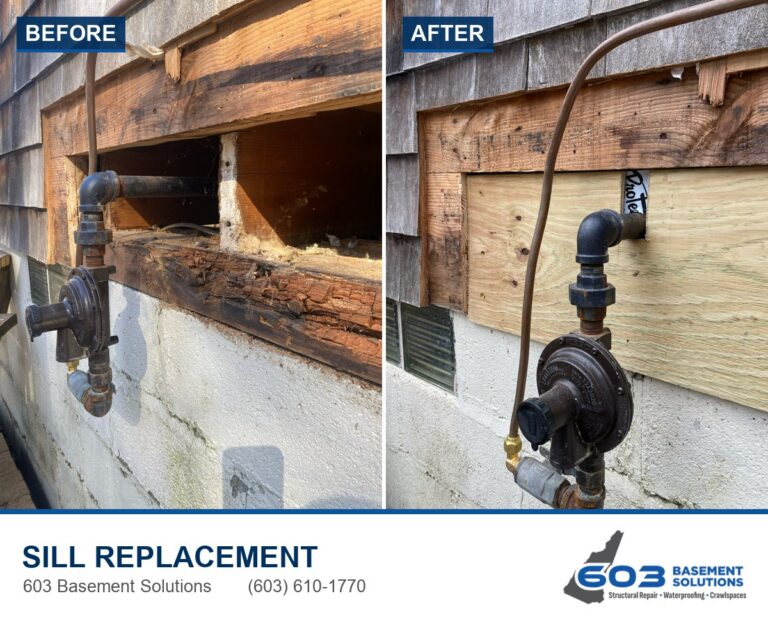
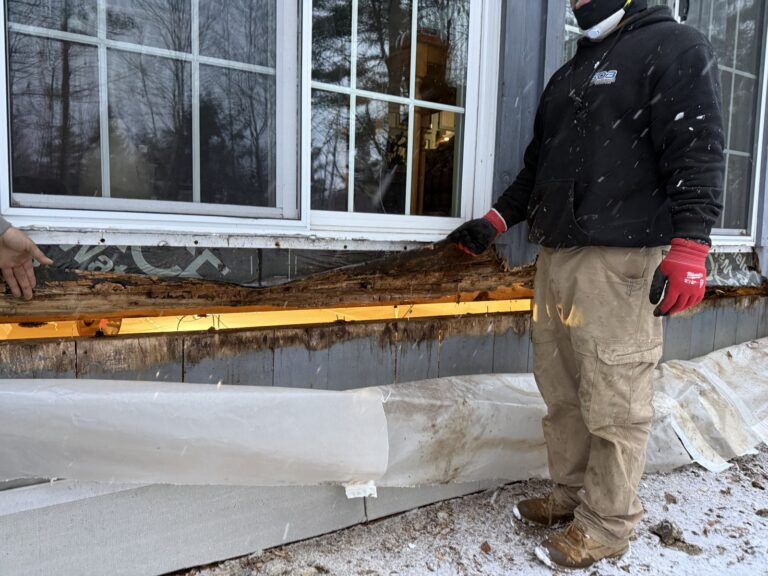
A floor can dip near an outside wall even when the foundation below it is stable. Water and age can damage the wood sill that transfers the framing load to the concrete or block. In that case, adding a post in the middle of the basement misses the failed material at the perimeter. We inspect the sill ends, nearby joists, beam line, and exterior access before pricing the repair.
When to Schedule a Foundation Inspection in Nashua
A finished room is about to hide the wall. Inspect it before framing. Once drywall goes up, the comparison points disappear and any later structural work becomes more disruptive.
A sale or renovation is already scheduled. Foundation questions slow down when nobody knows whether the mark is old, active, or already repaired. A written scope gives the homeowner, buyer, and other contractors the same information.
The floor and wall are changing together. One isolated symptom can be monitored. Several changes in the same part of the house deserve a closer look because they may share a load-path problem. Photograph what you see, note the date, and leave the area accessible.
None of those automatically means an expensive repair. They mean it is cheaper and clearer to document the condition before another layer of work covers it.
What to Send Before Your Foundation Inspection
A few wide photos are more useful than ten close-ups of the same crack. Show the entire wall, the floor above the affected area if it is accessible, and any post or beam nearby. Tell us whether the condition appeared after a renovation, whether another contractor has touched it, and whether you have an older inspection report. We still need to see the house, but that context helps us arrive ready to inspect the right parts instead of treating the first photograph as the whole problem.
Leave a tape measure or familiar object in one photo for scale. Avoid editing the image or drawing over the crack; the unmarked original gives us more to work with.
When the slab belongs in the structural inspection
Not every floor crack belongs in a foundation scope. We first establish whether the concrete is a surface inside a separate foundation or a slab that helps support the house. Displacement, a crack that keeps changing, and aligned movement in walls or doorways make the broader inspection more important. The finding may call for monitoring, a focused repair at the crack, stabilization, or replacement of a failed slab area. Our slab foundation repair service explains how those options differ from cosmetic floor work.
What Your Foundation Inspection Provides
We identify the likely cause, explain which method fits it, and send a written estimate within 24 hours. The goal is a scope you can understand. If foundation crack repair in Nashua is the right scope, we tell you. If the problem needs helical piers, wall stabilization, sill work, or floor support, the proposal names that work directly.
Foundation Repair Questions from Nashua Homeowners
Is every wide crack structural?
Width is one signal, not the whole diagnosis. Direction, change over time, wall movement, and symptoms elsewhere in the house matter too.
Can 603 lift a settling foundation?
603 self-performs structural lifting and helical-pier installations when the inspection and design call for that method.
What does a foundation estimate cost?
The inspection and estimate are free. The written quote is normally delivered within 24 hours.
Where can I compare broader repair costs?
Use the New Hampshire foundation repair cost guide, then use the inspection for the house-specific scope.
For a complete overview of settlement, wall stabilization, sills, beams, and floor supports, see Structural and Foundation Repair.
What makes one Nashua foundation estimate more useful than another
The better estimate explains the chain from symptom to repair. It should show why a crack is considered stable or structural, why a low floor points to a post, beam, sill, or footing, and why an exterior settlement finding calls for a certain number and location of piers. A list of products without that chain makes it difficult to tell whether two contractors are solving the same problem.
Nashua’s 2023 American Community Survey profile reports a citywide median housing year of 1974, with 19.3% of units built in 1939 or earlier. That range is one reason we do not infer foundation material or condition from the city name. The inspection verifies what was built, what has been altered, and where the load actually travels.
- the observed condition and the measurements used;
- the component being treated and the areas that were checked around it;
- the repair quantity, placement, and access assumptions;
- any engineering or municipal review required before installation;
- the exact warranty and the conditions that can void it.
Why Homeowners Choose 603 for Foundation Repair
603 has portfolio images from helical-pier installations, lally-column and footing work, wall bracing, sill replacement, and beam repairs. The photos on this page show the work clearly. 603 self-performs helical-pier installation and is licensed and insured.
A recent foundation customer wrote that Corey explained several options, walked through how the foundation worked, and never made the homeowner feel pressured. That is the standard the inspection should meet: clear choices tied to the structure, not urgency tied to a sales script.
From Foundation Inspection to Repair
- Send the useful evidence. Wide and close photographs, a short timeline, and any prior repair records help the inspector prepare.
- Inspect the whole support path. The visible crack or slope is checked alongside the wall, footing, sill, beam, joists, posts, and connections that may share the load.
- Receive the written decision. The inspection and estimate are free, and 603 normally provides the quote within 24 hours.
- Keep the completion record. Save the final scope, photographs, and warranty with the house documents for future maintenance or a sale.
Method-specific warranties include 25 years for engineered helical-pier performance, 25 years for treated wall stabilization within design tolerances, 10 years for floor support against further settlement in treated areas, and 10 years for the structural bond of an epoxy injection. The proposal should state which coverage belongs to your repair.
Get the structure checked, not just the crack
Free inspection, free estimate, and no-pressure explanation.
Sources: U.S. Census ACS 2023 5-year table B25035; 603 confirmed service, pricing, and warranty information; public Google review. Work photos show 603 repair methods.