
Quick Answer
603 Basement Solutions inspects and repairs structural foundation problems in Sterling, Massachusetts for foundation movement, wall displacement, framing deflection, column concerns, and failed sill material. The result may be a pier layout, wall bracing, corrected support line, sill or beam replacement, crack-specific work, or a recommendation to watch the condition. A free site visit establishes the scope before the homeowner decides.
Understand yard access before exterior foundation work
A pier or exterior foundation repair can affect more than the concrete. The route may pass close to steps, paving, siding, gardens, drainage, or buried utilities.
We first confirm the structural target. Then we look at the safest way to reach it and explain what parts of the yard may be disturbed.
What the Sterling housing number can and cannot tell us
The 2023 ACS lists 1979 as the median year built for housing across Sterling. That is a citywide midpoint, not the age or condition of your foundation.
Sterling's Census housing midpoint does not reveal the footing depth or exterior access at your property.
The useful facts come from measurements at the settling section, visible foundation details, utility markings, and the surfaces between the driveway and the work area.

Foundation Problems, Inspection Points, and Possible Repairs in Sterling
| What you are seeing | What 603 inspects | Possible repair |
|---|---|---|
| Cracks and openings are changing near one settled area | Compare elevations and trace loads into the footing below | Helical or push piers may be designed where competent bearing is needed |
| The wall leans toward the basement | Inspect how the wall is built and what is acting on it from outside | Wall reinforcement can be selected for the material and displacement found |
| A floor sags near a beam or interior post | Define damaged material and identify what must be held during repair | A new footing or column may be paired with beam and sill repair where needed |
| One concrete opening leaks after rain | Read the pattern in context with the rest of the foundation and structure | Repointing, drainage, or stabilization answer different fieldstone conditions |
A symptom at one Sterling home can have a different cause at another.
Four useful checks for this Sterling concern
Walk the route before choosing the access
Gate width, slopes, corners, overhead branches, steps, and soft ground can affect how equipment reaches the foundation.
Find utilities before digging
Public utility markings are essential, but private lines may also cross a yard. Septic parts, irrigation, drains, and exterior wiring need attention.
Separate structural backfill from finished surfaces
Closing an excavation safely is different from restoring paving, masonry, lawn, or plantings to their final appearance.
See the bracket before it is covered
A pier connection or repaired foundation area may disappear once soil returns. Photos can show its location and final connection.
How pier selection fits this finding. A Sterling yard plan follows the confirmed settling footing; it should not dictate where piers are placed. Push piers use the existing structure as resistance during installation, while helical piers advance through helical plates. Building weight, footing condition, utilities, access, and design select the system. Excavation stations and restoration limits then support the measured repair rather than shifting it toward the easiest patch of ground.
Connect the Sterling slab finding to the yard plan
The interior concrete and exterior work area need matched stations. A Sterling basement floor surface may not support the building, so it cannot automatically define excavation. Displacement, continuing crack change, and related movement at a loaded wall help show whether a structural slab or adjacent support belongs in the concern. The inspection can recommend monitoring, focused crack repair, stabilization, or replacement before the yard route is finalized. See slab foundation repair when the load-carrying slab is confirmed. Utilities, equipment, spoil, and restored surfaces remain on a separate logistics layer tied to the same endpoints.
How confirmed 603 prices may apply in Sterling
If the measured wall in Sterling needs stabilization, a power brace costs $1,300 and a carbon-fiber strap costs $850. Work completed to the written design carries a 25-year warranty.
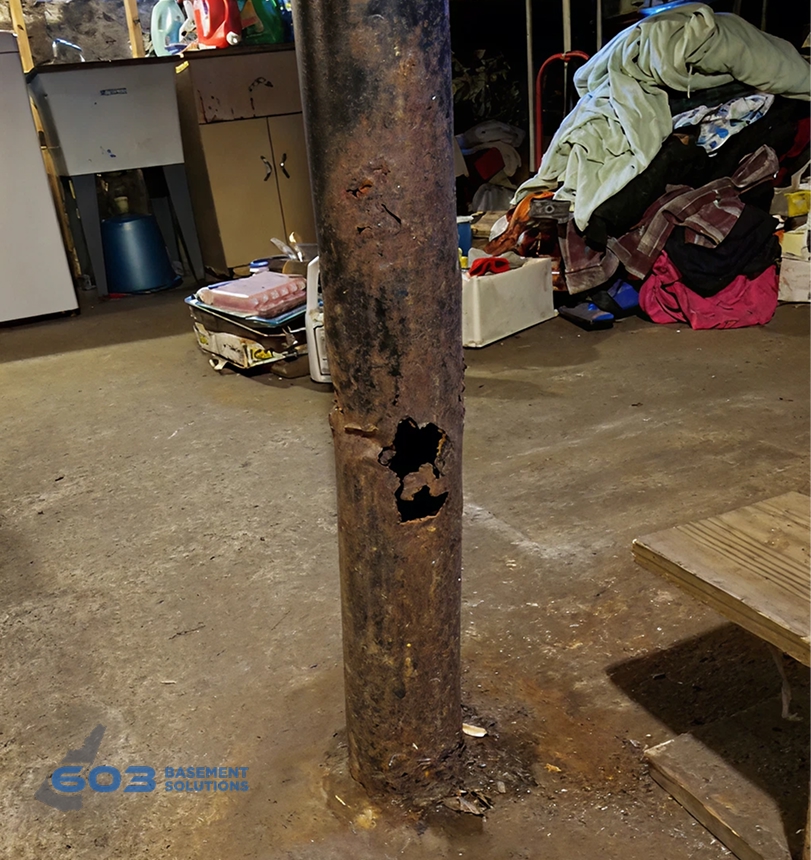
When the weak point is under a beam, a lally column costs $1,300 to $2,500. The support work carries a 10-year settlement warranty.
If settlement calls for helical piers, the first three cost $2,700 each. Additional piers cost $2,200 each, and engineered work carries 25-year coverage.
Those figures do not choose the repair. The right method and count depend on the wall, beam, post, footing, or settling section found at your Sterling home.
Walk the route before choosing the access
We compare possible routes after confirming where the repair belongs. The shortest path is not always the least disruptive or safest.
Existing cracks, worn paving, and delicate plantings should be noted before work. That gives you a realistic picture of what may need protection.
Find utilities before digging
A conflict does not automatically move a pier. The repair still has to support the measured foundation section.
If a utility blocks safe access, the crew should explain the alternative. Guessing underground is not a reasonable shortcut.
Separate structural backfill from finished surfaces
Ask what backfill and grading the structural work includes. Then ask whether finish repair is included or needs another contractor.
The answer should be clear before excavation. A homeowner should not discover afterward that a walkway or planting bed was outside the price.
See the bracket before it is covered
We also check the nearby grade and drainage path before leaving the exterior. Water should not be directed toward the opened area.
If the structure is stable and access would be extensive, monitoring may be the better answer. A difficult yard does not create a need for piers.
Private utilities may not have public markings
Irrigation, exterior lighting, septic parts, propane lines, and homeowner-installed wiring can cross the access route. Point out anything you know about before excavation.
Unknown private lines deserve caution. A repair should not begin with the assumption that every underground service will appear in a standard utility marking.
Grade still matters after backfill
Soil returned beside the foundation should not create a low pocket that holds water. Downspouts, drains, and window wells also need a clear path.
Walk the area after backfill and look from several angles. Structural repair should not leave new drainage trouble at the same wall.
Ask what surface repair is included
Pavers, concrete, asphalt, steps, lawn, and planting beds require different restoration. The structural crew may handle rough backfill while another trade completes the finish.
Neither approach is wrong when it is explained in advance. The homeowner simply needs to know the expected appearance after the foundation work and who handles the remaining surface.
A hard route can support a monitoring choice
Extensive access should not be accepted for a condition that has not shown movement. If measurements are stable, another check may provide better evidence before disturbing the yard.
Call sooner if a crack opens, a corner drops, or doors above the area change quickly. Otherwise, a dated baseline can help decide whether exterior work becomes necessary.
Walk the finished route with the crew
After equipment leaves, follow the same path from the access point to the foundation. Check gates, steps, paving, siding, lawn, and the area where soil was returned.
Make sure drains and downspouts still work and that window wells are clear. Ask about any surface that still needs a landscaper, mason, or paving contractor.
This walk-through is separate from judging the structural result. Both matter because the homeowner lives with the repaired foundation and the yard used to reach it.
Ask where equipment will turn, rest, and load materials, not only where it enters the yard. A route may fit through the gate but still need working room beside the foundation. That area should be part of the access discussion.
Protect downspout extensions and drainage outlets before equipment moves through. After backfill, confirm that they still carry water away from the wall. A structural repair should not create a new wet-basement concern.
If a valued tree or permanent feature blocks the safest route, discuss alternatives before choosing the work. The right answer may involve smaller equipment, another side of the house, or additional monitoring before any excavation.
You should also know where excavated soil will sit during the repair. Keeping it away from drains, wells, and walking paths can prevent a second problem while the foundation is open.
How to read a Sterling foundation estimate
A Sterling estimate should connect each pier or exterior repair to the supported foundation section. It should state the expected access and the surfaces likely to be disturbed.
Ask what the crew will backfill and what finish work remains. That simple question prevents most confusion after the structural work is covered.
What happens during the free foundation inspection
We measure the structural concern before discussing excavation. Once the repair location is supported, we walk the possible access routes with you.
If repeat measurements do not show an active concern, you may not need exterior work. We can establish a baseline instead.
603 Basement Solutions is licensed and insured and has worked in more than 5,000 homes. The same team handles helical piers and structural lifting.
If work is recommended, 603 normally sends a written quote within 24 hours. The price and warranty should match the exact area being treated.
Why Homeowners Choose 603 for Foundation Repair
603’s customer feedback and field documentation below give Sterling owners concrete evidence to weigh with the written scope.
Get the Sterling foundation checked
We will explain the structural repair and the practical effect on your yard before you decide.
Sources: U.S. Census Bureau 2023 ACS 5-year table B25035. The city image caption gives its photographer and Wikimedia Commons license. 603 supplied the service, price, warranty, and crew details. The work photo shows a 603 repair method. See Structural and Foundation Repair or Foundation Crack Repair.