
603 radon mitigation systems
Worried about radon in Milford? Start with the rock. Milford is “The Granite Town,” and granite is exactly where radon comes from. The granite bedrock and soil under New Hampshire carry trace uranium, that uranium breaks down into radon gas, and the gas works its way up through cracks and seams in your basement floor and walls. More than a third of New Hampshire homes that get tested come back at or above the EPA action level of 4.0 pCi/L (NH DHHS). You can’t see it. You can’t smell it. A test is the only way to know your number. We test for $50, then install the system that drives the level down. Free inspection, free estimate, quote within 24 hours.
Radon doesn’t care how new your house is or how dry you keep the basement. It’s a colorless, odorless radioactive gas, and over time it’s the leading cause of lung cancer in people who never smoked (US EPA). In a granite town like Milford, the source rock is right under your feet. Here’s the part that matters: it’s fixable. Once a system is in, it just runs.
What radon is, and why Milford homes get it
Radon forms when the uranium that sits naturally in granite and soil breaks down. New Hampshire is the Granite State for a reason, and Milford goes by “The Granite Town.” Granite quarried right here even went into the pillars of the U.S. Treasury Building (Wikipedia: Milford, NH). That same bedrock is the radon source.
The gas pushes up out of the ground and takes the easiest way into the warm, lower-pressure air of your house. Cracks in the basement slab. The floor-wall joint where the slab meets the foundation. Gaps around the pipes. An unsealed sump, or a dirt crawl space. It settles on the lowest level first, and that’s your basement.
One honest note on Milford’s geology, because we’re not going to overstate it. Milford sits on two kinds of bedrock: a younger granite and the older Massabesic Gneiss Complex (Williams College geology). USGS research ties granite bedrock to higher radon probability and the Massabesic gneiss to lower probability (USGS). So your neighbor’s number doesn’t tell you your number, and neither does a county map. The bedrock changes block to block. Test your own home.
Milford: local context
People ask us what the numbers say around here. Here’s what’s actually confirmed for Milford, and where each one comes from.
Start with the county. Hillsborough is the most-tested county in NH, and the aggregated testing puts the estimated mean at 5.3 pCi/L across 5,528 pre-mitigation tests (American Lung Association / CDC tracking data, 2008-2017). On average that’s over the 4.0 action level. Still a county-wide average, though, not your house.
Statewide, more than a third of New Hampshire homes that get tested come back at or above the 4.0 pCi/L action level (NH DHHS radon program). Long-term radon is estimated to kill about 100 New Hampshire residents a year (NH DHHS). That’s not a scare line. It’s why we test before we sell anybody a thing.
On the zone, we’ll keep you honest. The EPA maps Hillsborough County as Radon Zone 2, a predicted average indoor screening level of 2 to 4 pCi/L (EPA Map of Radon Zones, NH). Zone 2 is moderate, not high. So we won’t tell you Milford is a “high-risk zone,” because the map doesn’t say that. Only Carroll County is Zone 1 in NH. The risk is real, it just runs home-by-home, which is the whole reason you test.
The mechanism is the granite. New Hampshire’s granite and soil hold trace uranium, and that uranium breaks down into radon (NH DHHS). Milford is the Granite Town, so the source rock is right here.
Well water is a second pathway most folks forget. Plenty of Milford-area homes run off private bedrock wells, and radon dissolved in that water gets released into the indoor air when you shower, run the dishwasher, or do laundry (NH DHHS, Radon in Your Home overview). USGS figures roughly 55% of New Hampshire’s groundwater probably has elevated radon (USGS / NHPR). On a well, test the water right alongside the air.
So here’s the takeaway. A county average and a zone map are just background. Your house has its own number, set by the rock under it and the way the gas finds its way in. The $50 test settles it.
Testing for radon (start here, $50)
You don’t mitigate first. You test first. We run a radon test for $50. It’s a real fee, not a “free” gimmick, and we credit it toward the mitigation job if you decide to move ahead.
If your result comes back at or above 4.0 pCi/L, the EPA says fix it. Before anybody sells you anything, we sit down and walk you through your number and what it actually means. On a well, test the water too. That’s a separate pathway.
One thing we don’t do: tack retesting onto your bill. After we install a system, retesting is your call. We’ll tell you when and why to run one, and you do it on your own schedule.
How radon mitigation works
The standard fix for a New Hampshire basement is a radon mitigation system, specifically active sub-slab depressurization. Here’s the plain version.
- We seal the obvious entry points: slab cracks, the floor-wall joint, gaps around pipes, and the sump.
- We core a hole in the slab and run a pipe down into the gravel or soil under it.
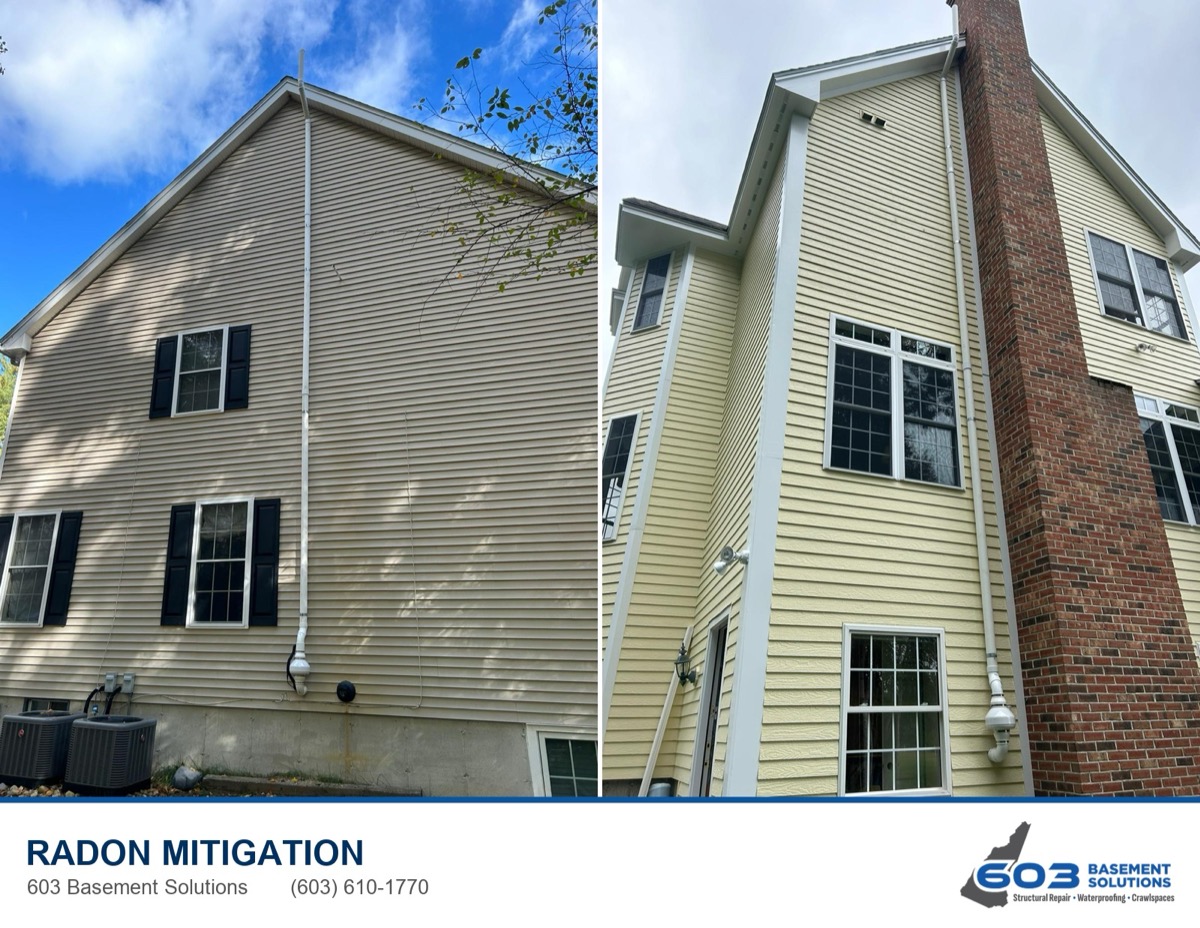
- A continuous in-line fan pulls the radon-laden air out from under the slab and vents it up and out above the roofline, where it disperses harmlessly.
- The system runs quiet, around the clock. A simple gauge lets you check at a glance that it’s still working.
Got a dirt or fieldstone crawl space? No slab to depressurize, so we put in a sub-membrane system instead: a sealed barrier over the dirt floor with the suction pulled from underneath. We install these in-house, and it goes right alongside the older-foundation work we already do every week.
This is a radon mitigation system. We don’t call it the Forever Dry System. The Forever Dry System is our basement waterproofing product, a different fix for a different problem.
Get your radon levels back down to safe
Milford is The Granite Town, and that granite is where the radon comes from. More than a third of tested NH homes top 4.0 pCi/L. We test for $50, then install the fix.
Cost of radon mitigation in Milford
Straight numbers, no games. A radon mitigation system from 603 runs $900 to $6,000, and most homes land around $1,950 to $2,250. What moves you around inside that range: your foundation type, how the house is laid out, where the fan and pipe can run, and whether a crawl space needs a sub-membrane system instead of a slab system.
| What | 603 NH price |
|---|---|
| Radon test | $50 (credited toward the job if you proceed) |
| Radon mitigation system | $900 – $6,000 (most homes ~$1,950 – $2,250) |
If your basement is also wet, or you’re thinking about finishing it, handle the water and the radon together. No sense opening the slab twice. Financing is available, subject to approval, and 603 doesn’t make a dime off the financing.
Why Milford homeowners call 603
We’re a local, owner-run New England crew, not a national franchise reading off a script. We’ve done 5,000+ jobs across New Hampshire, Maine, and Massachusetts, we’re licensed and insured, and we’re a state-certified radon mitigation contractor (cert #RMS-113966). Google reviewers have us at 4.9 stars across 250 reviews, and we’re BBB A+ accredited.
You get a named crew, a plain-English explanation of your number, and a quote within 24 hours. And if your test comes back fine, we’ll tell you that and send you on your way. We’re not here to sell you a system you don’t need.
What a recent customer said
603 Basement Solutions has a great team to work with. All involved are professional and courteous. The Radon Mitigation quote I received was the final price. I understand unseen problems occur, but I was fortunate. They estimated my radon levels would drop to around 2 but my monitor is reading a 7 day average of .4, WELL below what I was promised and even expected. Highly recommend 603 Basement Solutions
Jeff Eddy, ★★★★★ Google review
Frequently asked questions
Why does Milford have a radon problem?
It comes down to the rock. Milford is called “The Granite Town,” and granite is the radon source. New Hampshire’s granite bedrock and soil carry trace uranium that breaks down into radon gas, and the gas seeps up through cracks in basement floors and walls. More than a third of tested NH homes come back at or above the EPA action level of 4.0 pCi/L (NH DHHS). Milford’s bedrock changes block to block, so the only way to know your home’s level is to test it.
Is Milford in a high radon zone?
No. The EPA maps Hillsborough County, which includes Milford, as Radon Zone 2: moderate, with a predicted average indoor level of 2 to 4 pCi/L. It is not Zone 1. Only Carroll County is Zone 1 in NH. But a zone is just a county-wide average, not your house. Plenty of homes in moderate zones test high because of the rock right under them, so test regardless of the zone.
How much does radon mitigation cost in Milford, NH?
A radon mitigation system from 603 runs $900 to $6,000, and most Milford-area homes land around $1,950 to $2,250. The price depends on your foundation type, the layout, and whether a crawl space needs a sub-membrane system. A radon test is $50, and we credit it toward the job if you move ahead. Financing is available, subject to approval.
Ready to get started?
Free inspection, free estimate, and a written quote in your hands within 24 hours.
Common questions about radon
- Radon was a big deal 30 years ago. Is it still something New England homeowners need to test for and fix?
- The radon test at the home we are buying came back high (6.8). Is it a dealbreaker, and can it be fixed?
- What are the potential risks of being exposed to high levels of radon?
- What are the signs of radon under a house, other than a high test result?
- What is a mitigation system for radon?
- What is a radon test?
- What is the major source of radiation in our homes?
- What mask should I use to filter radon while installing a fan
- What should you do if you find radon in your home?
- What was your radon level before and after the mitigation system?
- Why are rain gutters sometimes used for radon mitigation systems?
- Why is radon more prominent in homes?