



A slab that carries the house is not the same as a basement floor that just looks uneven.
A basement floor within another foundation may not carry the building.
Connected wall, door, and floor changes deserve measurement of the load path.
A dropped patio or drive belongs in concrete repair unless the house also moved.
Start with measurements, not opinions. A laser level or string line across a load-bearing slab can show whether one area has dropped relative to another. Check the first step and landing as one set of fixed heights, then look separately at the apron so an entry repair is not mixed with roadway access. Record crack width, direction, and whether edges are offset vertically. Note sticking doors, wall cracks, or gaps at sill plates, because those connected symptoms suggest the slab and the structure above are moving together. Surface spalling, hairline shrinkage, and a worn finish are different findings. The goal is to know whether the slab is stable, moving slowly, or already failed before anyone talks about repair methods.
Not every slab finding needs a repair. A stable slab with cosmetic wear, a nonstructural basement floor, or a single old crack that has not changed in years may only need monitoring. Monitoring means marking crack ends with a date, photographing the same view monthly, and keeping a simple log of measurements. If the readings hold steady, the honest recommendation can be no structural work. If the slab is load-bearing and the readings are stable, a smaller scope such as crack repair or local patching may be enough. That decision belongs in writing, with the limits stated. A homeowner should not be pushed into a full support system when the measurements do not show ongoing movement.
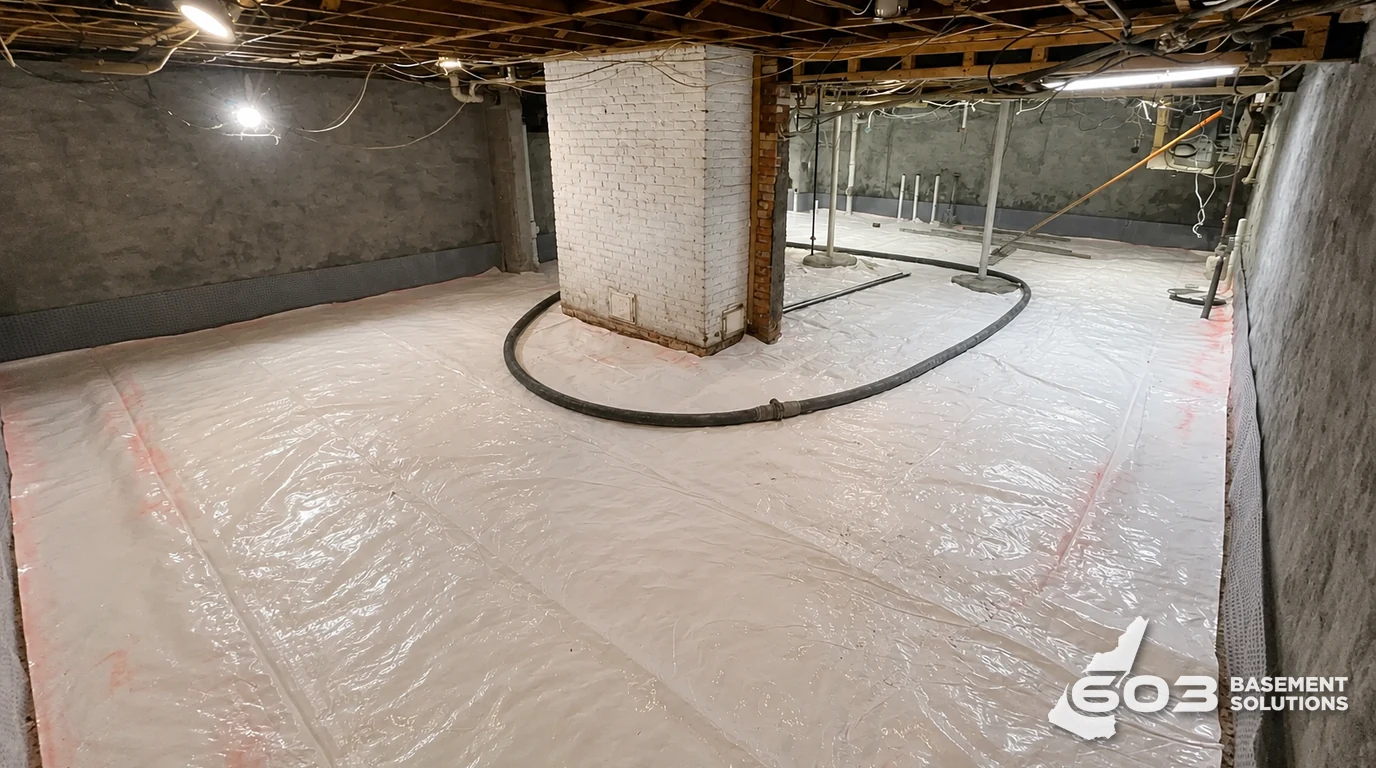
Support and cosmetic leveling solve different problems. Cosmetic leveling changes the surface profile; support repair addresses how the slab transfers load to the ground. ACI RAP-11 discusses slabjacking assessment, and ACI RAP-7 discusses horizontal concrete repair preparation, but those references do not prove what any contractor will do on a given Exeter property. The method should follow the diagnosis. If the slab is intact and the concern is a trip edge or a hollow spot, a surface repair may be appropriate. If the slab is cracked through a load path or has settled with connected symptoms, the scope needs an engineer’s input before a method is chosen. Do not accept a method-first quote that skips the measurements.
ACI’s structural-slab distinction is general technical guidance, not a specification for this house.
Exeter’s building-permit form asks the applicant to describe the proposed work and its location. That detail matters here. A floor-surface patch should be described as such. Work beneath a bearing point needs its own structural scope. We measure and name the affected part before checking the town review path.
Read the Exeter source. We check the approval path against the proposed scope.

A slab repair can be outside scope for reasons that are not visible in a photo. The slab may be tied to a foundation wall, a step, or a landing in a way that makes a local repair change the load path. Water may be entering from a source that no slab work will fix. A previous patch may hide a void or a failed base. ACI RAP-1 discusses structural concrete cracks, which is a reminder that crack appearance alone does not classify the cause. If the estimate does not state what is excluded, the homeowner cannot tell whether the quote covers a structural slab, a basement floor, or an exterior apron. Ask what happens if the opening reveals a condition the quote did not include.
A finished room can hide the joint between slab and foundation wall. That joint, along with any post or partition support, often matters more than the center of a low floor. We need access to the crack ends and stable reference points for elevation readings. If water is entering, we trace that separately before promising a concrete fix. The Exeter permit description can then name the actual work, rather than mixing a surface patch with a structural alteration.

A useful estimate starts with the measurements taken on site. It should name the surface covered: load-bearing slab, basement floor, step, landing, or apron. It should list the observed findings, the proposed scope, and what is excluded. If monitoring is the recommendation, the estimate should say so and give a recheck interval. If a design professional is needed, that should be stated before any repair price. The quote should not promise piers, epoxy, lifting, or a specific outcome unless the diagnosis supports it. Ask for the measurement record and the exclusion list in writing. A quote that cannot say which surface it covers is not ready to compare against another quote.
Sometimes the best answer is no work. If the slab is load-bearing but stable, the cracks are old and unchanged, or the symptoms are cosmetic, monitoring or a small repair may be right. A smaller scope might be crack repair, a local patch, or drainage correction. A larger scope is justified when measurements show ongoing movement, connected symptoms are worsening, or a design professional identifies a structural concern. The decision sequence is: measure, compare symptoms, state the scope, then choose monitoring, smaller work, or a professional review.
Measure first. Check fixed heights at a step or landing, crack width and movement, and any connected door or wall symptoms. If the slab is load-bearing and the readings are stable, monitoring or a small repair may be enough. If movement is ongoing, a design professional should review the scope before a method is chosen. Cosmetic leveling changes the surface; support repair addresses load transfer. The written estimate should state which surface is covered and what is excluded.
Show us the concrete and we will tell you what is worth fixing, what can stay, and what still needs checking.

