



A permit archive and an old floor patch need separate physical interpretation.
An older basement-floor patch and an incomplete online permit search do not tell a Nahant homeowner whether a support footing is sound. The patch might follow a drain, a utility, a prior walking-slab replacement, or work near a loaded post. 603 Basement Solutions would compare any archived scope with the room as built, measure framing and floor movement independently, and inspect bearing only where the physical clues warrant it. A missing record is not proof that work was unsafe; a found permit is not proof of current structural performance. The right repair could be a bounded floor fix, monitoring, or a supported structural intervention. The evidence must pick the branch.
Begin with what can be seen. Map the patch’s length, width, sawcut shape, aggregate, joint and nearby drains or utility penetrations. Photograph it with a ruler before moving a wall or laying a new finish. Ask for prior-owner invoices, closing documents, renovation photographs and the permit record, but mark every uncertain date as uncertain. A line through the concrete may be the edge of a drain trench. A square around a post may be later restoration over an independent pad. Different surface colors cannot establish whether either element is load-bearing.
Next draw the structural plan. Trace floor joists or walls to beams, columns and foundation walls. Mark where each load reaches a pad or footing and where the walking floor is simply soil-supported. If a basement is finished, do not assume a boxed-in column is decorative. A patch across the room may stop short of the bearing area even if it appears aligned from above. Conversely, a short cut beside a footing may matter more than a longer cut elsewhere if it disturbed supporting soil. Only measurements and, where needed, a selective opening can locate the relationship.
Take repeatable readings rather than interpreting a single crack photograph. Measure floor elevations on both sides of the patch and along the nearby beam. Check post contact, wall plane and changes to doors or finishes above. Ask when the unevenness or crack first appeared. If nothing is moving and the structure reads consistently, immediate underpinning may not be justified. If a loaded post has a new gap or a wall has measurable displacement, a fresh topcoat is not a safe substitute for investigation. Keep moisture observations separate; a water stain can coexist with, but does not prove, movement.
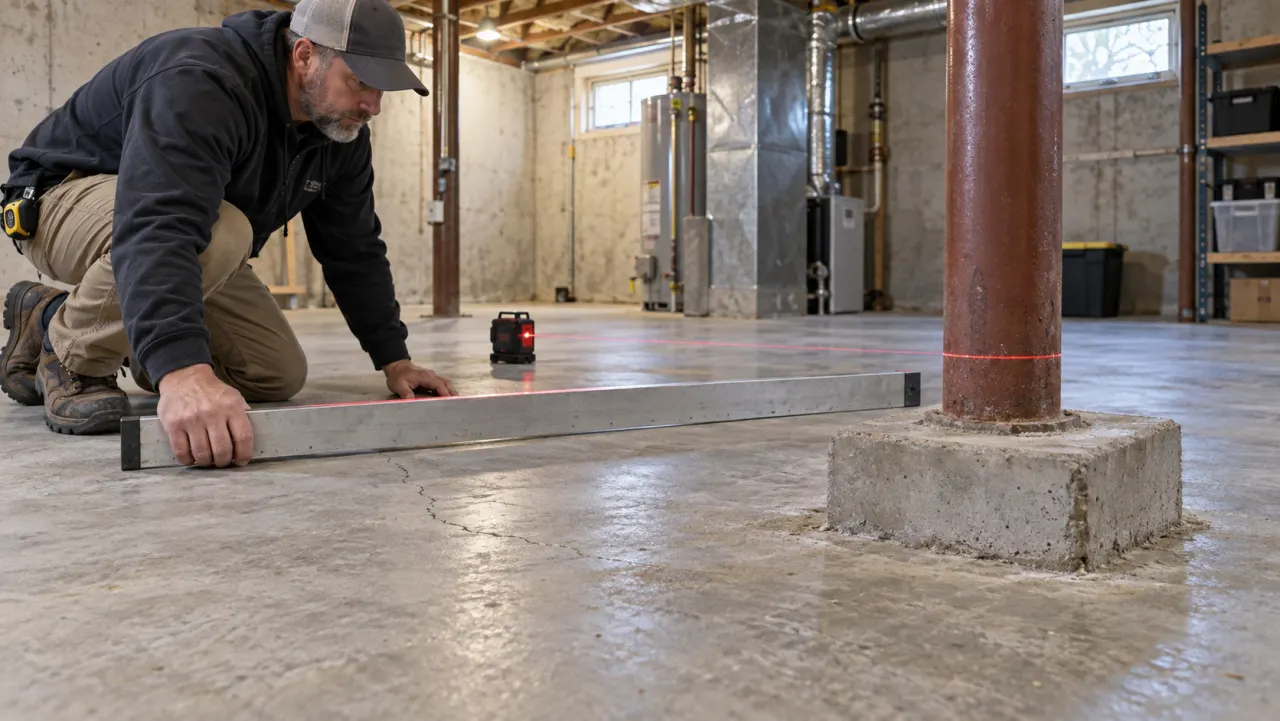
If records and surface readings leave a critical bearing question, write down the hypothesis before demolition. Is the post pad independent of the patched floor? Was soil removed beside its edge? Is the post actually bearing on concrete of adequate extent? Locate plumbing, electric and any embedded heat first. Protect a loaded member with an appropriate temporary-support plan before cutting near it. Photograph the exposed thickness, pad edge, soil or base and any void with a scale. An opening that sees only the top of a pad cannot establish the condition beneath it.
Set a pause point. If exposure shows clean base and a steady post/beam, the scope may shrink to a surface repair, water correction or monitoring. If it shows undermining or lost contact, stop before covering it and bring in the necessary structural expertise. Agree beforehand who interprets the exposure, whether an engineer or inspector must see it, and who restores the opening under each branch. A contractor should not price the worst-case support system as if it were already diagnosed, nor leave a homeowner with an open floor and no next decision.
ACI’s slab-on-ground FAQ distinguishes a soil-supported floor from concrete intended to transfer building loads. A stable nonbearing patch with weak edges may fit concrete repair after its base or water source is corrected. A broad failed walking floor with poor support or moisture detailing may need concrete slab pouring after removal and proper preparation. An intact separate sunken panel may sometimes be a concrete leveling candidate if its geometry, load and drainage allow it. None of these floor operations creates bearing for a deficient post footing.
If measurements show a changing beam, post, wall or loaded pad, begin with structural and foundation repair. The solution may involve staged support, engineering, a localized new footing or another detail chosen after exposure. A pier or underpinning proposal should show how the load moves from the building to reliable support, which surfaces will be opened, and how the result will be measured. Do not infer the final system from the age of a patch or a portal search. A structural job can also require floor restoration, but that is a consequence of the support work rather than its proof.
If dampness is part of the complaint, trace it separately. Record rain timing, plumbing use, sump cycles and condensation before calling the patch a leak path. Drying a basement cannot confirm a footing is stable, and stabilizing a footing cannot promise the room will be dry. Put drainage, vapor, structural and finish-floor tasks on separate lines. The homeowner can then see which observation warrants each cost and which trade must act first.
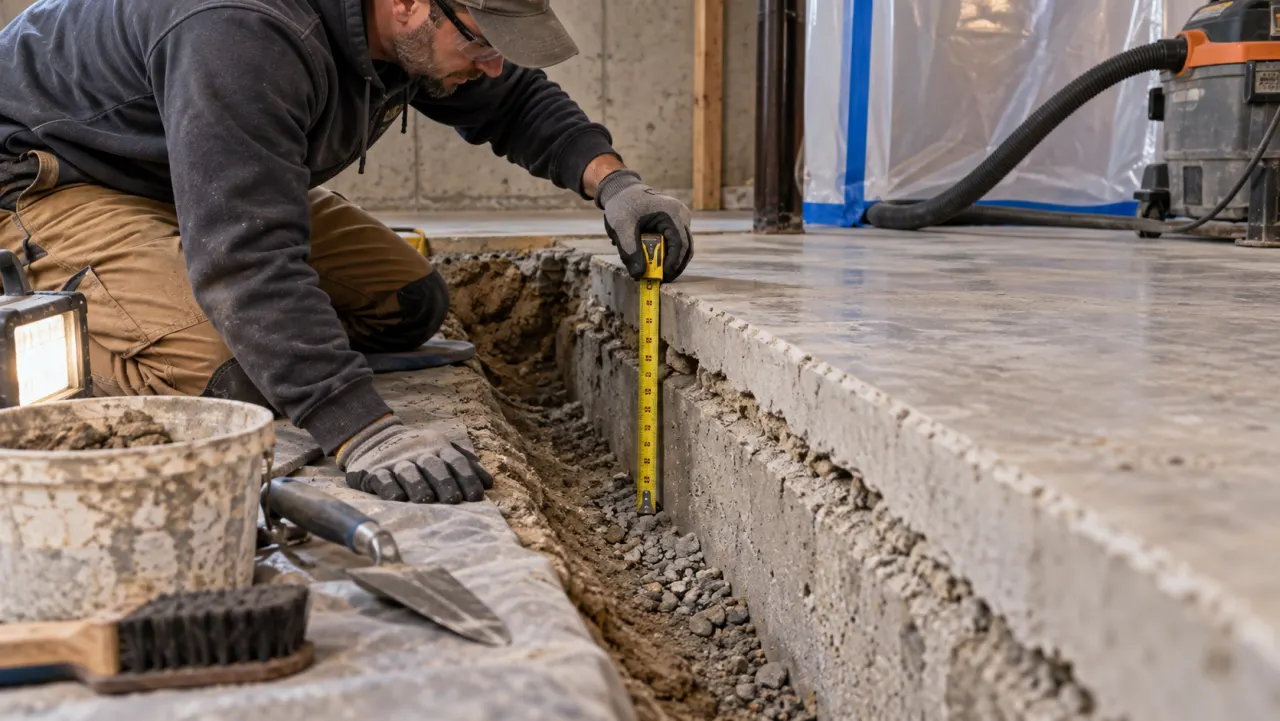
Compare bids at the same evidence point. One contractor may include selective demolition and measurement while another prices a full support system from photographs. Ask for a limited investigation price, a floor-only branch if bearing is sound, and a structural branch if it is not. Include utility location, dust protection, temporary support, engineering and permit tasks where applicable, photographs before closure, and finish restoration. If an opening changes the diagnosis, require a written change with the new evidence. A low surface-patch price is not an alternative to a legitimate support repair if the pad is truly failing.
Likewise, do not buy needless structural work because a bidder emphasizes uncertainty. If the support is sound, the homeowner should be allowed to stop at monitoring or a floor fix. Define a measurement baseline and what change would trigger reassessment. A historical crack may remain visible after successful stabilization, while a new floor can develop joints or hairline cracks without indicating lost bearing. The proposal should name the specific outcome it can test rather than promising a permanently flawless surface.

Nahant’s permit guidance says homeowners may request building-permit copies from its archive for 2005 through 2015. It also says most permits from 2008 onward are available in its online system. Those ranges overlap, and the word “most” matters. If an old slab patch is thought to be from that period, search by address and ask the office what additional archive material exists. An online miss is not evidence that no permit was issued or that the concrete is structurally deficient.
Use a found permit to ask narrower questions: what work was described, what location was shown, and were any inspections documented? Compare that with the current post and beam positions. A permit can describe a trench without documenting its exact depth next to a footing. An approved construction phase cannot tell us whether later water, soil movement or alterations have changed support. For new work, ask the town what permit or inspection fits the defined repair, not a vague “slab” label. Keep the photos of any newly exposed footing with the permit file so the next owner has both administrative and physical evidence.
Do not buy underpinning solely because no online record appears or because the patch is a different color. A sound post and pad with a bounded walking-floor defect may need limited restoration or monitoring. Do not buy only sealant when a post is separating from its pad, the beam line is changing, or an opening shows disturbed bearing. The bidder should say what observation would disprove a structural recommendation. That protects a homeowner from treating an archive gap as a diagnosis and from treating a stamped permit as a warranty.

Google review · Customer experience
Aimee Workum ★★★★★
“The initial inspection was extremely thorough. Liam took the time to inspect not only our basement, but the entire house. He was very knowledgeable and provided helpful feedback on additional items we should keep an eye on.
The Phase 1 support installation went smoothly. The lead installer was also highly knowledgeable and took the time to answer all of our questions, including those beyond the scope of the installation and related to Phase 2.
Overall, we are very pleased with 603 Basement Solutions and plan to use them again for Phase 2 in the future.”
Bring any permit number or archive response, invoices, wide basement photographs, dated close-ups of the patch with a ruler, and notes on water or upstairs changes. Do not disturb concrete beside a loaded member yourself. Ask 603 to mark observed conditions, plausible interpretations and hidden unknowns separately. A Nahant homeowner should leave with the smallest safe next test, a hold point before the floor is closed, and a repair scope that follows the actual bearing evidence rather than a story inferred from incomplete records.
Show us the affected concrete. We will explain what we measured, what can stay, and which scope fits the house.

